

Could Humanoid Robots Eventually Affect Jobs?
Almost certainly — if they become capable and economical enough.
But the effect is unlikely to happen all at once.
Early deployments are more likely to target tasks that are:
repetitive,
physically demanding,
difficult to staff,
structured,
or potentially hazardous.
There may also be situations where robots work alongside employees rather than replacing an entire role.
A retail employee’s job, for example, contains many different tasks.
A robot might eventually handle some repetitive physical work while people continue handling judgment, customer relationships, problem-solving, and unusual situations.
The same pattern has appeared with other forms of automation.
Technology often automates tasks before it automates complete occupations.
That distinction matters whenever we discuss AI and employment.
Physical AI Could Be the Next Big AI Battleground
For the past several years, most mainstream AI attention has focused on things that happen on screens.
Chatbots.
Image generators.
Search.
Coding assistants.
AI agents.
Office productivity.
Those technologies are still developing rapidly.
But humanoid robotics represents another frontier.
The AI has to leave the screen.
It has to understand three-dimensional space.
It has to interact with objects.
It has to operate around people.
And it has to turn digital intelligence into reliable physical behavior.
That is a much more demanding problem.
It is also potentially enormous.
If companies eventually develop general-purpose robots that can perform many useful tasks in environments already designed for humans, the economic consequences could reach manufacturing, logistics, retail, hospitality, healthcare support, maintenance, and countless other sectors.
We are not there yet.
But production milestones like XPENG’s make the possibility harder to dismiss.
A Production Line Changes the Conversation
There is a useful way to think about this announcement.
Before a production line, the central question is:
Can you build the robot?
After a production line, the questions begin changing:
Can you build it repeatedly?
Can you build enough of them?
Can they do useful work?
Will customers pay for them?
Can the economics work?
Those are much more serious commercial questions.
And they are exactly the questions the humanoid-robot industry needs to answer next.
We have seen AI follow a similar progression in software.
First came astonishing demonstrations.
Then millions of people began using the tools.
Then companies started asking whether those tools actually improve productivity.
As discussed in AI Is Saving Us Time—So Why Do We Feel Busier?, technological capability and genuine productivity are not always the same thing.
Humanoid robotics will face the same test.
The Bottom Line
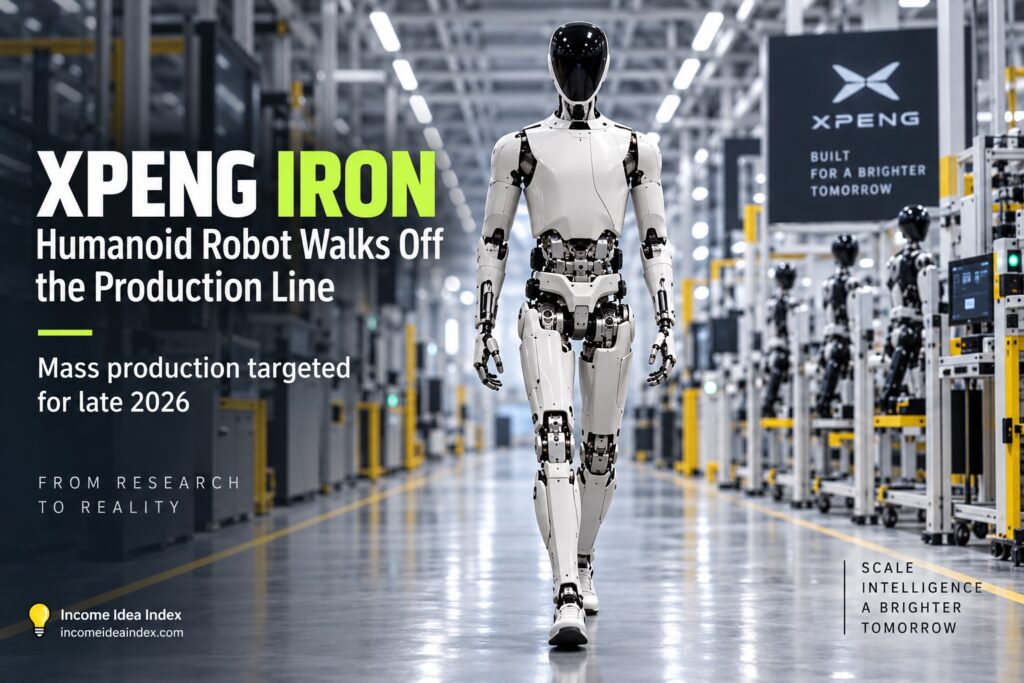
The XPENG IRON humanoid robot walking off a production line may not look as dramatic as a robot breaking a sprint record.
But commercially, it could be the more important milestone.
XPENG has now commissioned a highly automated production line specifically for humanoid robots.
It says more than 80% of core manufacturing processes are automated.
IRON combines 76 degrees of freedom across its body, dexterous 21-degree-of-freedom hands, and three Turing AI chips delivering up to 2,250 TOPS of computing power.
Mass production is planned by the end of 2026.
Initial deployment is expected inside XPENG stores and campuses.
And official launch and broader deliveries are planned for 2027.
None of that guarantees that IRON will become a commercial success.
The hardest part still lies ahead: proving that humanoid robots can create enough real-world value to justify their cost.
But the industry is beginning to move beyond asking whether human-like robots are technically possible.
Companies are starting to ask how to manufacture them, deploy them, improve them, and sell them.
That is a very different stage of the story.
And XPENG IRON just took another step into it.