

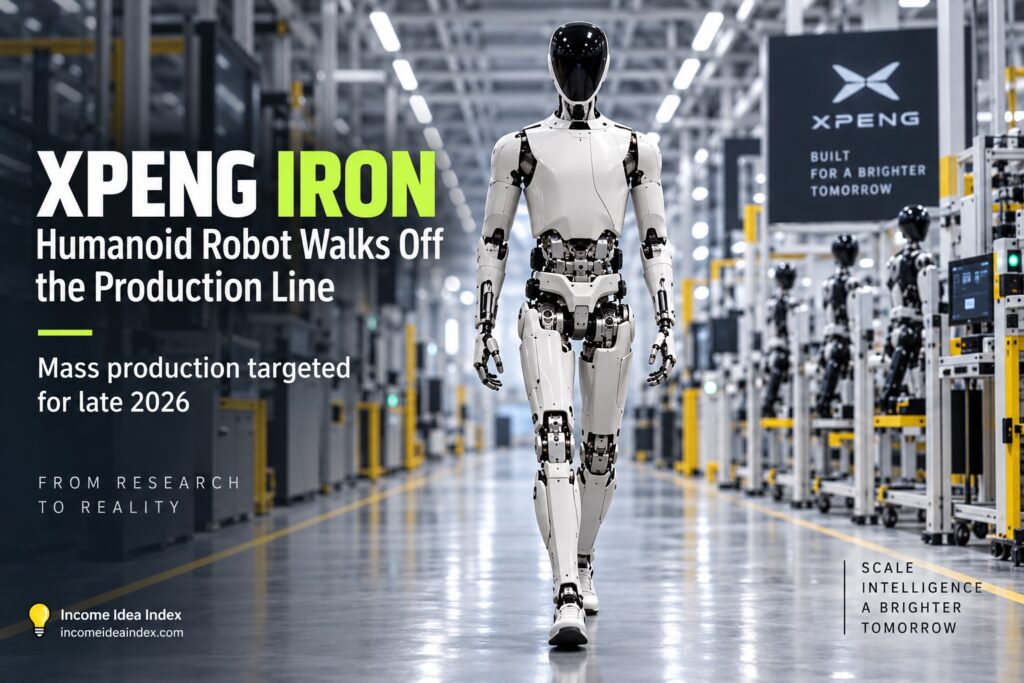
XPENG Wants IRON to Become a General-Purpose Platform
The phrase general-purpose humanoid robot comes up repeatedly in XPENG’s description of IRON.
That is an ambitious target.
Today’s industrial robots are normally extremely specialized.
One robot welds.
Another moves packages.
Another picks components.
Another paints.
Their lack of flexibility can actually be an advantage because the system is optimized around one clearly defined task.
A general-purpose humanoid robot is trying to solve a different problem.
Instead of designing a completely different machine every time the job changes, companies hope one sufficiently capable humanoid platform could learn multiple tasks.
That could make automation practical in places where traditional fixed robots are too inflexible.
But this is also much harder.
A robot that performs one repetitive factory motion does not need human-like generalization.
A general-purpose robot does.
It must deal with variation.
Different objects.
Different environments.
Different instructions.
Different people.
Unexpected situations.
The industry is nowhere near solving all of that perfectly.
But the ability to manufacture robots at scale could accelerate the learning process because more deployed robots can generate more real-world experience.
The Data Flywheel Could Become Extremely Important
XPENG describes something similar to a data flywheel.
As more IRON robots operate in real environments, they can generate more behavioral and interaction data.
That data can potentially improve the AI models.
Better models can improve robot performance.
Better performance can make the robots useful in more situations.
More deployments then create even more data.
That loop is one reason companies are racing not only to build the smartest humanoid robot, but also to manufacture and deploy robots in meaningful numbers.
A small research fleet can only experience so much.
Thousands of machines operating in stores, campuses, warehouses, or service environments could generate a very different scale of learning.
That does not guarantee the approach will work.
Real-world data needs to be useful, safe, properly managed, and translated into meaningful model improvements.
But it explains why production capacity itself can become part of the AI advantage.
Where Will XPENG IRON Be Used First?
XPENG is not starting by placing robots in people’s homes.
The company says its first commercial scenarios will be inside XPENG stores and campuses.
That is a sensible approach.
Using the robots within environments XPENG controls gives the company more control over:
layout,
tasks,
maintenance,
staff training,
safety,
data collection,
and troubleshooting.
It also lets IRON gain real-world experience without immediately facing every unpredictable condition found in an open consumer environment.
After those internal deployments, XPENG says IRON will officially launch and begin deliveries in China and overseas markets in 2027.
The company has specifically identified retail and service sectors as initial external markets.
That provides a clue about what early humanoid adoption may look like.
Rather than immediately replacing highly skilled workers, humanoid robots may first appear in structured service environments where repetitive physical and interaction tasks can be defined more clearly.
How Many Robots Could XPENG Build?
XPENG has not promised millions of humanoid robots anytime soon.
But it is already talking about capacity beyond laboratory-scale production.
During its second-quarter 2026 earnings update, XPENG said monthly robot production capacity could be ramped to several thousand units by 2027, depending on market demand.
That is significant.
A few dozen robots can support demonstrations and pilots.
Several thousand units per month would represent a very different commercial operation.
Whether demand actually justifies that level of production remains to be seen.
But the fact that XPENG is building for that possibility helps explain why the new manufacturing line matters.
Read XPENG’s Q2 2026 update on IRON production and deliveries
Investors Are Taking the Robot Business Seriously
The production announcement also follows a very large financing round.
In August, XPENG announced that its robotics business had raised more than $900 million at a post-money valuation of more than $6.3 billion.
XPENG described it as the largest single-round private financing in China’s embodied-AI industry to date.
The round was led by IDG Capital, with participation from Gaorong Ventures and strategic support from Tencent and Alibaba.
XPENG says the money will support robot hardware and software development, Physical AI model training, data generation, manufacturing facilities, and global commercial expansion.
Read XPENG’s robotics financing announcement
Money does not guarantee success.
The humanoid-robot sector is attracting enormous attention, and not every highly funded company will ultimately produce a commercially successful machine.
Still, funding at this scale shows that investors increasingly view humanoid robotics as more than a research project.