
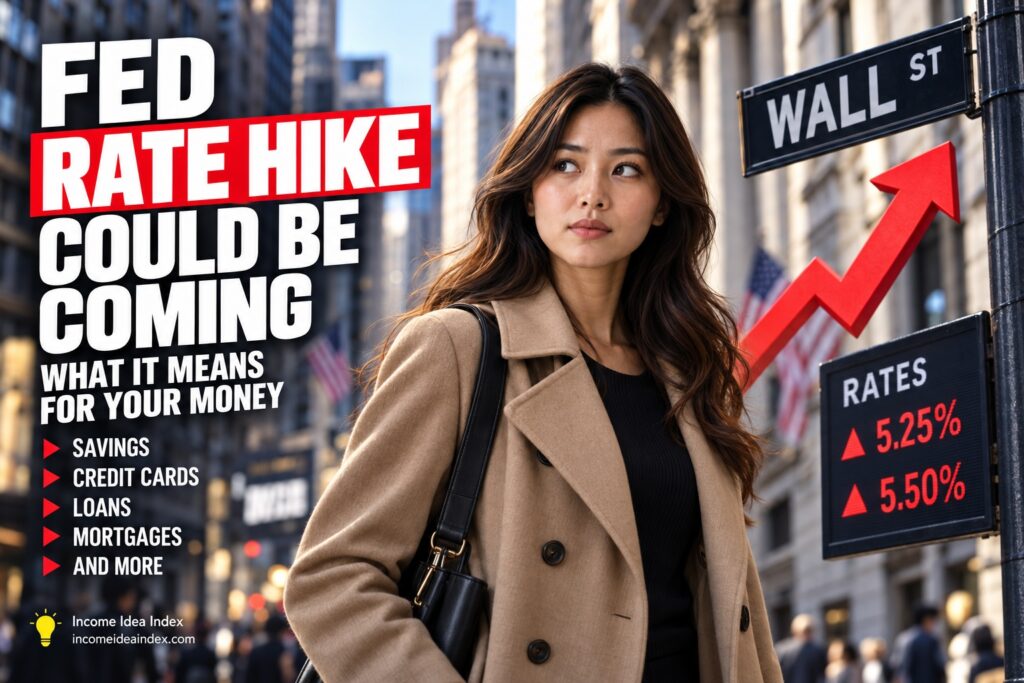
A Fed rate hike is looking increasingly possible next week—and if it happens, the effects could eventually show up in everything from your credit card bill to the interest you earn on savings.
The Federal Reserve’s next policy meeting is scheduled for September 15–16, 2026. The Fed is expected to announce its decision at 2:00 p.m. Eastern Time on September 16, followed by a press conference.
Until then, nothing is final.
But financial markets changed their expectations significantly after the latest inflation report.
Consumer prices rose 0.4% in August, while inflation remained 3.4% higher than a year earlier. Core inflation, which excludes food and energy, increased 0.3% during the month and 2.4% from a year earlier. After the report, markets were pricing roughly an 85% chance of a quarter-point Fed rate hike, up from about 67% before the data.
That does not guarantee the Fed will raise rates.
It does mean a rate hike has suddenly become much more important for ordinary households to understand.
See the Federal Reserve’s official 2026 meeting calendar
Why Is the Fed Considering Raising Rates Again?
The Federal Reserve has two major economic responsibilities: supporting maximum employment and maintaining stable prices.
Inflation is the problem drawing attention right now.
The Fed’s longer-term inflation goal is 2%, but inflation continues to run above that level.
The Federal Reserve held its federal funds target range at 3.50% to 3.75% at its July meeting. Importantly, that decision was not unanimous.
Three policymakers voted against holding rates steady and instead favored a quarter-point increase.
That meant support for tighter monetary policy already existed before the latest inflation numbers arrived.
Now the pressure has increased.
Producer prices also rose 0.4% in August, with final-demand prices up 5.4% from a year earlier. Consumer inflation then showed another 0.4% monthly increase.
At the same time, energy prices and broader inflation concerns have been putting upward pressure on financial markets.
That combination creates a familiar problem for the Fed.
If inflation remains too high, leaving interest rates unchanged for too long could allow price pressures to become more persistent.
Raise rates too aggressively, however, and the Fed risks making borrowing more expensive and slowing economic activity more than necessary.
That balancing act is why a rate decision that sounds as small as one-quarter of one percentage point can receive so much attention.
What Does the Federal Reserve Actually Raise?
When people say the Fed is “raising interest rates,” the Fed is not directly changing every interest rate in America.
The Federal Open Market Committee sets a target range for the federal funds rate.
That is the rate banks use when lending reserve balances to one another overnight.
But changes in that rate spread through financial markets.
The Federal Reserve explains that movements in the federal funds rate are typically reflected quickly in short-term lending rates and can affect floating-rate loans, credit lines, household borrowing, business borrowing, spending, and broader financial conditions.
Read the Federal Reserve’s explanation of how monetary policy works
That is why this matters even if you have never heard anyone discuss overnight bank reserves in everyday life.
The Fed changes one important interest rate.
The financial system transmits that change outward.
What a Fed Rate Hike Could Mean for Credit Cards
Credit cards are one of the places consumers may notice higher rates relatively quickly.
Many credit cards use variable APRs.
A variable APR is tied to an underlying interest-rate index, frequently the prime rate. When the underlying rate changes, the APR can change as well.
That matters most if you carry a balance.
Someone who pays a credit card statement in full every month generally avoids purchase interest, so a small rate increase may have little direct effect.
Someone carrying thousands of dollars in revolving credit-card debt has a very different situation.
A higher APR means a larger portion of each payment can go toward interest rather than reducing the balance.
The Federal Reserve Bank of Boston recently noted that most credit cards have variable rates that generally rise or fall as Federal Reserve policy rates change.
See the CFPB’s explanation of variable credit-card APRs
If you already have credit-card debt, a potential rate hike is a good reason to look at the APR you are currently paying.
You do not need to panic.
But expensive variable-rate debt becomes increasingly important to address when borrowing costs are rising.
Could Personal Loans and Auto Loans Get More Expensive?
They can.
New borrowing costs are influenced by far more than the federal funds rate. Your credit score, loan term, lender, down payment, collateral, income, and overall market conditions all matter.
But higher benchmark rates generally make financing more expensive.
That can show up in newly issued personal loans, auto loans, business loans, and other forms of consumer credit.
If you already have a fixed-rate loan, a Fed hike normally does not change the interest rate specified in your existing agreement.
The more immediate concern is usually new borrowing and variable-rate debt.
This is one reason a higher-rate environment can gradually slow spending.
Buying something with borrowed money simply becomes more expensive.