

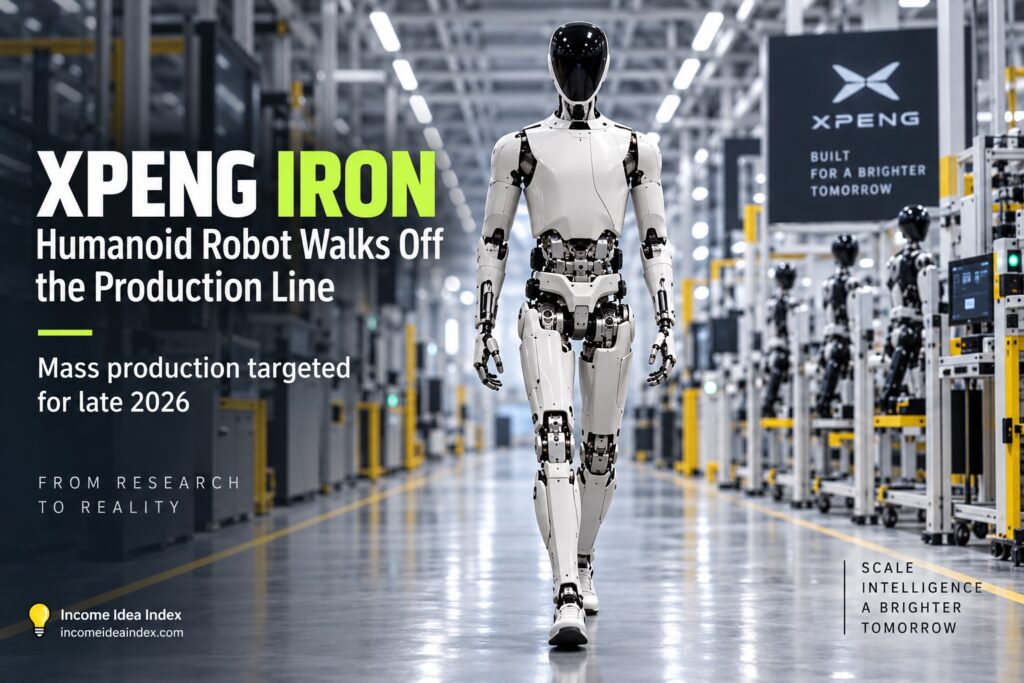
The XPENG IRON humanoid robot has taken an important step from futuristic demonstration toward something much more consequential: actual production.
On September 8, 2026, XPENG announced that its new humanoid-robot manufacturing line had officially gone into operation and that an IRON robot had completed production and walked off the line autonomously.
That distinction matters.
Humanoid robots have become increasingly impressive at trade shows, technology demonstrations, sporting events, and carefully controlled tests. But building one impressive prototype is very different from creating a manufacturing system capable of producing robots consistently and eventually at scale.
XPENG now says it is trying to make that transition.
The company plans to move IRON into mass production by the end of 2026, initially deploy robots in its own stores and campuses, and then officially launch and begin deliveries to customers in China and overseas markets in 2027.
Read XPENG’s official production-line announcement
Why This Is More Important Than Another Robot Demo
Humanoid robots are having no trouble getting attention.
We have seen robots run, dance, box, climb stairs, carry objects, and interact with people.
Some of those demonstrations are genuinely remarkable.
We recently covered the TianGong Ultra humanoid robot breaking the human 100-meter world-record time, another example of how rapidly robotic mobility is improving.
But impressive capability is only one part of creating a real industry.
A company also has to answer much less glamorous questions:
Can the robot be manufactured repeatedly?
Can quality remain consistent from one unit to the next?
Can production increase without costs becoming unmanageable?
Can components be sourced reliably?
Can the robot be serviced?
Can enough units be produced to support real commercial deployment?
Those questions are why XPENG’s latest announcement deserves attention.
The milestone is not simply that IRON can walk.
It is that XPENG built a production system intended to manufacture robots rather than just prototypes.
XPENG Says More Than 80% of Core Production Processes Are Automated
XPENG says more than 80% of the core processes on its new humanoid-robot production line are automated.
The company describes the facility as borrowing heavily from the manufacturing systems it already developed for electric vehicles.
That makes sense.
XPENG has spent years building vehicles that combine mechanical systems, batteries, sensors, processors, software, AI, and precision manufacturing.
A humanoid robot requires a different product architecture, but many of the manufacturing disciplines are familiar:
quality control,
supply-chain management,
precision assembly,
electronics integration,
software and hardware validation,
and consistent high-volume production.
XPENG says it is applying automotive-grade quality standards to the robot business.
That may ultimately prove to be one of its most important advantages.
A robotics startup may have an excellent robot.
An automaker already understands what it takes to manufacture complicated machines in significant numbers.
See XPENG’s explanation of its robot production system
What Is the XPENG IRON Humanoid Robot?
IRON is XPENG’s next-generation general-purpose humanoid platform.
The company has deliberately designed the robot to look and move in a highly human-like way.
That is not simply an aesthetic decision.
Most of the physical world humans have built is designed around human bodies.
Doors.
Counters.
Shelves.
Tools.
Controls.
Stairs.
Workstations.
Retail stores.
Warehouses.
Vehicles.
If a robot has a body that more closely resembles ours, in theory it can operate in more of those environments without requiring the environment itself to be redesigned.
XPENG says the current IRON has 76 degrees of freedom across its body.
Its hands are especially sophisticated, with 21 degrees of freedom in each hand.
Degrees of freedom describe the independent ways different parts of the robot can move.
More degrees of freedom can allow more natural and precise movement, although the number alone does not tell you how useful or reliable a robot will be.
The real question is whether the hardware and software can coordinate all that movement effectively.
IRON Has Serious AI Computing Power on Board
The physical body is only half the equation.
XPENG says IRON contains three of its Turing AI chips, providing as much as 2,250 TOPS of effective computing power.
That computing capacity allows the company to run its Physical AI foundation model directly on the robot.
According to XPENG, the goal is for IRON to perform increasingly complex tasks autonomously instead of depending on continuous remote human control.
That is where humanoid robotics begins to overlap with the broader AI-agent movement.
A conventional AI assistant works with digital information.
A physical AI system has to understand the world around it and then take physical action.
It needs to perceive.
Plan.
Move.
React.
Manipulate objects.
Recover when something does not go exactly as expected.
Our guide to AI Agents for Beginners explains why autonomy becomes more consequential when an AI can act rather than simply answer.
Humanoid robots push that concept much further.
The consequences of an action are no longer confined to a screen.
Why Running the AI Locally Matters
XPENG also emphasizes that IRON’s computing power allows more AI processing to happen directly on the robot.
That potentially has several advantages.
One is latency.
A robot interacting with the physical world may need to respond almost instantly. Sending every decision to a distant data center and waiting for an answer can introduce delays.
Another is connectivity.
A useful robot cannot necessarily assume that a perfect internet connection will always be available.
Then there is data.
A robot operating in a store, workplace, or eventually a more personal environment may encounter large amounts of sensitive visual and environmental information.
XPENG argues that on-device inference can improve data security by reducing how much processing needs to happen remotely.
That does not eliminate privacy questions.
But it demonstrates why powerful edge computing is becoming an important part of physical AI.