
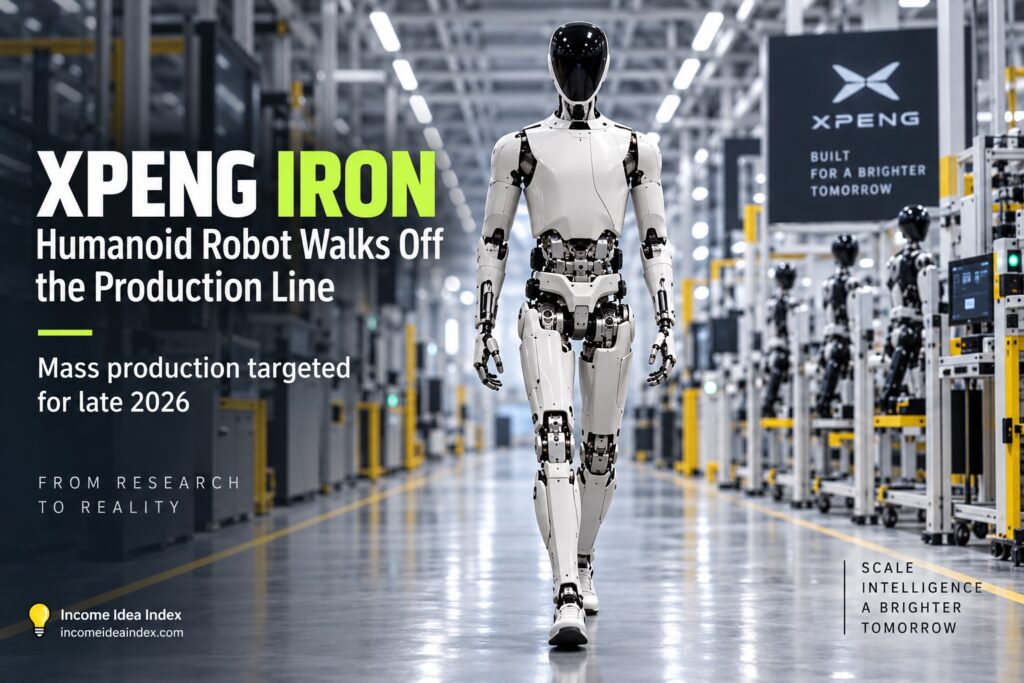
XPENG Has an Unusual Advantage: It Already Builds Complicated Machines
One of the more interesting aspects of XPENG’s robot strategy is where the company came from.
It is not primarily a robotics startup.
XPENG built its business around electric vehicles.
That means the company already has experience with:
large-scale manufacturing,
AI processors,
computer vision,
autonomous-driving technology,
software,
electric motors,
power systems,
sensors,
supply chains,
quality control,
and global product delivery.
Many of those capabilities transfer surprisingly well to robotics.
The exact products are different, but the underlying challenge is similar:
combine complicated hardware and software into a machine that must work reliably in the physical world.
XPENG has increasingly described itself as a Physical AI company rather than simply an automaker.
Its product strategy now spans vehicles, robotaxis, humanoid robots, and other AI-powered physical machines.
That is a much broader ambition.
Why Automakers Keep Appearing in the Humanoid-Robot Race
XPENG is not the only mobility company interested in humanoid robots.
There is a logical connection between autonomous vehicles and autonomous robots.
Both require machines to understand the physical world.
Both rely heavily on sensors.
Both need powerful onboard computing.
Both require AI that can turn perception into action.
Both must operate safely around people.
And both benefit from high-quality manufacturing.
A self-driving vehicle is essentially a large autonomous robot designed for roads.
A humanoid robot extends many of the same ideas into spaces designed for people.
That does not mean building a smart car automatically makes a company good at humanoid robotics.
Walking, balancing, manipulating objects, and interacting physically with environments introduce entirely different challenges.
But the technological overlap is substantial enough that automakers have good reasons to explore the field.
Is IRON Actually Ready to Work Beside People?
This is where excitement should be balanced with caution.
Moving onto a production line does not mean IRON has solved all the difficult problems of humanoid robotics.
There is an enormous gap between:
can perform a task
and
can perform that task safely, reliably, affordably, and repeatedly every day.
Commercial robots need reliability that demonstration robots do not.
A viral demo can succeed nine times out of ten and still look impressive after editing.
A workplace robot may need to perform correctly thousands of times without creating safety problems or costly downtime.
That is a much higher bar.
XPENG says IRON is being designed around strong safety and quality standards, but the real test will come with deployment.
That is why the planned store and campus rollouts matter.
They will begin showing whether the technology can move from controlled demonstration to sustained operation.
The Economics May Matter More Than How Human-Like It Looks
IRON receives attention because its movement and proportions are unusually human-like.
But businesses will eventually care more about economics.
How much does it cost?
How many useful hours can it operate?
How often does it require maintenance?
How quickly can it learn a new task?
How much human supervision does it need?
How long does the hardware last?
What happens when something unexpected occurs?
Those answers will determine whether humanoid robots become transformative or remain expensive technology showcases.
XPENG itself appears to understand this.
In its September announcement, the company said it expects unit gross margins in advanced humanoid robots eventually to be significantly higher than those in new-energy vehicles because of high technical barriers and limited high-quality supply.
That is XPENG’s expectation, not a guaranteed outcome.
But it shows that the company views robotics as a potentially important business in its own right, not merely as a publicity project.