
How to Avoid Missing the Next Estimated Tax Deadline
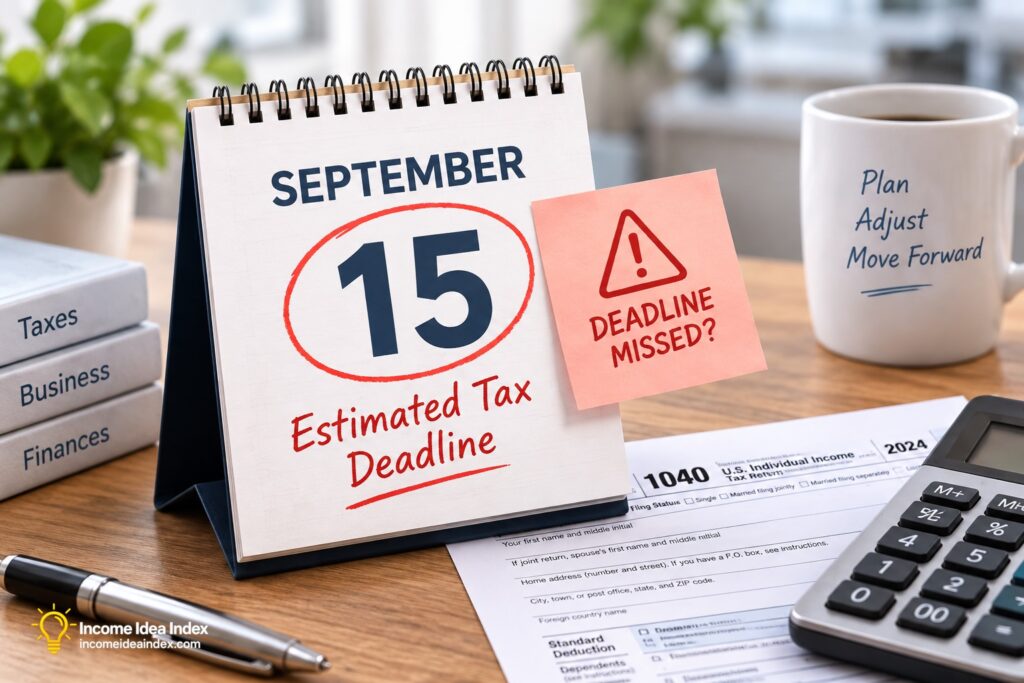
The next regular federal estimated-tax installment for the 2026 tax year is due January 15, 2027.
Instead of treating the deadline as something to remember in January, build the payment into your system now.
Put the Four Tax Dates on Your Calendar
For a typical calendar-year taxpayer, estimated payments generally revolve around four dates:
- April 15
- June 15
- September 15
- January 15 of the following year
Weekend, legal-holiday, disaster-relief, or other special rules can sometimes change an applicable deadline, so verify the current IRS calendar each year.
Review Your Tax Estimate Regularly
A freelancer whose income changes every month should not necessarily calculate estimated taxes once in January and then ignore the numbers all year.
Review your estimate when something significant changes.
Examples include:
- signing a major new client,
- losing a major source of income,
- selling an investment,
- receiving a large bonus,
- increasing business profit,
- starting a new side hustle,
- changing jobs,
- or changing your withholding.
The goal is to keep your tax plan connected to your real income.
Keep Tax Money Separate From Spending Money
One practical problem with self-employment income is that the entire payment may arrive in your bank account.
Nothing has automatically been removed for federal income tax or self-employment tax.
That can make the account balance look more spendable than it really is.
A separate savings account or another clearly separated system can make it easier to reserve money intended for taxes.
The exact amount you reserve should be based on your own tax estimate rather than a universal percentage.
For Gig Workers and Side Hustlers, Good Records Matter
Accurate estimated taxes begin with accurate records.
If you do not know how much you earned or spent, estimating taxable profit becomes much harder.
At minimum, keep records of:
- income received,
- business expenses,
- payment-processing fees,
- platform fees,
- supplies,
- software,
- qualifying vehicle expenses,
- and other potentially deductible business costs.
If driving is part of your work, mileage can become particularly difficult to reconstruct months later.
The Income Idea Index guide to tracking gig-worker mileage for taxes in 2026 explains how to maintain mileage records throughout the year and use the free Gig-Worker Mileage Tracker.
Good records do not guarantee a particular deduction.
They give you better information for preparing your return, estimating profit, and discussing deductions with a tax professional.
Common Estimated-Tax Mistakes to Avoid
Waiting for a 1099 Before Thinking About Taxes
A tax form is not what makes income taxable.
Freelancers and gig workers should generally track income as it is earned and received rather than waiting until forms arrive the following year.
Waiting until tax season also makes it harder to plan cash flow for estimated payments.
Assuming “Quarterly” Means Every Three Months
The federal estimated-tax payment periods are not four identical calendar quarters.
Use the actual IRS dates rather than simply setting a repeating three-month reminder.
Assuming Every Self-Employed Person Must Pay the Same Amount
Two freelancers earning the same business profit can have very different tax situations.
One may have substantial W-2 withholding.
Another may have none.
One may qualify for substantial credits or deductions.
Another may not.
Estimated taxes are based on the taxpayer’s overall situation, not a standard percentage charged to every freelancer.
Calculating Taxes From Revenue Alone
Revenue is the money coming into a business.
Profit generally accounts for qualifying business expenses.
Confusing the two can distort both your business analysis and your tax estimate.
Assuming the January Payment Automatically Fixes September
Each estimated-tax payment period matters.
If a September payment was required and late, making a larger January payment does not make the September payment timely.
Forgetting About State Taxes
This article focuses on federal estimated taxes.
Your state may have its own:
- estimated-tax requirements,
- tax rates,
- payment schedules,
- forms,
- safe-harbor rules,
- and penalties.
Check the official tax agency for your state rather than assuming the federal schedule covers everything.
Frequently Asked Questions About a Missed Estimated Tax Deadline
Is There a Grace Period After September 15?
There is not a general federal grace period that automatically gives every taxpayer extra days after the normal estimated-tax deadline.
However, deadlines can be affected by weekends, federal holidays, disaster relief, and other specific IRS relief.
Check current IRS guidance if unusual circumstances apply.
Should I Wait Until January 15 If I Missed September 15?
If you determine that you had a required September payment, do not assume waiting until January is harmless.
The IRS calculates estimated-tax underpayments by payment period.
Review what you owe and determine whether making the missed payment now is appropriate.
Could I Get a Tax Refund and Still Owe an Estimated-Tax Penalty?
Yes.
The IRS specifically states that a taxpayer may be charged an estimated-tax penalty for failing to pay enough by a payment-period deadline even if the annual tax return ultimately shows a refund.
What If I Started Freelancing Late in the Year?
You may not have been required to make estimated payments before you began receiving income that created the tax obligation.
Publication 505 includes rules for taxpayers who first receive income subject to estimated tax during a later payment period.
For example, income first received after August 31 can result in a first regular payment date of January 15 of the following year.
Your complete tax situation still matters.
What If My Income Was Much Higher in One Part of the Year?
The annualized income installment method may help taxpayers whose income was earned unevenly.
Instead of assuming the same income level for every period, the method considers when income was received.
Review Publication 505 and Form 2210 guidance or consult a tax professional if your income pattern makes the standard installment method inaccurate.
Will the IRS Tell Me Immediately That I Missed a Payment?
Not necessarily.
The IRS says it sends a notice when it determines that an underpayment penalty is owed.
Do not assume that silence means there is no issue.
Keep your own payment records and review your estimated-tax position during the year.
The Best Time to Fix a Missed Tax Deadline Is Before the Next One
Missing an estimated-tax deadline does not mean you should ignore taxes until April.
It means you have new information:
Your tax-payment system may need attention.
Start by determining whether the missed installment was actually required.
Then update your income estimate, withholding, deductions, credits, business profit, and payments.
If additional tax should have been paid, review your options and make an informed decision about catching up rather than automatically waiting for the next quarterly date.
And once the immediate problem is handled, use it to improve the system:
Track your income.
Track your business expenses.
Keep tax money separate.
Review withholding when appropriate.
Put the next deadline on the calendar.
For the 2026 tax year, that next regular federal estimated-tax date is January 15, 2027.
Estimated taxes become much easier to manage when they are treated as an ongoing part of earning income rather than a surprise that appears at tax-filing time.
This article is for educational and informational purposes only and is not individualized tax, legal, accounting, or financial advice. Tax rules can change and individual circumstances vary. Review current IRS and state guidance or consult a qualified tax professional when determining your own tax obligations.