
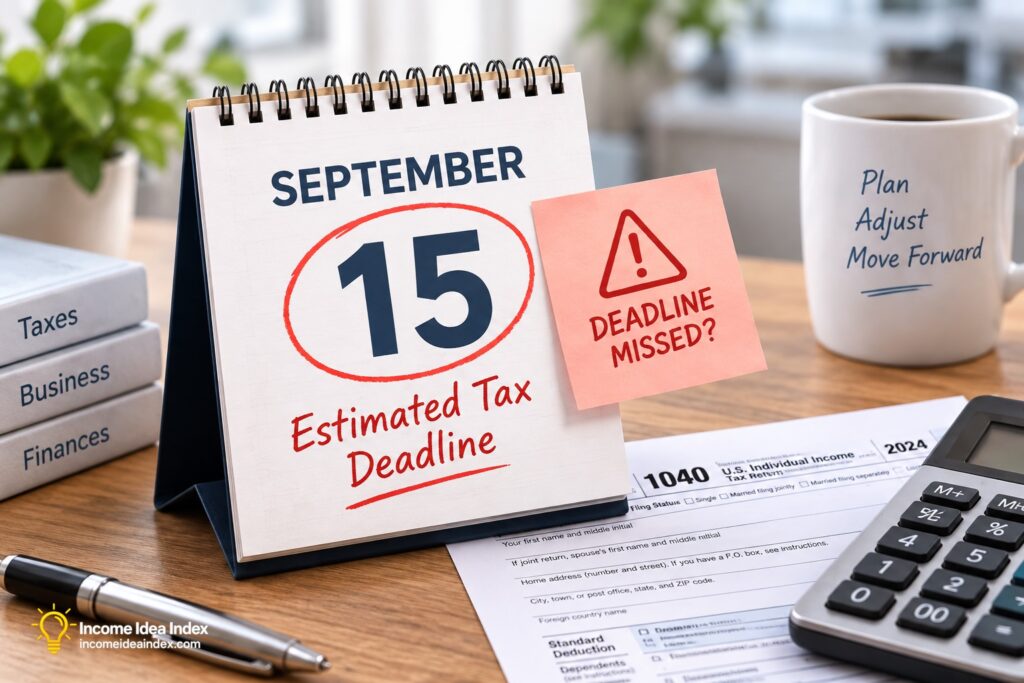
Missed estimated tax deadline? If you were supposed to make the September 15, 2026 estimated tax payment and the date slipped by, the next step is figuring out whether you actually had a required payment, how much you may still owe, and what you should do now.
For freelancers, gig workers, independent contractors, small-business owners, investors, and others with income that is not fully covered by withholding, missing an estimated tax deadline can potentially lead to an IRS underpayment penalty.
But missing the deadline does not mean you should simply wait until tax season—or automatically assume you owe a penalty.
The important thing is to review your 2026 tax situation, determine whether a payment was required, and correct any shortfall as soon as practical.
The September 15 Deadline Was the Third 2026 Estimated Tax Payment
Federal income taxes generally operate on a pay-as-you-go system.
Employees usually satisfy much of that requirement through taxes withheld from their paychecks.
But income that does not have sufficient withholding may require estimated tax payments during the year.
According to the IRS 2026 Publication 505, the regular federal estimated-tax schedule for calendar-year individuals is:
| Income period | 2026 payment due date |
|---|---|
| January 1–March 31 | April 15, 2026 |
| April 1–May 31 | June 15, 2026 |
| June 1–August 31 | September 15, 2026 |
| September 1–December 31 | January 15, 2027 |
That schedule is one reason the term “quarterly taxes” can be slightly misleading.
The four IRS payment periods are not four equal three-month calendar quarters.
The second period, for example, covers only April and May, while the third covers June through August.
If you missed September 15, do not assume that the January 15 payment simply replaces it.
Each payment period can have its own required amount.
Who Actually Needs to Make Estimated Tax Payments?
Earning money outside a traditional job does not automatically mean you owe four estimated-tax payments.
The calculation depends on your entire tax situation.
The 2026 Form 1040-ES instructions state that, in most cases, estimated payments are required when both of these conditions apply:
- You expect to owe at least $1,000 in federal tax for 2026 after subtracting withholding and refundable credits.
- Your withholding and refundable credits are expected to be less than the smaller of generally 90% of your 2026 tax or 100% of the tax shown on your 2025 return.
Special rules can apply, including different prior-year percentages for certain higher-income taxpayers and separate rules for farmers and fishers.
That is why “I made side-hustle income” is not enough information by itself to determine whether an estimated payment was required.
Income That Can Create an Estimated-Tax Obligation
Self-employment is one common reason people make estimated payments, but it is not the only one.
The IRS recently reminded taxpayers that estimated taxes can also apply to income such as:
- freelance and contract income
- gig-economy earnings
- business income
- interest
- dividends
- capital gains
- rental income
- prizes and awards
- other taxable income without adequate withholding
You can review the IRS explanation in Estimated Taxes Aren’t Just for the Self-Employed.
A Side Hustle Does Not Automatically Mean You Need Four Payments
Suppose you have a regular W-2 job and earn additional freelance income.
If enough federal tax is already being withheld from your paycheck to cover your total required tax payments for the year, you may not need separate quarterly payments for the freelance income.
The IRS specifically notes that employees can sometimes avoid estimated payments by increasing withholding from their regular wages.
On the other hand, someone with little or no withholding may need estimated payments even if the extra income did not come from a traditional business.
The correct question is not:
Did I make side-hustle income?
It is:
Will my withholding and other tax payments be enough to satisfy my required tax payments for the year?
First, Check Whether You Really Missed a Required Payment
Before sending money simply because September 15 passed, determine whether a payment was actually required from you for that period.
That can depend on when you earned the income.
For example, if you had no income requiring estimated tax until later in the year, your first required payment may also occur later.
Publication 505 provides special timing rules when income subject to estimated tax begins after the first payment period.
Someone who first receives income requiring estimated tax after August 31, for example, may have a first payment date of January 15 of the following year rather than September 15.
Your Income May Not Arrive Evenly
A freelancer might earn:
- $4,000 in January
- $1,000 in February
- $800 in March
- almost nothing for several months
- $12,000 from a large project in August
That does not look like a business earning the same amount every month.
The IRS provides an annualized income installment method that may help taxpayers whose income varies significantly throughout the year calculate payments based more closely on when income was actually received.
That can matter for seasonal businesses, commission-based work, large investment gains, irregular freelance income, or other uneven earnings.
The method is more complicated than simply dividing an annual estimate by four, so taxpayers with substantial or irregular income may want to review Publication 505 or work with a qualified tax professional.