
Claude for Small Business Gets a Major Upgrade: 43 Workflows and 27 New Integrations
Running a small business often means jumping between more software than the size of the company would suggest.
Customer information may live in one app. Payments are somewhere else. Accounting has its own system. Marketing uses several more tools. Meetings generate notes and follow-up tasks that still have to be moved into the right places.
Anthropic wants Claude to do more of that connecting.
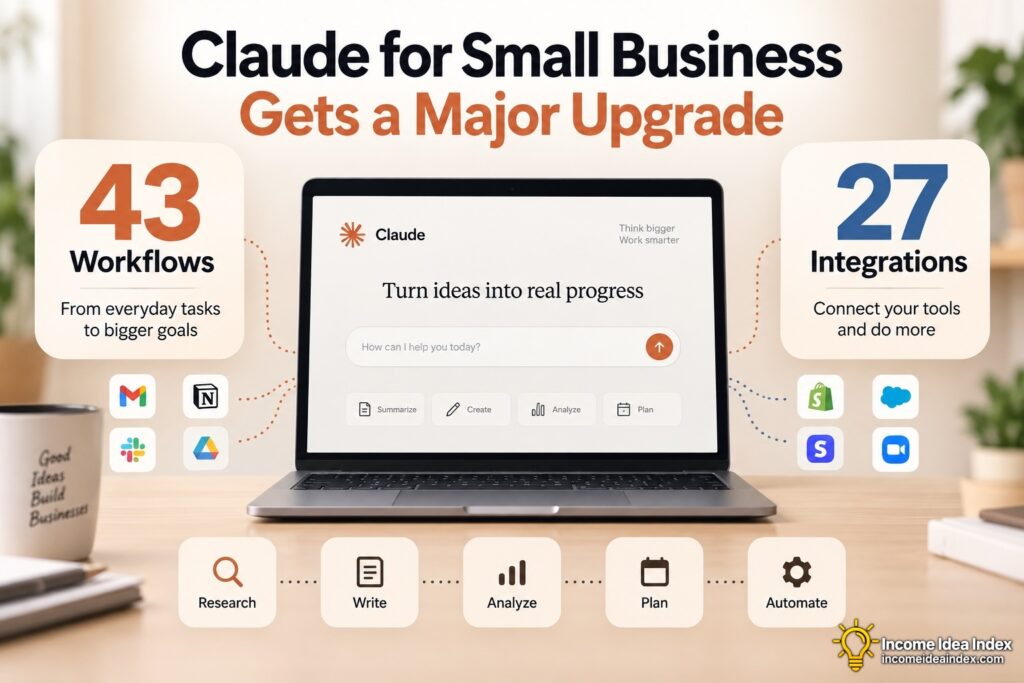
On September 15, 2026, the company announced a major expansion of Claude for Small Business, bringing the package to 43 workflows and adding 27 new integrations with services including Shopify, Salesforce, TikTok, Zoom, Xero, Gusto, Square, Stripe, Zapier and others.
The bigger change is not simply that Claude can connect to more software. Anthropic is increasingly positioning Claude as an AI system that can work across those tools, complete multistep business tasks and run recurring workflows instead of waiting for a new prompt every time something needs to happen.
For a small business owner, that could make AI considerably more useful than another chatbot sitting in a browser tab.
What Changed With Claude for Small Business?
Claude for Small Business itself is not brand new.
Anthropic originally launched it in May 2026 as a collection of connectors and ready-to-run workflows designed specifically for small businesses. The original idea was to move AI beyond a standalone chat window and connect it to software that businesses already use.
According to Anthropic’s September 15 announcement, Claude for Small Business has since been installed more than 900,000 times.
The September update significantly expands what it can connect to and what owners can ask it to do.
Claude for Small Business now includes 43 workflows and 37 partner connectors, with 27 integrations added in the latest expansion.
The supported services include familiar business platforms covering accounting, ecommerce, marketing, sales, productivity, communications and payments.
Among them are:
- Shopify
- Salesforce
- Stripe
- Square
- Xero
- Gusto
- Zapier
- Zoom
- TikTok Ads
- HubSpot
- QuickBooks
- PayPal
- Canva
- Google Workspace
- Microsoft 365
- Slack
- Mailchimp
- Notion
That breadth is important because the value of an AI business assistant depends heavily on whether it can reach the information required to do useful work.
An AI assistant that can write an email is helpful.
An AI assistant that can identify a new sales lead, check the CRM, look at the calendar, draft an appropriate response and prepare the information for follow-up is operating at a very different level.
The 43 Workflows Are More Important Than the Number Sounds
A list of 43 workflows could easily become another feature count that looks impressive without explaining why anyone should care.
The practical question is what those workflows actually do.
Anthropic is organizing them around business processes that owners repeatedly have to manage.
One example is a weekly business brief.
Claude can pull together information such as cash position, recent sales, changes in the sales pipeline and overdue invoices, then summarize what appears to need attention.
Instead of opening several systems and assembling the information manually, an owner could begin the week with a consolidated view.
Another workflow focuses on responding to incoming leads.
A new inquiry might arrive through email, a website or another communication channel. Claude can use connected systems to help qualify the lead, draft a response, check available meeting times and record the interaction in a CRM.
There is also a proposal-building workflow.
Information from a voice memo, meeting notes, photos or a request for proposal can be combined with existing business information to prepare a draft proposal for review.
Marketing receives similar treatment.
Claude can help prepare a content calendar, draft social posts, work with product information and organize marketing activity across connected services.
And at the end of the month, accounting-related workflows can help reconcile information from sales, expenses and payroll while identifying discrepancies that may require attention.
These are more significant than simple one-prompt tasks because they involve several steps and potentially several software systems.
That is the same broader transition we discussed in AI Agents for Beginners: What They Can Do—and Where You Should Stay in Control.
AI is gradually moving from answering questions to carrying out processes.
The New Integrations Could Be the Bigger Story
For many businesses, the 27 new integrations may matter even more than the additional workflows.
Consider an ecommerce business using Shopify.
Product data, inventory and sales information already exist in Shopify. If an AI assistant cannot access that information, the owner has to repeatedly copy information into the AI system before asking useful questions.
Connecting the systems changes that relationship.
Claude can potentially work with existing store information while helping the owner analyze activity or prepare marketing work.
The Stripe integration extends Claude into another important part of a business: payments and cash flow.
Zoom can provide context from conversations and meetings.
Gusto brings payroll-related information into supported workflows.
Salesforce and HubSpot connect Claude with customer and sales information.
Zapier is especially interesting because it can act as another bridge between applications. That potentially gives a business a way to connect Claude to software that does not have a dedicated native integration.
The result is something closer to an operating layer across multiple business applications rather than an isolated AI assistant.
That does not mean a small business should immediately connect every service it uses.
It does mean that AI tools are becoming much more capable of working with the systems where business activity already happens.