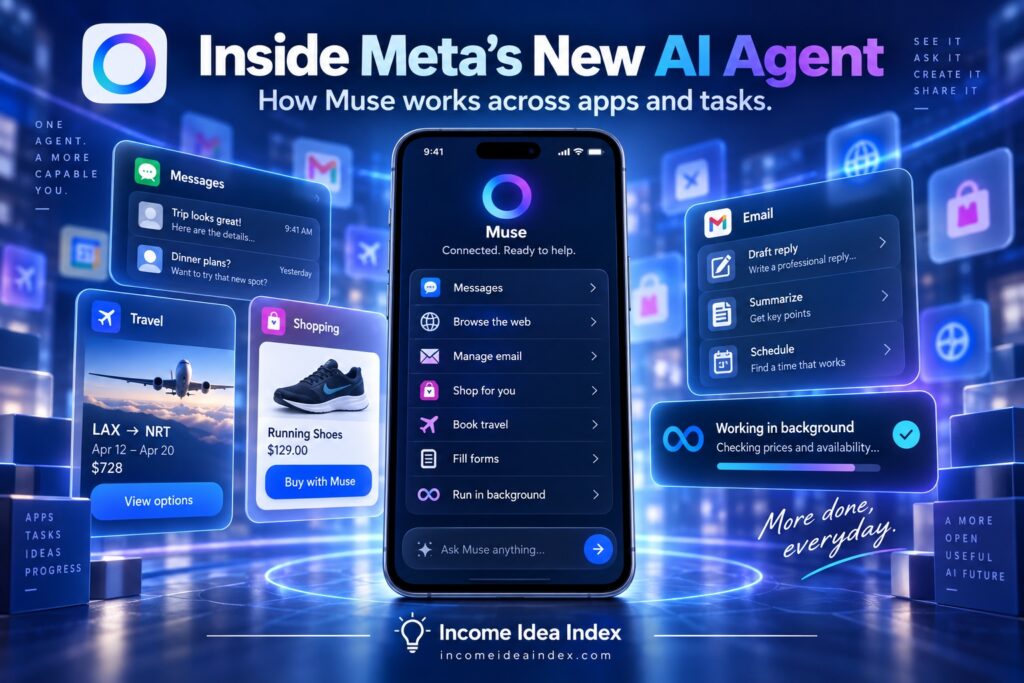
A separate system called Sentinel monitors actions from Muse and determines whether additional permission is required before something reaches the internet.
Muse is also designed to ask for confirmation before sensitive actions such as sending an email or making a purchase.
Users can control which services Muse connects to and what level of access each connection receives.
That distinction is important.
An AI agent may be useful because it can take action, but the same capability increases the consequences if it misunderstands an instruction or is given more access than it actually needs.
Our broader guide to AI agents for beginners recommends starting with low-risk tasks, granting only necessary permissions and requiring human approval for meaningful actions.
Muse Can Make Purchases
Muse can also help complete online purchases.
Meta partnered with Stripe to integrate Link into the system.
According to Meta, Link can generate a one-time-use card number for an agent so the actual payment-card information does not need to be entered across different websites.
Muse is designed to request approval before making a purchase.
Meta also says support for Shop Pay and 1Password is planned.
This ability demonstrates both the promise and the risk of AI agents.
Saving ten minutes on an online purchase may be useful.
Giving software unrestricted purchasing authority would be considerably less appealing.
The safest approach is to let the agent handle repetitive preparation while keeping final authorization under human control.
Muse Remembers Information About You
Muse is also designed to remember information from previous conversations.
That allows it to personalize future suggestions and potentially complete tasks with less explanation.
Meta gives an example of Muse taking a recipe someone saved on Instagram, turning it into a grocery list and remembering dietary restrictions previously mentioned when planning a dinner.
That could make an agent significantly more useful over time.
It also makes privacy controls increasingly important.
Meta says users can tell Muse to forget information it has learned, disconnect services and opt out of having Muse interactions used to train Meta’s AI models.
The company also says conversations and data stored within a Muse virtual machine are not shared with Meta’s advertising systems.
Later in 2026, Meta plans to introduce Muse Confidential VM, which Meta says will encrypt the entire virtual environment using a key controlled by the user so that even Meta cannot access its contents.
Could Muse Actually Save You Time?
For many people, the most useful question will not be whether Muse has sophisticated AI.
It will be whether it removes enough work to justify using it.
Potentially useful tasks could include:
- Researching several options before a purchase
- Preparing travel plans
- Organizing appointments
- Handling repetitive online forms
- Drafting routine communications
- Gathering information for a project
- Creating a plan from a larger goal
- Coordinating repetitive administrative work
Those are exactly the types of tasks where AI can reduce friction.
Our guide to 7 practical ways to use AI to save time every week focuses on the same basic principle: technology is most valuable when it eliminates work rather than creating another tool you constantly have to manage.
Muse takes that concept further because the AI can potentially perform parts of the workflow instead of merely helping you prepare them.
Is Meta Muse Free?
Meta says Muse is free for most everyday use, while subscription plans are available for people who want to use it more heavily.
That means people should be able to experiment with the service before deciding whether additional usage is worth paying for.
Before subscribing to any new AI service, however, it is worth asking whether it solves a problem you actually have.
AI subscriptions can accumulate quickly.
Our guide to choosing online tools that are actually worth paying for explains how to evaluate whether a tool saves enough time, improves your work or creates enough value to justify another monthly expense.
Where Can You Use Meta Muse?
Muse is initially rolling out in the United States.
Meta says it is available through:
- iOS
- Android
- The Muse website
Meta also plans to bring Muse to its AI glasses.
Availability and features could expand as the service develops, so users interested in current access should check Meta’s official Muse information for the latest details.
Should You Use Meta Muse?
Muse is interesting because it represents where consumer AI appears to be heading.
The first generation of popular AI tools focused largely on conversation.
You asked a question.
The AI answered.
The next generation is increasingly focused on delegation.
You describe an outcome.
The AI figures out some of the steps and starts completing them.
That could make tools such as Muse genuinely useful for repetitive administrative work, research, planning and other tasks that consume time without necessarily requiring constant human judgment.
But greater capability should come with greater caution.
Start with tasks that are easy to review.
Limit account permissions.
Require approval before messages, purchases, bookings or other meaningful actions.
And do not assume that an AI agent is correct simply because it can act independently.
The useful version of AI automation is not giving software unlimited control.
It is letting technology handle more of the routine work while you remain responsible for the decisions that matter.
Meta Muse Shows Where AI Is Going Next
Meta Muse is not simply another chatbot with a different name.
Its significance comes from what it is designed to do: move artificial intelligence from answering questions toward completing real-world digital tasks.
Whether Muse itself becomes the dominant personal AI agent remains to be seen.
But the larger shift is already happening.
AI is gradually moving from “What would you like to know?” toward “What would you like me to get done?”
For consumers, freelancers and small-business owners, that could eventually be a much bigger change than simply having a smarter chatbot.