
Meta’s newly launched Muse AI agent is one of the clearest examples yet.
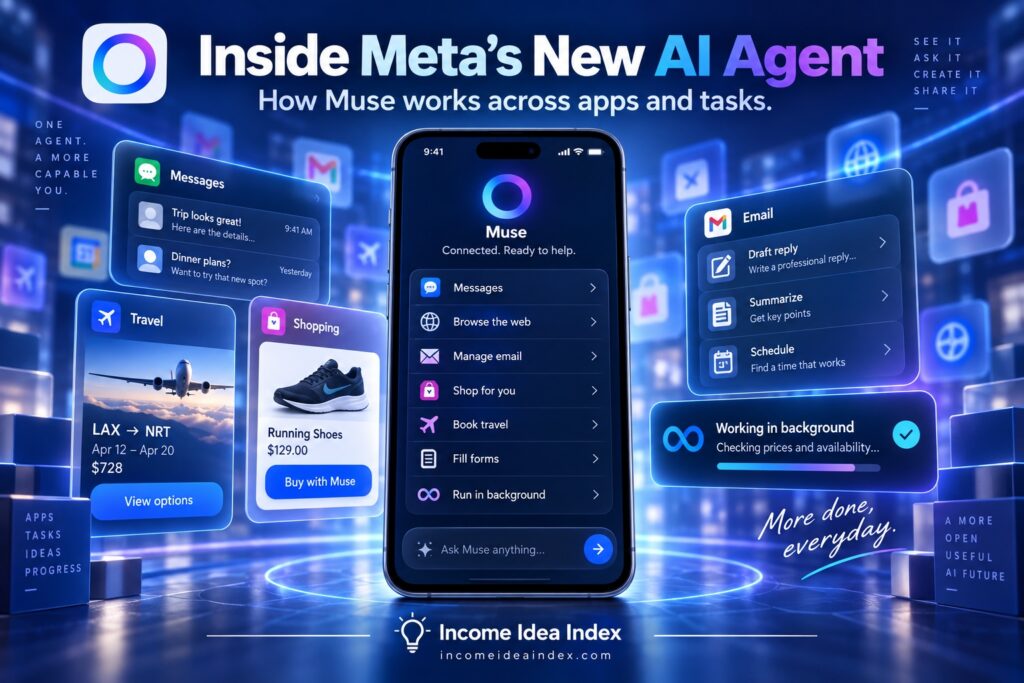
Introduced on September 8, 2026, Muse is designed to handle tasks such as sending emails, booking travel, filling out online forms, shopping, organizing plans and working toward longer-term goals.
Unlike a traditional chatbot that primarily gives you information or instructions, Muse can open a browser, use connected services and take actions on your behalf.
That makes Muse part of a much larger shift toward AI agents — systems designed not just to tell you how to complete a task, but to help complete the task itself.
What Is Meta Muse?
Muse is a new personal AI agent developed by Meta.
According to Meta’s official Muse announcement, the idea is simple: instead of repeatedly telling an AI what to do one step at a time, you give Muse a goal and allow it to work through the necessary steps.
For example, Muse may be able to:
- Send or prepare emails
- Search the web
- Book travel
- Fill out forms
- Shop online
- Help sell an item
- Organize schedules and plans
- Work across connected apps
- Help manage longer-term projects
- Return when it needs your approval
This is fundamentally different from asking an ordinary chatbot, “How do I book a trip?”
A chatbot might explain the process.
An AI agent could potentially search for options, compare them, enter information and prepare the booking for approval.
If AI agents are still unfamiliar, our guide to AI agents for beginners explains how these systems differ from ordinary chatbots and why maintaining human oversight matters.
Muse Can Keep Working After You Close the App
One of the more significant features of Muse is that it does not necessarily stop working when you leave the conversation.
Meta says Muse can continue longer-running tasks after the app is closed.
It can then return when something changes, when the task is completed or when it needs permission to continue.
Imagine asking an AI agent to research travel options, compare products or work through a larger administrative task.
Instead of keeping the conversation open and repeatedly providing new instructions, Muse is designed to advance the work independently within the permissions you have given it.
That begins to make AI feel less like a search box and more like delegated assistance.
Muse Uses Its Own Secure Virtual Computer
Giving an AI permission to browse websites and access accounts creates an obvious question:
How much access should an AI agent have?
Meta has built Muse around what it calls Muse Secure VM.
A virtual machine, or VM, is essentially a software-based computer running in the cloud. Each Muse user gets a dedicated environment where the agent operates and where connected data and credentials can be stored.
Meta says Muse itself does not see users’ passwords or payment information.
A separate system called Sentinel monitors actions from Muse and determines whether additional permission is required before something reaches the internet.
Muse is also designed to ask for confirmation before sensitive actions such as sending an email or making a purchase.
Users can control which services Muse connects to and what level of access each connection receives.
That distinction is important.
An AI agent may be useful because it can take action, but the same capability increases the consequences if it misunderstands an instruction or is given more access than it actually needs.
Our broader guide to AI agents for beginners recommends starting with low-risk tasks, granting only necessary permissions and requiring human approval for meaningful actions.
Muse Can Make Purchases
Muse can also help complete online purchases.
Meta partnered with Stripe to integrate Link into the system.
According to Meta, Link can generate a one-time-use card number for an agent so the actual payment-card information does not need to be entered across different websites.
Muse is designed to request approval before making a purchase.
Meta also says support for Shop Pay and 1Password is planned.
This ability demonstrates both the promise and the risk of AI agents.
Saving ten minutes on an online purchase may be useful.
Giving software unrestricted purchasing authority would be considerably less appealing.
The safest approach is to let the agent handle repetitive preparation while keeping final authorization under human control.