
What the Cheaper Models Could Mean for Businesses
For small businesses, developers and independent creators, the most important part of today’s announcements may not be which company wins a benchmark.
It is that powerful AI is becoming cheaper to operate.
That changes what can realistically be automated.
A business might decide that using a premium model for every customer interaction is too expensive.
But a lower-cost model could make it practical to categorize those interactions, prepare draft responses and escalate only complicated cases to a stronger model or a human employee.
The same approach can work with research.
A cheaper model might gather and organize information first.
A stronger model could then handle the most difficult analysis.
This type of model routing allows businesses to use expensive intelligence selectively instead of paying the highest rate for every step.
Small Businesses Probably Do Not Need the Most Powerful Model for Everything
One side effect of rapid AI development is that people can feel pressure to use whatever model is newest.
That is not always necessary.
For many small-business tasks, reliability, cost, integrations and ease of use may matter more than achieving the highest benchmark score.
Routine work could include:
- organizing information;
- summarizing documents;
- drafting standard communications;
- categorizing customer inquiries;
- extracting information from invoices;
- preparing social-media drafts;
- creating first-pass research;
- updating internal records.
A lower-cost model may perform those tasks perfectly well.
More complicated work can then be routed to a stronger model.
That is potentially a much more economical approach than assuming every AI request needs the most powerful model available.
Consumers May Eventually Benefit Too
API prices primarily affect developers and companies building AI into their own products.
But falling infrastructure costs can eventually affect ordinary users as well.
If AI companies can serve capable models more efficiently, they have more flexibility to increase usage limits, include stronger models in lower-priced plans or make advanced capabilities available to more users.
OpenAI is already positioning Sol and Luna as ways to broaden access to GPT-6 capabilities.
GPT-6 Sol and Luna are launching in ChatGPT Work and Codex for Plus, Pro, Business, Enterprise and Edu users.
OpenAI says Free and Go users can access GPT-6 Luna through the desktop application.
The models are also available through the API as gpt-6-sol and gpt-6-luna.
Anthropic, meanwhile, has made Opus 5.5 available through major cloud platforms including Amazon Web Services, Google Cloud and Microsoft Azure, according to Reuters.
The immediate impact is strongest for developers.
The longer-term effect could be more capable AI becoming available at lower prices throughout the software people already use.
This Does Not Settle Which AI Model Is Best
Same-day launches naturally invite comparisons.
But it is too early to declare a universal winner between GPT-6 Sol, GPT-6 Luna and Claude Opus 5.5.
OpenAI has published benchmarks showing strong cost-adjusted performance for its models.
Anthropic has published its own evaluations showing Opus 5.5 performing strongly in software development and other demanding work.
Those results were produced under different test conditions.
Real-world performance will also vary considerably by task.
Coding, writing, research, computer use, business automation and data analysis do not necessarily favor the same model.
Independent testing and actual customer usage over the coming weeks will provide a clearer picture.
For users, that may be a good reason to avoid becoming too attached to a single benchmark number.
The more useful question is whether a model performs reliably for the work you actually need it to do.
What Happens Next?
The September 22 launches probably will not be the end of this pricing shift.
Anthropic has already said Sonnet 5.5 and Haiku 5.5 are coming.
OpenAI now has Astra, Sol and Luna in the GPT-6 family, giving customers several capability and price points.
Other major AI providers are competing for many of the same developers and enterprise customers.
That creates pressure throughout the market.
A company that introduces a stronger model may gain attention.
A competitor can respond with a model that is slightly less capable but dramatically cheaper.
Another can compete through better integrations, faster inference, longer context windows or more reliable agent behavior.
The AI race is therefore becoming multidimensional.
Raw intelligence still matters.
So do speed, safety, reliability, integrations and cost.
And as AI moves deeper into everyday business operations, cost may become one of the most important competitive advantages of all.
The Bottom Line
September 22 may prove to be an important day in the shift toward cheaper frontier AI.
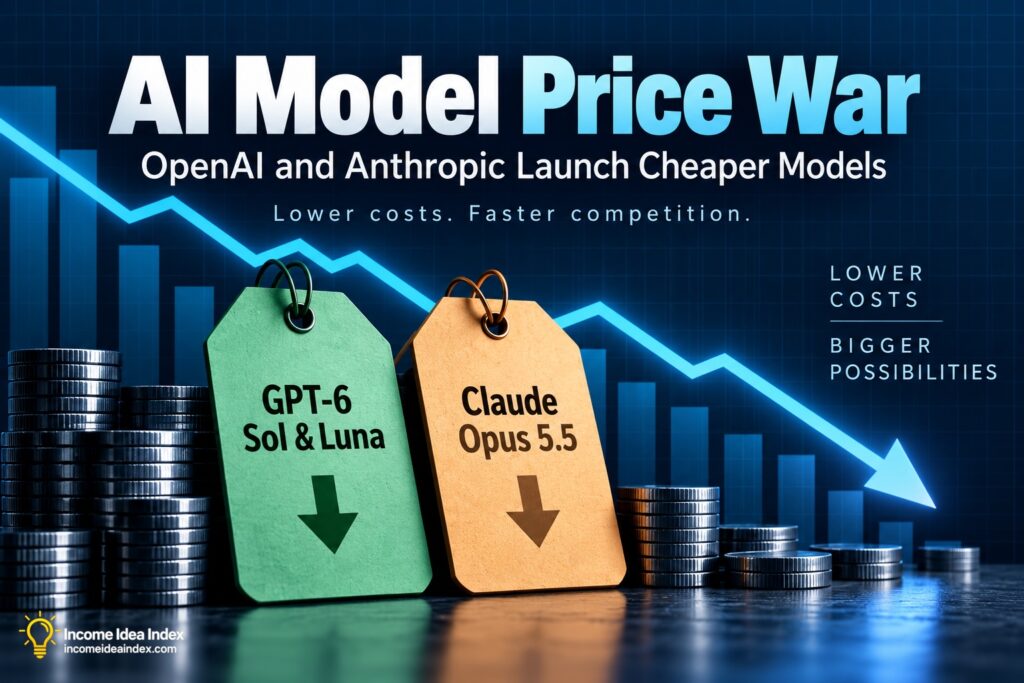
OpenAI launched GPT-6 Sol and Luna with API pricing 50% below the promotional rates of their GPT-5.6 predecessors.
Anthropic released Claude Opus 5.5 and says the model can deliver roughly Fable 5.1-level performance on most tasks while costing about 40% less to run than Opus 5 on typical workloads.
Only two days earlier, Anthropic’s next model was still an unconfirmed possibility.
Now both companies have put lower-cost AI models at the center of their competitive strategy.
For businesses and developers, that may ultimately matter more than another round of benchmark records.
The next phase of the AI race is not simply about building the smartest model.
It is about making increasingly capable intelligence affordable enough to use everywhere.