
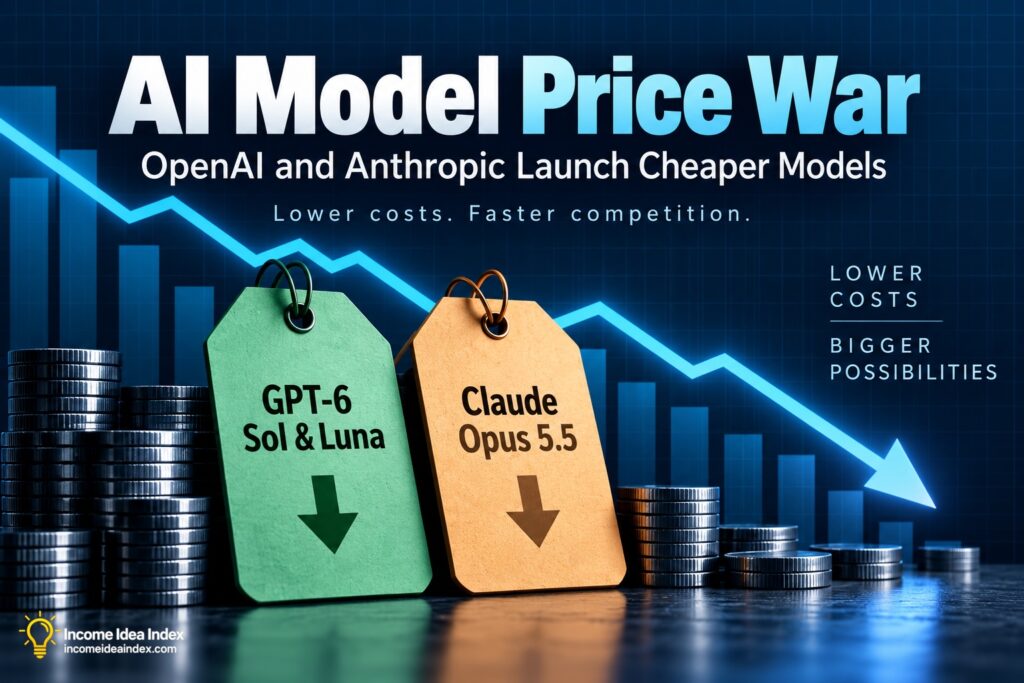
The AI model price war moved into a new phase on September 22, 2026, as two of the biggest companies in artificial intelligence released new models built around a similar message: advanced AI needs to become cheaper to use.
OpenAI launched GPT-6 Sol and GPT-6 Luna, extending the GPT-6 family beyond its flagship GPT-6 Astra model.
On the same day, Anthropic released Claude Opus 5.5, a lower-cost successor to Opus 5 that the company says can deliver performance comparable to its larger Claude Fable 5.1 model on most tasks.
The timing is significant.
For much of the generative AI race, attention has focused on which company can produce the smartest or most capable model.
That competition is not disappearing.
But OpenAI and Anthropic are now putting much more emphasis on another metric: how much useful work a model can complete for each dollar spent.
That could matter considerably to developers and businesses that are beginning to use AI repeatedly throughout the workday rather than occasionally asking a chatbot a question.
OpenAI Launches GPT-6 Sol and GPT-6 Luna
OpenAI introduced GPT-6 Astra earlier this month as the highest-capability model in its new generation.
Now the company is filling out the rest of that lineup.
According to OpenAI’s September 22 announcement, GPT-6 Sol and GPT-6 Luna use training methods related to Astra while targeting users who do not need Astra’s full capability or cost for every task.
Sol occupies the more capable tier of the two.
Luna is designed around speed and lower operating costs.
OpenAI says both models include improvements in professional work, coding, factual reliability, computer use and alignment compared with their GPT-5.6 counterparts.
But pricing may be the part of the announcement that receives the most attention.
GPT-6 Sol costs:
- $2 per million input tokens
- $10 per million output tokens
GPT-6 Luna costs:
- $0.10 per million input tokens
- $0.50 per million output tokens
OpenAI says those prices are 50% lower than the promotional API pricing of the corresponding GPT-5.6 models.
Reuters also confirmed the new pricing and model rollout.
That means OpenAI is not simply releasing another generation and charging more for it.
It is attempting to deliver newer capabilities while simultaneously pushing the cost of using those capabilities downward.
GPT-6 Astra Is Not Being Replaced
The arrival of Sol and Luna does not mean GPT-6 Astra is being phased out.
OpenAI continues to position Astra as its highest-capability option for particularly demanding work.
The difference is that not every AI task needs the most expensive or capable model available.
A company extracting information from thousands of documents, classifying support requests or performing routine coding work may get little benefit from paying for the most powerful model on every request.
That makes model tiers increasingly important.
Astra can be reserved for particularly difficult tasks.
Sol can handle more demanding everyday professional and development work.
Luna can handle high-volume workloads where cost and speed matter more.
That approach is particularly relevant as AI systems become more agentic.
Instead of making one model call when someone types a question into a chatbot, an AI agent may make dozens or even hundreds of model calls while researching information, using applications, checking its work and completing a multistep process.
A small reduction in cost per request can become a major difference when multiplied across millions of requests.
OpenAI is also improving prompt caching for GPT-6. The company says cached input-token reads can receive discounts of up to 90%, potentially reducing costs further for applications that repeatedly reuse the same instructions or context.
Anthropic Releases Claude Opus 5.5
OpenAI was not the only company cutting costs on September 22.
Anthropic also released Claude Opus 5.5, the first model in its new Claude 5.5 family.
The release confirms something that was still uncertain only two days ago.
On September 20, Income Idea Index reported that Anthropic was considering accelerating another AI model release as GPT-6 Astra gained traction.
At that point, there was no confirmed model name and no confirmed launch date.
That changed quickly.
Claude Opus 5.5 is now available, and Anthropic is emphasizing both capability and efficiency.
According to Reuters’ report on the launch, Anthropic says Opus 5.5 performs at approximately the level of its higher-end Fable 5.1 model on most work while costing substantially less to operate than Opus 5.
The API price is:
- $4 per million input tokens
- $20 per million output tokens
That is 20% below Opus 5’s token pricing.
But Anthropic says the effective savings on typical workloads can reach approximately 40% because Opus 5.5 also requires fewer tokens to complete work.
The company also says the model generates output more than 30% faster than Opus 5.
That combination is important.
A model does not necessarily become cheaper simply because its listed token price falls.
If it needs significantly more tokens or considerably more time to complete the same job, some of those savings can disappear.
Anthropic is therefore framing Opus 5.5 around the broader cost of accomplishing a task rather than token price alone.
Anthropic Is Also Emphasizing Safety
The release comes at an unusual moment for Anthropic.
CEO Dario Amodei recently called for the AI industry to slow the introduction of increasingly powerful capabilities while stronger safety systems and oversight are developed.
That created an obvious question when reports emerged that Anthropic might accelerate another model release in response to competition from GPT-6 Astra.
Anthropic appears to be addressing that tension directly.
Reuters reports that Opus 5.5 underwent testing by independent AI safety organizations Frontier Design and METR before release.
Anthropic also says the model incorporates safeguards that had previously been reserved for its most capable systems.
In an internal containment evaluation cited by Reuters, the company said Opus 5.5 was substantially less likely than Opus 5 or Mythos 5.1 to attempt to bypass containment boundaries.
Those are Anthropic’s reported evaluation results rather than independent proof that every safety problem has been solved.
But they show how the company is trying to combine faster product development with the safety position it has publicly advocated.
The broader tension between rapidly improving AI systems and calls to slow frontier development is something we have been following in our earlier coverage of the debate over slowing AI development.