
Why the AI Model Price War Matters
The AI model price war matters because the economics of artificial intelligence are changing almost as quickly as the models themselves.
A slightly better model can attract attention.
A dramatically cheaper model can change whether an entire business process is economically practical.
Consider a company using AI occasionally to write marketing copy.
The cost difference between two models may barely matter.
Now consider a company deploying an AI agent that examines every incoming customer request, pulls information from a CRM, checks account history, prepares a response, updates a database and determines whether a human employee needs to intervene.
That system could make enormous numbers of model calls.
At that scale, AI pricing begins to look less like the cost of buying software and more like an operating expense that has to be managed continuously.
OpenAI and Anthropic both appear to recognize that.
The Competition Is Moving From Intelligence to Intelligence Per Dollar
AI companies still promote benchmark scores, and both OpenAI and Anthropic are making strong performance claims for their new models.
Those comparisons should be interpreted carefully.
The companies often use different benchmarks, different reasoning settings and different assumptions about cost.
A benchmark showing one model ahead on a particular test does not establish that it will perform better for every user or every workload.
The more important industry shift may therefore be intelligence per dollar.
Can a less expensive model complete enough of the work that previously required a flagship model?
If the answer increasingly becomes yes, businesses may be able to deploy AI much more broadly.
This is similar to what happened with cloud computing.
The technology became more useful not simply because servers became more powerful, but because companies could access computing resources at a price and scale that made new applications practical.
AI may be entering a similar stage.
Cheaper Models Could Make AI Agents More Practical
The shift is particularly important for AI agents.
Income Idea Index recently covered Anthropic’s expansion of Claude for Small Business to 43 workflows and 27 new integrations.
Those workflows can connect AI with systems used for payments, ecommerce, accounting, marketing, sales and productivity.
But connecting AI to more business processes also means using more AI.
An agent creating one weekly report might consume relatively little.
An agent continuously handling leads, preparing proposals, checking financial information, researching customers and coordinating work across applications could generate far more usage.
Lower model prices can make those workloads easier to justify.
That helps explain why both OpenAI and Anthropic are emphasizing cost alongside capability.
The companies are not competing only for individual chatbot subscriptions.
They are competing to become the AI infrastructure sitting behind software, businesses and automated workflows.
The Pricing Difference Is Still Large Between Model Tiers
Published API pricing also shows why businesses will increasingly need to choose models based on the task.
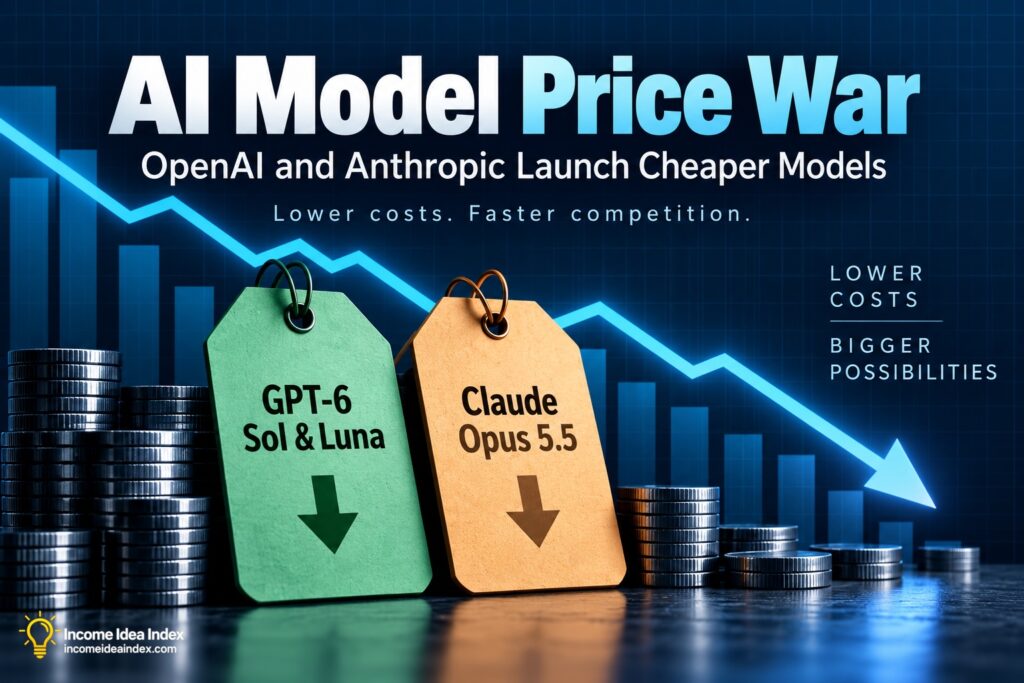
GPT-6 Luna costs just $0.10 per million input tokens and $0.50 per million output tokens.
GPT-6 Sol costs $2 and $10.
Claude Opus 5.5 costs $4 and $20.
That does not mean Luna is automatically the better value or that Opus 5.5 is overpriced.
The models are designed for different levels of work, and the amount of computation required to successfully complete a task matters more than the sticker price alone.
A cheaper model that fails repeatedly can ultimately cost more than a more expensive model that completes the job correctly the first time.
The practical question becomes:
What is the least expensive model that can reliably complete this particular task?
That is likely to become one of the central questions for companies deploying AI at scale.
Claude Opus 5.5 Also Pressures Anthropic’s Own Model Lineup
Opus 5.5 creates another interesting dynamic inside Anthropic’s own product family.
The company says the model can perform at approximately Fable 5.1 levels on most work despite being substantially less expensive to operate.
If that holds across real-world workloads, some customers who previously needed Fable-level performance may be able to move work to Opus.
Anthropic has also said that Claude Sonnet 5.5 and Claude Haiku 5.5 are expected in the coming weeks.
That means the pricing competition may not stop with today’s announcement.
If those lower-tier models receive similar efficiency improvements, Anthropic could reduce costs across a much wider portion of its product lineup.
OpenAI may face the same pressure.
Once customers become accustomed to each new model generation delivering more capability for less money, raising prices becomes considerably harder.