

Google AdSense identity verification is changing, and the change could affect new publishers before they earn their first dollar.
Google has updated its AdSense payment-threshold documentation to say that, depending on location, the identity verification threshold is now $0. That means some publishers may be required to verify their identity before their AdSense account can begin showing ads and receiving payments.
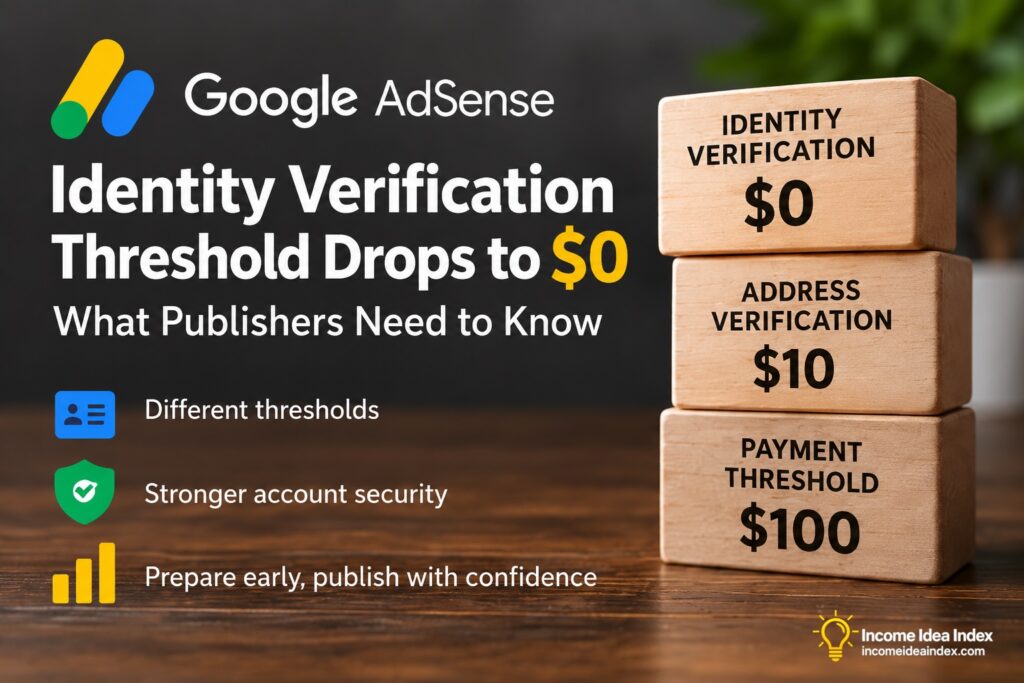
The change is important because identity verification and address verification are no longer tied to the same earnings threshold. Google still lists the address-verification threshold at $10 or the local equivalent.
What Changed With Google AdSense Identity Verification?
Until now, many publishers associated AdSense verification with reaching an earnings milestone.
Search Engine Roundtable reported on September 23, 2026 that Google had changed its documentation to separate the identity and address verification thresholds. The current Google AdSense payment-threshold page lists the U.S. dollar thresholds as $0 for identity verification and $10 for address verification.
Google’s documentation says:
Identity verification may now be required at $0, depending on location.
Address verification remains at $10 or the local equivalent.
The regular payment threshold has not been reduced to $0. For accounts using U.S. dollars, Google still lists the payment threshold at $100.
That distinction matters.
A $0 identity threshold does not mean Google will pay publishers immediately. It means Google may want to establish who is behind the account before allowing the account to move forward with advertising and payments.
Google’s current payment-threshold information is available through its official AdSense documentation. Google AdSense payment thresholds
Why Would Google Require Verification Before You Earn Anything?
Google says identity verification is used to confirm that the personal information connected to an account is accurate and to help protect its advertising system against fraud.
Moving verification earlier in the process changes when that check can happen.
Instead of allowing an account to begin generating advertising revenue and verifying the publisher later, Google can potentially establish the publisher’s identity before ads start serving.
For legitimate publishers, this mostly means that identity information needs to be correct earlier.
For Google, earlier verification can make it harder to create disposable publisher accounts using false, mismatched, or repeatedly recycled identities.
It also means someone starting a new content website should no longer assume that identity verification is something they can deal with after the site begins earning money.
Does the $0 Threshold Apply to Every AdSense Publisher?
Not necessarily.
Google specifically uses the phrase “depending on your location” when describing the threshold change. That means publishers should not assume every account in every country will move through exactly the same process.
The safest source for your own account is the account itself.
Google directs publishers to open AdSense and go to Payments → Verification check to see what verification actions are required.
That is particularly important while this change is rolling out because Google’s help documentation does not appear completely synchronized yet.
For example, Google’s current payment-threshold page shows the new $0 identity threshold, while another AdSense page describing the steps to getting paid still discusses $10 as an early earnings milestone before the verification process.
That does not necessarily mean anything is wrong with your account. It means publishers should rely on the instructions presented inside their own AdSense dashboard when there is a difference between general help pages.
What Will Google Ask You to Verify?
For individual publisher accounts, Google generally requires a valid government-issued identity document.
Depending on your country, accepted documents can include a passport, driver’s license, national or state identification card, or residence permit.
Google says the information on your documentation needs to correspond with the information in your account.
That makes one seemingly small detail particularly important:
Do not casually enter a nickname, shortened name, old address, or inaccurate business information when creating your payment profile.
A difference that seems insignificant to you can become a problem when an automated verification system tries to compare your account information with official documents.
Google also advises publishers to submit clear images, include both sides of two-sided documents when required, make sure the entire document is visible, avoid glare, and use documents that are current rather than expired.
Some Publishers May Be Asked for a Video Selfie
Identity verification may involve more than uploading a photograph of an ID.
Google says that, depending on location, some publishers may be asked to submit a government-issued photo ID and complete a video selfie.
Google describes this as part of a newer verification process intended to improve the verification experience while strengthening protections against fraud. It also says information gathered through that process is used for verification purposes.
That option is not necessarily available to every publisher.
If your account does not offer online verification or a video-selfie option, follow the verification instructions Google provides inside your account instead.
You Normally Have 45 Days Once Google Requests Verification
The $0 threshold does not mean publishers have 45 days from the day they create an AdSense account.
The countdown begins when Google actually asks the publisher to complete identity verification.
Google says publishers generally have 45 days from the date of the request to submit the necessary documentation.
If the publisher does not provide the documentation—or Google is still unable to verify the identity after that period—Google says ads can stop showing on the publisher’s pages.
Verification therefore should not be treated like an optional profile-completion step.
Once the request appears, deal with it.
Waiting until day 44 gives you very little room to resolve a rejected photograph, mismatched name, expired ID, or another verification problem.
Identity Verification and Address Verification Are Different
This change is much easier to understand when the two processes are separated.
Identity verification asks: Are you who you say you are?
Address verification asks: Can Google confirm the payment address associated with the account?
Google’s current threshold documentation places identity verification at $0 for affected publishers while leaving address verification at $10 or the local equivalent.
Traditional address verification commonly involves Google mailing a six-digit Personal Identification Number, or PIN, to the payment address.
Google says the PIN usually takes around three weeks to arrive, although actual delivery times can vary. Publishers then enter the PIN into their AdSense account to confirm the address.
Google also notes that, depending on location, some publishers who successfully complete online identity verification may not need the traditional address-verification process. Your account’s Verification check page will show whether address verification is still required.
That is why the headline change should not be interpreted as “Google eliminated the $10 verification threshold.”
It did not.
Google separated two different verification requirements.