
The Risk Is Not Limited to Lawyers
Most people are not writing court filings. But many people now use AI for work that affects customers, income, deadlines, and decisions.
A freelancer might use AI to research a client’s industry before writing a proposal. A creator might use it to draft an article. A small business owner might use it to prepare product descriptions or customer-service replies. An employee might use it to summarize a report before a meeting.
Each use can be sensible.
The problem appears when AI output is treated as verified research, final advice, or a substitute for knowing the subject.
Here are a few everyday examples.
A freelancer sends a proposal with invented details
Suppose you ask an AI assistant to research a potential client’s company and suggest ways you could help them.
The response may mention a product launch, an executive, a customer problem, or a recent business change. If one of those details is wrong, your proposal can immediately look careless.
Before you use research in a pitch, open the company’s website, press releases, public social accounts, or other reliable sources. Make sure the information is current and accurate.
A business publishes a claim it cannot prove
AI can make product descriptions and marketing copy much faster to draft. But it can also create claims that sound appealing without being supportable.
For example, it may describe a product as “proven,” “guaranteed,” “industry-leading,” or “the best” without evidence. It may also make health, financial, legal, or performance claims that need more care than a generic prompt can provide.
The business owner is still responsible for what is published.
An employee makes a decision from a flawed summary
AI summaries can be useful when you are sorting through long material. But a summary is not a replacement for reading the critical source.
If you are using a summary to decide whether to sign something, recommend a vendor, change a process, approve a budget, or present information to leadership, review the original material yourself.
A summary can help you find where to focus. It should not be the only thing you rely on.
A creator publishes content with errors
AI can help turn notes into a first draft, generate headline ideas, or make a long piece of content easier to organize. That is one of the practical ways to use AI to save time every week.
But if an article includes facts, dates, product details, statistics, or recommendations, those parts need a human review.
Readers may forgive a small typo. They are less likely to trust a site that confidently shares information that is wrong.
Use AI for the Right Parts of the Job
The answer is not to avoid AI completely.
For many tasks, AI is genuinely helpful. The key is to give it work that benefits from speed and structure while keeping responsibility for accuracy where it belongs.
AI is generally useful for:
- Creating a first draft from your notes
- Brainstorming headlines, names, angles, or questions
- Organizing a rough to-do list
- Turning a process into a checklist
- Reformatting information you already know is accurate
- Suggesting ways to explain an idea more simply
- Preparing questions before a meeting or phone call
- Identifying possible gaps in a plan
AI deserves more caution when the output involves:
- Legal, tax, medical, or financial guidance
- Customer promises or public claims
- Names, dates, quotations, and statistics
- Contracts, policies, or compliance requirements
- Client research
- Business decisions involving money
- News reporting
- Advice that could materially affect someone else
The difference is not whether the task feels “important.” The difference is whether being wrong could cause harm, cost money, mislead someone, or damage trust.
A Simple Verification Process Before You Use AI Output
You do not need to turn every AI-assisted task into an all-day research project. You just need a process that matches the risk.
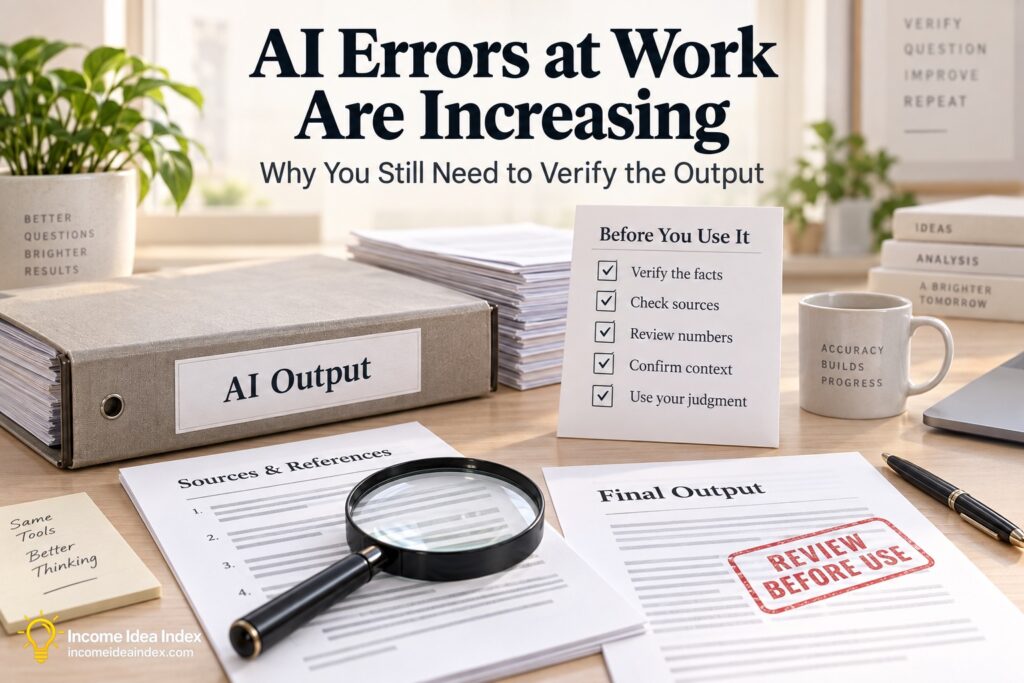
Before you send, publish, or act on something AI helped create, use this quick check.
1. Identify the claims that matter
Look for anything specific:
- Numbers
- Dates
- Names
- Sources
- Quotes
- Laws or rules
- Prices
- Product features
- Promises
- Recommendations
These are the details most likely to cause trouble if they are wrong.
2. Check the original source
Do not ask the AI tool to confirm its own answer.
Instead, go to the original source whenever possible. That might be a government agency, company website, official document, direct report, trusted publication, or the source material you provided.
For example, if AI mentions an IRS rule, check IRS.gov. If it describes a company update, check that company’s announcement. If it cites a study, find the study itself.
3. Read for what is missing
Sometimes an AI answer is not false. It is incomplete.
Ask yourself:
- Does this answer include an exception?
- Is there a date or location that changes the result?
- Does this advice apply to my exact situation?
- What would someone with more experience notice here?
- Is this written too confidently for the evidence available?
That last question is particularly useful. Confident language can hide weak information.
4. Add your own experience and judgment
AI can generate a generic answer quickly. Your value comes from knowing what actually fits the person, project, audience, or situation.
If you are writing for a client, use what you know about their goals. If you are publishing content, add your own reasoning and make sure the article reflects the actual source material. If you are making a business decision, consider the facts that do not appear in a prompt.
This is how AI becomes an assistant instead of a substitute.
Do Not Let Speed Create Rework
The biggest reason to verify AI output is not fear. It is efficiency.
A small mistake can cost more time than the AI saved.
You may have to correct a public post. Explain an incorrect claim to a client. Rewrite an email after it creates confusion. Repair trust after sharing bad information. Or redo an entire project because it was built on an assumption that was never checked.
That is why the best use of AI is not “generate everything faster.”
It is “remove low-value work so you have more time for thinking, checking, and making better decisions.”
The same principle applies when you use AI to support content creation. It can help you repurpose useful ideas and create a more sustainable process, as explained in How to Turn One Piece of Content Into a Week of Marketing. But the final content still needs your standards, your point of view, and your review.
AI Can Help You Move Faster—With a Human Still in Charge
The court cases in the Reuters report are a reminder that AI mistakes are not just a theoretical concern. They happen when people move too quickly, assume the output has been checked, or let convenience replace judgment.
That does not make AI useless. It makes responsible use more important.
Use it to get past the blank page. Use it to organize scattered notes. Use it to generate options, simplify a first draft, and reduce repetitive work.
Then pause before you trust the final answer.
Verify the facts. Check the sources. Read the important details yourself. And remember that anything you send, publish, recommend, or decide is still your responsibility.
AI can help you do more. Your judgment is what makes the work worth trusting.