
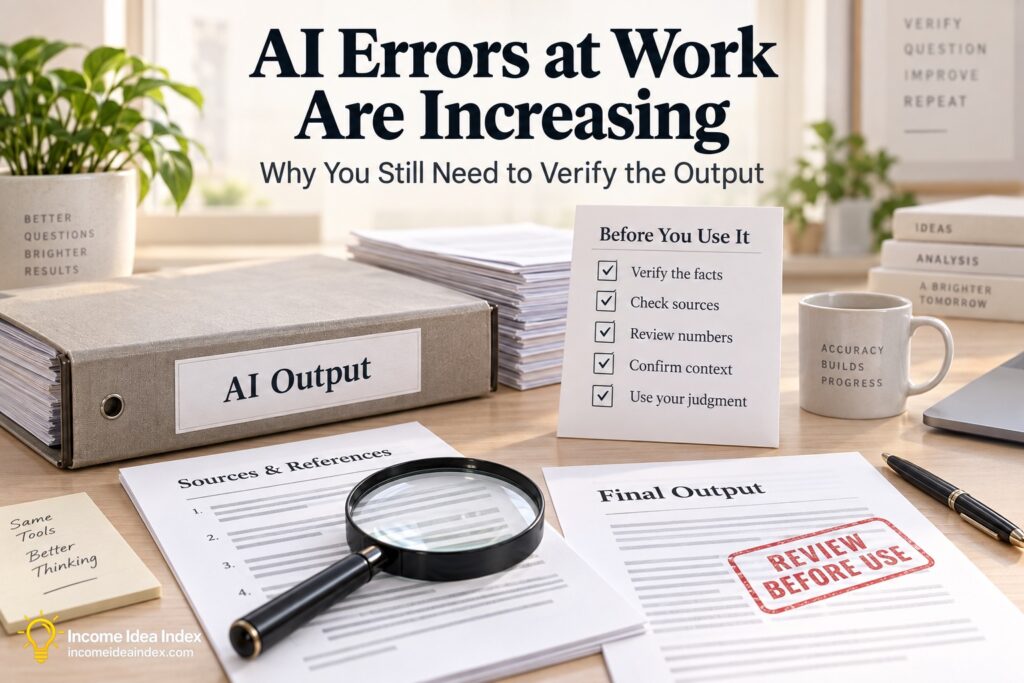
AI errors at work are becoming harder to ignore.
Generative AI can help people draft emails, organize notes, summarize long documents, brainstorm ideas, create marketing copy, and prepare for meetings. Used carefully, those capabilities can save real time.
But a recent Reuters report shows what can happen when someone treats AI output as finished work instead of a starting point. According to research cited in the report, AI-generated errors have now appeared in at least 1,395 state and federal court cases in the United States.
The legal examples are extreme because mistakes can become part of the public record. Still, the lesson applies far beyond lawyers. A confident-sounding AI mistake can create problems for a freelancer sending work to a client, a small business publishing product information, or an employee preparing a report for a manager.
The useful rule is simple: use AI to move faster, but do not let it become the final decision-maker.
What the New Report Reveals About AI Mistakes
The Reuters report describes several recent legal cases involving fabricated testimony, incorrect quotations, and citations to cases that did not exist. In one California case, a lawyer representing State Farm was fined after submitting inaccurate citations and quotations produced with generative AI.
These are not ordinary typos.
A typo might change one date or misspell a name. AI errors can be more persuasive and more dangerous because the answer often arrives in complete sentences, with a professional tone and apparent certainty.
That can make an incorrect answer feel trustworthy at first glance.
AI does not “know” facts in the same way a person checks a source, understands a situation, or takes responsibility for an outcome. It predicts a useful-sounding response based on patterns in information. Often, that response is helpful. Sometimes, it is incomplete, outdated, misleading, or simply wrong.
This is commonly called an AI hallucination. The term sounds technical, but the basic problem is straightforward: the tool gives you information that sounds believable but is not reliable enough to use without checking.
The risk grows when you are rushed.
If you are trying to finish a proposal, reply to a customer, write a blog post, prepare research, or create a presentation, it is tempting to copy the answer and move on. That moment is where a small time-saving tool can create extra work later.
Why Confident Errors Are So Easy to Miss
People expect software to be consistent.
A calculator gives the same answer when you enter the same numbers. A spelling checker points out a possible mistake. A calendar displays the date you selected.
Generative AI works differently. It produces a new response each time and can make an error while sounding completely sure of itself.
That creates a few common traps.
It can fill in gaps instead of admitting uncertainty
If you ask AI about a specific person, company, study, rule, or event, it may respond with details that appear complete even when it does not have enough reliable information.
For example, it may provide:
- A source that does not exist
- A statistic without a reliable origin
- A quote that was never said
- A summary that leaves out an important exception
- An outdated rule presented as current information
- A recommendation that does not fit your specific situation
The more specific the request, the more careful you should be.
It can turn weak research into polished writing
A rough AI answer may feel easier to question. A well-formatted response with headings, bullet points, examples, and confident language can feel finished.
But a polished format does not make the information accurate.
This matters especially when creating professional materials. A client does not see the prompt you used. They see the final proposal, report, product page, email, or article with your name attached to it.
It can miss context that changes the answer
AI may be able to explain a general idea correctly while still missing the details that matter in your situation.
For example, an AI tool might give a reasonable explanation of a tax rule but fail to account for your state, filing status, business structure, or the current year. It might draft a customer email that sounds polite but misses the relationship history. It might write marketing copy that overlooks a claim you cannot support.
This is why AI should support your judgment, not replace it.