

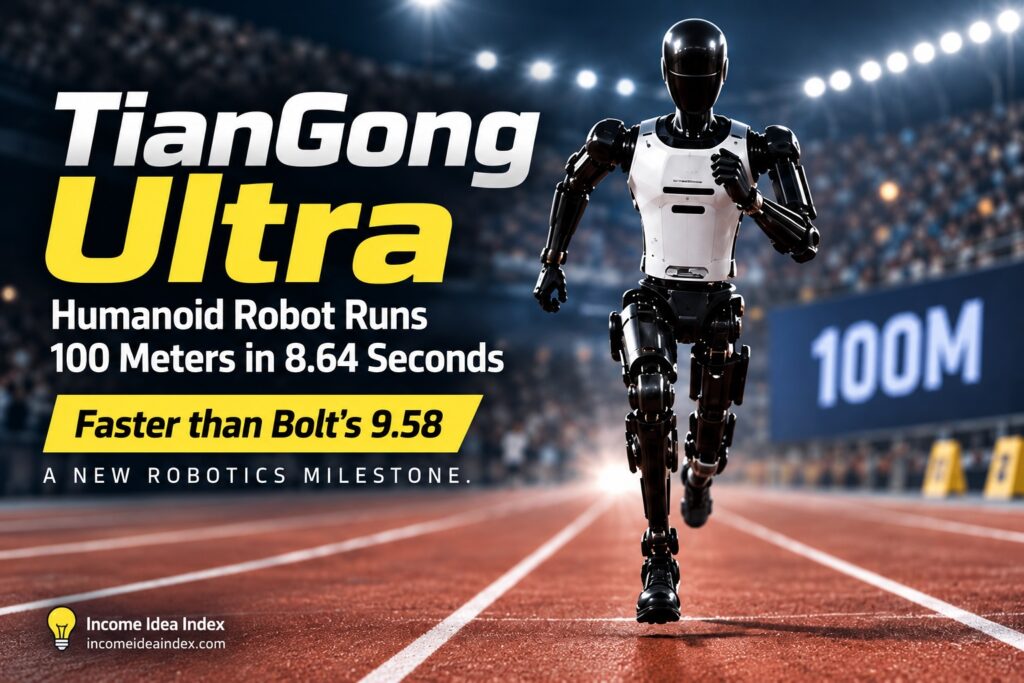
The TianGong Ultra humanoid robot just did something that sounds almost unreal.
At the second World Humanoid Robot Games in Beijing, TianGong Ultra ran 100 meters in 8.64 seconds. That is faster than Usain Bolt’s official 100-meter world record of 9.58 seconds.
That headline alone is enough to stop people scrolling.
A human-like robot just ran 100 meters faster than the fastest human ever officially recorded.
But as eye-catching as that is, the sprint time is not the whole story.
The more important question is what this performance actually means. Is it simply a flashy robotics stunt, or is it a sign that humanoid robots are moving much closer to real-world usefulness?
That is what makes this story worth paying attention to.
TianGong Ultra was built by X-Humanoid, also known as the Beijing Humanoid Robot Innovation Center. The company says the robot won the large-size 100-meter event with its 8.64-second run and successfully defended its title while once again surpassing the human world record.
Read X-Humanoid’s official race announcement
See Usain Bolt’s official 9.58 world-record mark at World Athletics
What Happened?
According to X-Humanoid, TianGong Ultra won the large-size 100-meter race at the second World Humanoid Robot Games with an official time of 8.64 seconds.
That was not the robot’s only strong result at the event. X-Humanoid says the broader TianGong lineup performed extremely well across the competition and helped the team finish with a large medal haul and numerous event-record performances.
Even so, the 8.64-second sprint became the attention-grabbing moment.
That is understandable.
Most people do not spend their days thinking about embodied AI, motor control systems, or robotic gait optimization. But they do understand what it means when a machine runs faster than Usain Bolt’s best official time.
The comparison makes the story instantly understandable.
It also gives the public a rare, concrete way to see just how fast humanoid robotics is moving.
For years, many people associated humanoid robots with stiff motions, slow walking, awkward demos, and stage appearances that looked impressive only because expectations were low.
That image is becoming outdated.
TianGong Ultra’s performance suggests that, at least in specialized locomotion tasks, humanoid robots are now entering a very different phase.
Why This Is Such a Big Milestone
The obvious reason is speed.
Usain Bolt’s 9.58-second 100-meter world record has long stood as one of the most iconic achievements in human athletics. To see a humanoid robot post a faster time immediately captures public imagination.
But there is a second reason the milestone matters.
Running fast as a humanoid robot is hard.
A sprinting machine must coordinate balance, stride timing, force generation, body stability, and continuous adjustment while staying upright on two legs. That is a much harder problem than simply making a wheeled machine go fast on a flat surface.
Humanoid robots are difficult because the form itself is unstable.
They have to manage dynamic movement in ways that resemble human balance more than traditional industrial automation.
That is part of the appeal of this milestone. It is not just that a machine went fast. It is that a human-like machine did it on two legs.
That makes the achievement relevant to the broader future of humanoid robots, not just to sports or spectacle.
Does This Mean Robots Are Better Athletes Than Humans?
Not in the simple way the viral headline might suggest.
It is fair to say TianGong Ultra beat the official human 100-meter world-record time. That part is true.
But it would be too simplistic to treat that as proof that humanoid robots have generally surpassed human athletic ability.
Why?
Because sprinting speed is only one dimension of performance.
Humans still dominate in adaptability, agility across varied sports, reaction in chaotic environments, strategy, endurance in many contexts, and overall physical versatility.
A robot can also be engineered for a very specific kind of performance in a controlled event. That does not automatically translate into broad human-like capability.
In other words, this result is best understood as a robotics milestone, not as a final verdict on human versus machine athletics.
Still, even with that qualification, the accomplishment is significant.
It demonstrates how quickly control systems, hardware design, and embodied AI are advancing.
And that matters far beyond the track.
The Bigger Story Is Not Sports. It Is Embodied AI.
If you only look at the headline, the story seems to be about a fast robot.
If you zoom out, it is really about embodied AI.
Embodied AI refers to artificial intelligence that operates in a physical form and interacts with the real world. Instead of simply generating text, images, or code, embodied AI must sense environments, move through them, make decisions, and carry out actions physically.
That is a much harder challenge.
A chatbot can give a wrong answer and create frustration.
A humanoid robot operating in the physical world has to deal with balance, obstacles, timing, manipulation, and safety.
That is why mobility milestones like this matter.
The ability to move quickly and stably is part of the foundation that real-world humanoid usefulness depends on.
It is similar to what we discussed in AI Agents for Beginners: What They Can Do—and Where You Should Stay in Control. Digital AI agents work across apps and information. Embodied AI is trying to do something even harder: connect intelligence to physical action.
A robot that can move well is not automatically a useful worker.
But a robot that cannot move well definitely will not be one.
X-Humanoid Is Not Just Building a Running Robot
This is another reason the TianGong Ultra story matters.
X-Humanoid is not presenting TianGong only as a race machine.
On its official site, the company highlights several real-world application areas for its embodied robots, including:
- exhibition and visitor guidance
- autonomous sorting of industrial parts
- electrical cabinet inspection and operation
- autonomous item handling and transport
See X-Humanoid’s official application examples
That changes how we should interpret the 8.64-second run.
The sprint is a public demonstration of underlying capability. It helps prove progress in movement, stability, control, and performance. But the commercial ambition is broader.
The company wants humanoid robots to become useful in business and industrial settings.
That is a much bigger goal than winning a robotics race.