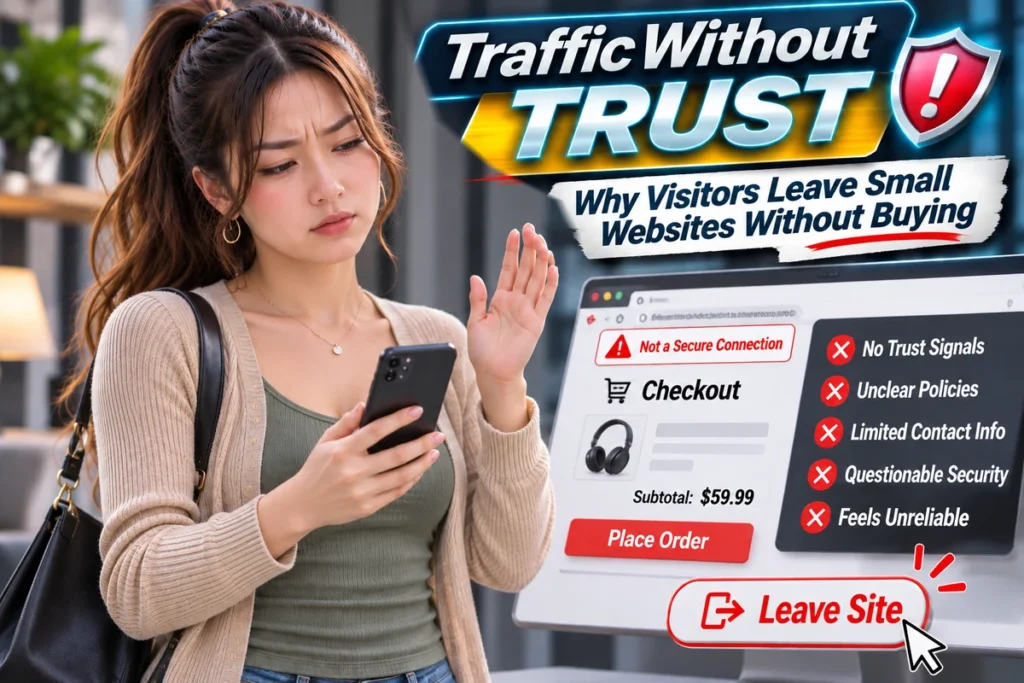
An independent business owner finally gets traffic. Search visitors are arriving. A social post sends hundreds of people to a product page. An email campaign produces clicks. Yet almost nobody buys, books, or even asks a question.
The natural response is to chase more visitors. Publish more posts. Spend more on promotion. Change the headline again. But what if the traffic is already reasonably relevant and the problem happens after someone arrives?
A stranger visiting a small website must resolve a series of unanswered questions. Is this business real? Does the product solve my problem? Does the price include everything? Who will help if something goes wrong? Is the payment process safe? Will the product arrive—or work as promised?
These are not merely design preferences. They are purchase decisions. Website trust signals are the clear, verifiable details that help a visitor evaluate credibility, risk, and suitability. They matter particularly when the seller is unfamiliar and the customer cannot rely on an established brand’s reputation.
The opportunity is not to decorate a website with trust badges. It is to identify the specific uncertainties standing between a visitor and a confident decision, and remove them honestly.
Traffic, interest and intention are different things
A pageview is not a purchase opportunity of equal value. Someone may click because a photograph is attractive, a headline is provocative, or a social post makes them curious. They may have no intention of buying. Another person arrives after comparing alternatives and needs only one unanswered detail before deciding.
Treat those visitors differently in your analysis. An informational article may be succeeding if readers find an answer and later explore a relevant service. A product page needs to make the offer understandable. A checkout page should make the transaction straightforward. Measuring every page by immediate sales produces nonsense conclusions.
The first diagnostic question is whether the page matches what brought the visitor there. If a search result promises a downloadable budgeting template and the landing page promotes a general finance newsletter instead, the visitor’s disappointment is not primarily a trust problem. It is a promise-versus-destination problem.
A visitor arriving from a highly targeted product search has different expectations than someone reading a broad educational article. Before changing the checkout, understand the entry page, referral source, search intent where available, device type, and next action. Separate low-intent traffic from plausible buyers.
Income Idea Index’s SEO for Beginners guide covers discoverability. Discoverability and conversion are separate disciplines: visibility gives people a chance to consider your offer, while clarity and trust determine whether consideration continues.
Website trust signals answer the invisible buyer questions
Imagine your website as a salesperson who never speaks unless the visitor asks exactly the right question. The customer wonders about refunds, but the answer lives in a hard-to-find policy page. They wonder who created the product, but the About page offers only slogans. They wonder what is included, but the product description lists adjectives instead of contents.
The visitor may not contact you. Many will leave rather than spend time resolving basic uncertainty. That does not necessarily mean they rejected your product on its merits. They may never have understood enough to evaluate it.
For each important page, write down what a reasonable first-time visitor needs to believe before taking the next step. They need to believe the product is relevant, the description is accurate, the price is clear, the seller can deliver, and help is available if the transaction fails.
Then inspect the page as if you know nothing about the company. Do not rely on information you remember because you built the site. Remove brand familiarity from the exercise. If a claim such as “premium quality” appears, ask what visible evidence supports it. If a button says “Get started,” ask what actually happens after clicking.
The best conversion improvements often replace ambiguous marketing language with concrete evidence, not louder persuasion.
Unexpected costs break confidence at the worst possible moment
Buyers may accept a high price if they understand it early. They are less forgiving when the total changes late in the process. The surprise makes them reassess whether the seller has been straightforward.
Baymard Institute’s 2026 cart-abandonment research distinguishes people who were merely browsing from shoppers who abandoned for other reasons. Among the latter, high extra costs such as shipping, taxes, and fees were a leading reported factor. Other reasons included delivery times, distrust of payment information handling, mandatory account creation, and complicated checkout. The study describes research respondents and reasons, not a prediction that any single website will gain a fixed conversion lift from one change.
For physical goods, disclose shipping policies, likely delivery ranges, and return costs early enough for comparison. For digital products, say whether the price is one-time or recurring, what file formats are included, whether updates are provided, and what access limitations apply. For services, distinguish an advertised starting price from the cost of a typical complete engagement.
Avoid a low headline price that depends on purchasing mandatory extras. Even if a pricing technique produces more clicks, it can create an expensive trust problem when buyers discover the real total.
A professional-looking site can still feel unsafe
Visual polish can create a positive first impression, but polish alone cannot prove legitimacy. A beautifully designed site with broken navigation, generic testimonials, unclear contact information, and vague payment instructions may feel less credible than a simple website with complete details.
Look for ordinary signals of care. Does the domain name match the business identity? Does the site use HTTPS? Are product images consistent with descriptions? Do contact channels work? Are legal and policy pages readable and relevant? Are current prices displayed clearly? Does the site identify the actual seller rather than hiding behind a mysterious brand name?
HTTPS is a baseline protection for data in transit, not proof that a merchant is honest. Likewise, a familiar payment processor may reduce friction, but a logo alone is not evidence that payments are secure. Do not add security seals or certifications you have not earned or cannot substantiate.