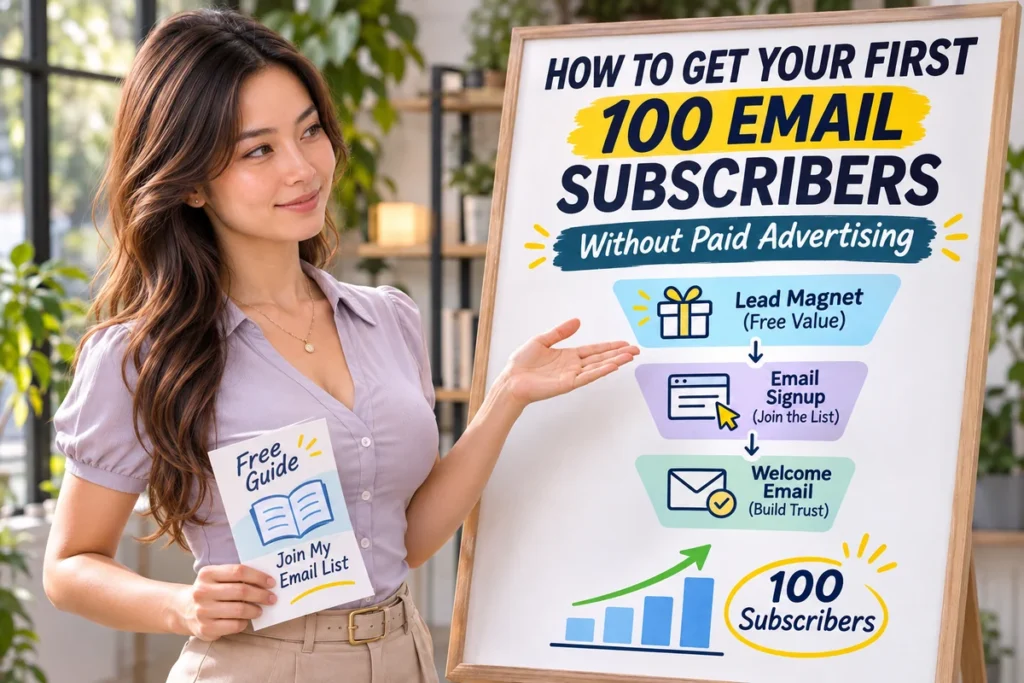
Getting your first 100 email subscribers without paid advertising is a small but meaningful test of whether people want to hear from you again. It is not about collecting a hundred random addresses or convincing visitors to join a vague “newsletter.” It is about creating a specific reason to subscribe, putting that invitation in front of relevant people, and delivering enough value that they remain interested after the welcome message.
A tiny list built through clear permission and a useful promise can be more valuable than a much larger list assembled from contests, purchased contacts, or people who do not remember signing up. This guide covers the offer, signup experience, organic distribution, measurement, and the basic email practices to establish before your list grows. No method here guarantees a particular number of signups or a deadline; the examples are plans you can adjust to your audience.
Start with one reader, one problem, and one reason to subscribe
Before selecting an email platform, describe the reader you want to serve. A financial blogger may write for people trying to organize irregular bills. A freelance designer may serve independent businesses that need clearer visuals. An educator may help beginners master one software workflow. Narrowing the subject makes the invitation easier to understand and gives you a way to evaluate whether a potential subscriber is a good fit.
Now complete this sentence: “Subscribe and I will help you ______ by sending ______.” The blank should contain a believable outcome and a recognizable format. “Get updates” gives visitors almost no information. “Receive one practical spreadsheet tip each Friday, with a short example you can copy” makes the commitment specific. If you cannot sustain a weekly schedule, promise monthly instead. An accurate promise builds trust better than aggressive frequency.
Identify what a reader will see in the first month. Draft three or four subject ideas that solve different parts of the same problem. If those topics do not come naturally, the audience definition may still be too broad. A useful newsletter starts as an editorial product, not as an empty list-building target.
Choose an email service before collecting addresses
A basic service should support signup forms or landing pages, contact management, unsubscribes, and reliable email delivery. Avoid using an ordinary personal email account as a bulk newsletter tool. Dedicated providers offer list-management features and can help you set up sender authentication, consent records, and compliant footers. Compare actual plan limits before signing up because free tiers and pricing change.
For example, Kit’s current free-plan documentation describes forms, landing pages, and broadcasts with a subscriber cap. That is one possible starting point, not an endorsement for every business. Other providers may be better if you need complex automations, ecommerce connections, different data-handling arrangements, or a particular country of operation. The best starting tool is one you can use confidently and maintain.
Before publishing a signup form, confirm the sender name, reply-to address, unsubscribe process, privacy-policy link, and how contacts will be handled. Authenticate your sending domain using the provider’s instructions. Google’s Gmail sender guidelines describe baseline authentication requirements and additional rules for high-volume senders. You do not need to become a deliverability engineer to begin, but you do need the essentials in place.
Create a signup incentive that previews your real value
A free download can help, but a lead magnet is not mandatory. The strongest incentive is directly connected to the emails you intend to send. A budgeting newsletter could offer a one-page annual-expense checklist. A freelance newsletter could offer a client brief template. A gardening newsletter could offer a planting calendar for a clearly specified region. The recipient should be able to use the resource immediately.
Resist the urge to create an enormous ebook merely to collect addresses. A two-page worksheet that solves one recurring problem is often easier to understand, create, and keep updated. Explain what the resource contains and its limitations. If your “budget template” requires paid software, tell visitors in advance. Do not present a generic checklist as proprietary research or promise results that depend on factors beyond the reader’s control.
An incentive that attracts the wrong audience can work against you. A giveaway with an expensive generic prize may produce signups from people who care about the prize rather than the newsletter. A specialized worksheet attracts fewer but more relevant readers. Since your first goal is a sustainable reader relationship, relevance matters more than raw collection speed.
Build a landing page that answers five questions
A signup page should make the decision easy. The visitor should understand who the content is for, what they will receive, why it is useful, how often email will arrive, and what happens after signup. You can place that information on a dedicated landing page or a focused signup section of an existing website. A full website redesign is not necessary for the first hundred subscribers.
Keep the main headline benefit-led. Follow it with one or two sentences that describe the format and frequency. Show a sample issue or a preview of the resource if one exists. Use a form that asks only for information you truly need; an email address may be sufficient. Additional fields add friction and may create privacy obligations. A clear button such as “Send me the checklist” is more informative than “Submit.”
Test the whole journey on a phone. Complete the form yourself with an address you control, check that the confirmation or welcome email arrives, follow the download link, and test the unsubscribe link. Try an incorrect email format and confirm that the form responds sensibly. A beautiful landing page is not useful if the integration silently fails.
Put the signup invitation where interested readers already are
People rarely subscribe just because a form exists. Connect the invitation to content that has already helped them. If someone reads a detailed article about making a monthly budget, offer a related annual-expense checklist near the relevant section and once near the conclusion. Do not interrupt the reading experience with repeated full-screen popups. The invitation should feel like an extension of the topic.
Use a sensible placement on your home page, relevant article pages, and a dedicated subscribe page. If your website has several unrelated categories, do not show the same generic promise everywhere. A reader exploring technology reviews may not want an unrelated personal-finance sequence. Start with the section of the site whose audience matches your email topic and expand when evidence supports it.