Be careful about using Waiting as an escape hatch for unlimited active commitments. If you return to every waiting project the moment its dependency clears, you may still overload your schedule. The total number of live obligations matters alongside the number you are physically working on at a given minute.
A work-in-progress limit protects finishing capacity
A WIP limit is a rule that says you will not start more than a defined amount of active work until something finishes or leaves the active queue. Its purpose is not to restrict ambition. It is to stop new commitments from continuously displacing the ones that already need completion.
For an individual managing mixed responsibilities, a reasonable experiment might be one major deliverable and one smaller active maintenance task. A consultant could choose a limit of three client deliverables in active production, with other accepted work scheduled for a future date. A household might allow one large home project to be underway while necessary repairs continue separately.
These are examples, not universal limits. Different kinds of work have different demands. A support team handling short requests needs a different rule from a writer developing a book. Your limit should reflect actual capacity and the amount of unavoidable interruption.
If a new urgent task appears while you are at the limit, make an explicit trade: finish something, pause something, or negotiate a new deadline. The key is to stop treating the addition of work as costless.
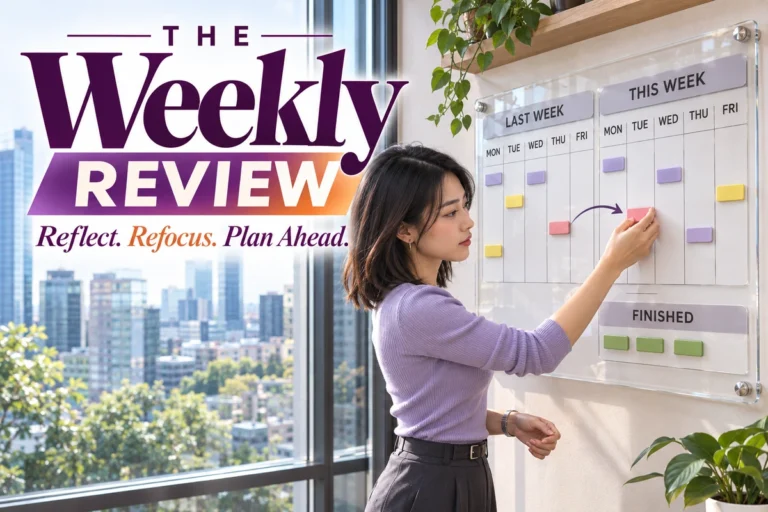
A project board can make this visible, but you do not need software. Three columns on paper can be enough. The discipline lives in the decision not to start another task simply because it is interesting or available.
Smaller deliverables make completion more realistic
“Launch my business,” “improve my website,” and “learn AI” are aspirations, not finishable work items. They are too broad to fit comfortably inside a single active slot. If you cannot define a finish line, the project can remain active indefinitely.
Instead, convert the aspiration into a deliverable with an observable result. “Publish a service page that explains the three packages and includes a working contact form” is finishable. “Complete the first lesson and pass the practice quiz” is finishable. “Review ten customer-support messages and update the confusing FAQ answers” is finishable.
The deliverable should be small enough to finish in a sensible window but large enough to provide real value. Cutting one important project into fifty meaningless checkboxes can manufacture the appearance of throughput without accomplishing anything.
An effective finish condition clarifies what counts as done. For a website page, it may include content reviewed, links tested, mobile layout checked, and the page published. For a client report, it may include required data verified, conclusions supported, and the final file delivered.
This is also an antidote to endless polishing. Once a result meets the agreed conditions, you can release it and move on. New improvements become separate decisions rather than reasons the original item can never close.
A simple example: three projects over six weeks
Consider a solo creator with three projects: a small paid guide, a service landing page, and a monthly newsletter. Each project needs twelve focused hours to reach a useful first release. The creator has six focused hours a week available.
The total work is thirty-six hours, so the theoretical minimum is six weeks if nothing changes and no rework occurs. Starting all three at once does not create extra available hours. It can, however, delay the first completed result.
In a fully sequential schedule, the creator spends Weeks 1–2 finishing the guide, Weeks 3–4 releasing the service page, and Weeks 5–6 preparing the newsletter. One result becomes available after two weeks, another after four, and all three by six.
In a perfectly divided schedule with no switching costs, the creator spends two hours on each project every week and finishes all three at the end of Week 6. The total hours are identical, but the first usable outcome arrives four weeks later. In the real world, switching and revisiting work may extend the second schedule further.
The sequential approach is not always best. Some tasks need feedback or parallel waiting time, and the guide might require customer review while the landing page can proceed. The lesson is that parallel work should be a deliberate choice based on dependencies, not the default response to having several good ideas.
Waiting time can justify limited parallel work
A blanket “finish one thing before touching another” rule is too rigid for many real businesses. Suppose a developer submits an app for a review process that takes several days. That waiting period is a legitimate opportunity to work on a different deliverable. The first item is blocked, not actively consuming the same hands-on capacity.
The important distinction is between productive parallelism and unplanned fragmentation. Productive parallelism uses an otherwise idle resource or waiting period. Fragmentation repeatedly interrupts work that could have continued, often because the next task feels more exciting or immediately rewarding.
Before opening another active project, ask what exactly is blocking the current one. If it genuinely requires someone else’s action, put it in Waiting with an owner and an expected follow-up point. If nothing blocks it except discomfort with a difficult section, switching may simply postpone the hardest work.
A good WIP policy allows exceptions for genuine emergencies and unavoidable dependencies, while keeping the exceptions visible. An invisible exception soon becomes the normal workflow, and the limit stops providing any benefit.
Project age reveals problems that a to-do list hides
A task list tells you what exists. Work item age tells you how long commitments have been waiting for completion. That distinction can be uncomfortable, but it is useful.
Imagine one item has been active for two days, while another has been open for eleven weeks. The older item may have unclear scope, missing resources, repeated rework, or low priority. If it still matters, it deserves a concrete decision. If it no longer matters, keeping it in Active creates artificial pressure.
Record the date meaningful work began. Review open items at least occasionally and identify those that are unusually old compared with similar work. The appropriate threshold depends on project size; a research report and a support reply cannot share the same expectation.
Do not use age as a reason to rush quality-critical work. A difficult problem may legitimately need longer. Instead, use age as a prompt to investigate: What is preventing completion? Is the scope still valid? Does the next action belong to you? Does the work need a smaller milestone?
Sometimes the best decision is to stop an old project explicitly. That is not the same as abandoning work through neglect. It is a resource decision based on current priorities and information.