Unlike a credit freeze, a fraud alert does not block access to your credit report.
For an initial fraud alert, you generally only need to contact one of the three major credit bureaus, which then notifies the others.
Which option makes sense depends on your circumstances.
If highly sensitive identity information has been exposed, a credit freeze generally provides the stronger barrier against unauthorized new credit.
8. Watch Your Email and Phone for Targeted Phishing
This is where the combination of exposed information matters.
If attackers know your email address and phone number, they can contact you.
If they also know your name, birth date, address, and financial provider, they can personalize that contact.
Expect scams to potentially reference:
- the Revolut breach;
- a suspicious transfer;
- a security review;
- government verification;
- a frozen account;
- a refund;
- identity-document replacement;
- or “urgent” fraud protection.
Do not allow urgency to override verification.
Go directly to the service involved rather than responding through the message.
9. Check Your Other Important Accounts
A data breach at one company can sometimes expose weaknesses elsewhere—not because the other companies were breached, but because customers reused passwords, recovery methods, or security habits.
Pay special attention to:
- your primary email account;
- banking accounts;
- payment apps;
- cryptocurrency accounts;
- password manager;
- phone carrier account.
Your email account is especially important because password-reset links for many other services are sent there.
If you have never mapped out what happens when you lose access to a critical digital account, the Income Idea Index digital emergency plan explains how to strengthen recovery methods, authentication, backup codes, and other account protections before you need them.
10. Save the Official Breach Notice
If Revolut sent you a notification confirming that your information was involved, keep it.
You may want a record of:
- the date you received it;
- what information Revolut says was exposed;
- any reference number;
- any protection services offered;
- and any instructions Revolut provides.
This can be useful if suspicious activity appears later and you need to establish that your information was involved in a documented incident.
Do not rely on remembering the details months from now.
Save the original notice somewhere secure.
Should You Close Your Revolut Account?
The breach alone does not necessarily mean you need to close your account.
Revolut says its systems and customer funds were not compromised.
Closing an account also cannot make already disclosed personal information secret again.
If your passport copy was exposed, closing Revolut today does not retrieve that copy.
Your decision should therefore depend on broader factors, including:
- whether you were actually affected;
- how sensitive the exposed information was;
- how Revolut responds to the incident;
- whether you continue to trust the company’s security processes;
- and whether you experience suspicious activity.
Security decisions are usually more useful when they are based on actual risk rather than frustration immediately after a headline.
This Was a Process Failure, Not Just a Technology Problem
One of the biggest lessons from the Revolut incident is that cybersecurity failures do not always begin with malicious software.
An attacker does not necessarily need to discover a sophisticated technical vulnerability if they can exploit a trusted process instead.
Organizations routinely receive legitimate requests for customer data from courts, regulators, law enforcement, and other government bodies.
Those requests need verification.
If an attacker can convincingly imitate that process, the company’s own employees or systems may release information that would have been difficult to steal directly.
This is a form of social engineering at an institutional level.
The attacker targets trust.
What Revolut Has Done So Far
Revolut says it blocked the email address used in the fraudulent requests after discovering the incident.
The company says it also alerted:
- the relevant government agency;
- law enforcement;
- data-protection authorities;
- financial regulators.
Affected customers were contacted directly, according to Revolut.
The company has not publicly disclosed the exact number of affected customers or identified the government agency whose domain was used.
Those are two of the biggest details still missing.
Future investigations may reveal more about how the unauthorized party gained access to the legitimate government email domain and how the fraudulent requests passed verification.
What Should We Watch Next?
Several developments could significantly change what we know about the breach.
Watch for:
- A confirmed victim count — Revolut currently says the number is limited but has not provided a figure.
- More detail about the exposed data — Different customers may have had different information disclosed.
- The identity of the government agency involved — Revolut has not named it.
- An explanation of how the legitimate email domain was abused — This could reveal whether another organization suffered a compromise.
- Regulatory findings — Data-protection and financial regulators may examine whether Revolut’s verification procedures were sufficient.
- Evidence of resulting fraud — The risk becomes more serious if exposed information is shown to be actively used against customers.
- Additional affected markets — Revolut has not publicly disclosed whether the incident was concentrated in one region.
Those facts will determine whether this remains a limited disclosure incident or develops into a larger security story.
The Bottom Line
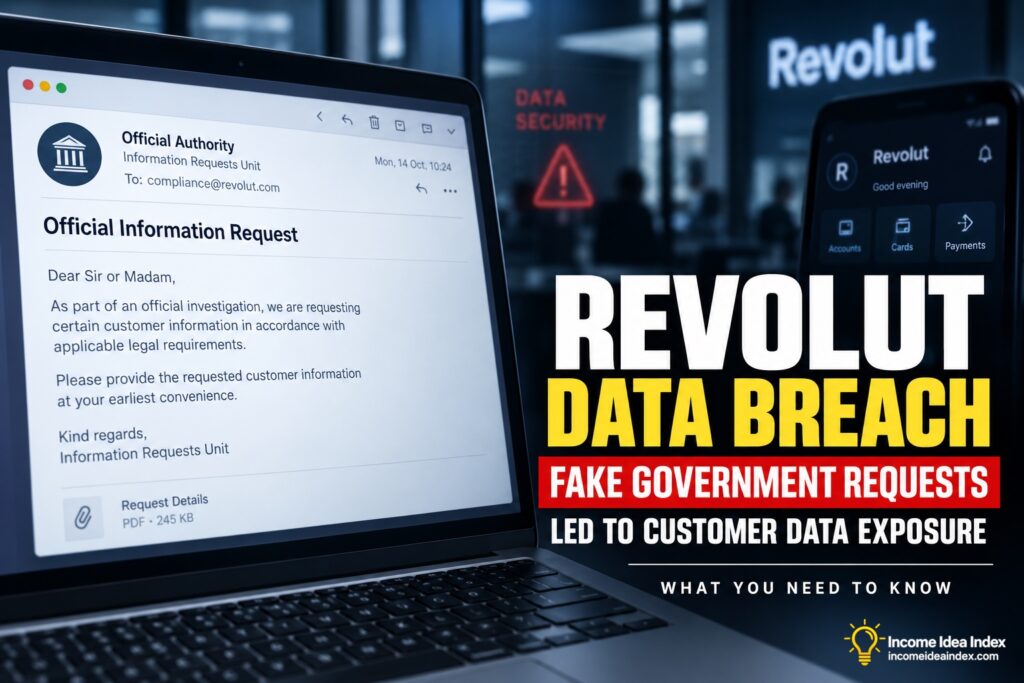
The Revolut data breach is unusual because attackers apparently did not need to break directly into Revolut’s systems.
They exploited trust.
An unauthorized party used a legitimate government-agency email domain to make fraudulent requests for customer information, and sensitive data was disclosed in response.
Revolut says its systems and customer funds were unaffected.
But affected information may include names, birth dates, addresses, phone numbers, passports, driver’s licenses, verification selfies, account statements, and transaction histories.
That makes the biggest immediate concern less about money already disappearing from accounts and more about what someone could attempt next using that information.
If Revolut notified you that your information was affected, verify the notice through the app, review your transactions, treat unexpected calls and messages with extreme caution, and consider additional identity protections based on the specific information that was exposed.
And remember the most important rule after any breach:
Someone knowing private information about you does not prove they are someone you should trust.