

What Should Revolut Customers Do Now?
You do not need to panic or immediately move all your money out of Revolut.
The most useful response is methodical.
Start by determining whether Revolut actually notified you that your information was affected.
If it did, read the notice carefully and identify the categories of information involved.
Then work through the following steps.
1. Verify the Breach Notification Inside Revolut
One of the biggest risks after a public breach is the flood of fake breach notifications that can follow.
Do not trust a message solely because it says it came from Revolut.
Avoid clicking unexpected links asking you to:
- confirm your account;
- enter your password;
- verify a transaction;
- provide an authentication code;
- upload identification again;
- or move your money to a “safe” account.
Instead, open the Revolut app independently.
Revolut says customers can contact support through its secure in-app chat.
Its official fraud-support guidance also explains how customers can report suspicious activity.
Using the app directly removes the need to trust the link inside an unexpected email or text.
2. Review Your Revolut Transactions
Look through recent transactions for anything you do not recognize.
Do not only check large purchases.
Fraudsters sometimes begin with smaller activity before attempting something larger.
Review:
- card purchases;
- bank transfers;
- cash withdrawals;
- cryptocurrency activity, if applicable;
- newly added recipients or beneficiaries;
- unfamiliar account changes.
If you see something suspicious, report it directly through Revolut.
Revolut advises customers who believe they have been victims of fraud to act quickly.
3. Be Extremely Suspicious of Calls Claiming to Be Revolut
This may be one of the most important precautions after this particular breach.
An attacker may have enough personal information to make a call sound convincing.
Do not assume someone is legitimate because they know private details about you.
A scammer knowing your date of birth does not prove they work for Revolut.
Knowing your address does not prove it.
Knowing that you recently made a particular type of transaction may not prove it either.
If a caller says there is an urgent problem with your account, end the call and contact Revolut through the app yourself.
Never provide a one-time authentication code to someone who calls you.
And be especially suspicious if anyone tells you to transfer money to protect it.
4. Change Your Revolut Passcode If You Suspect Account Access
Revolut says that customers who believe another person may have accessed their account should change their app passcode.
This does not mean every Revolut customer affected by the information disclosure must automatically change every credential they have.
The breach has not been reported as a theft of customer passwords.
But if you notice unusual account behavior, receive suspicious authentication prompts, or have another reason to think someone attempted to access the account, changing the passcode is a sensible defensive step.
If you have reused the same password or passcode elsewhere, change those reused credentials too.
Credential reuse can turn one account problem into several.
5. Freeze Your Card If Card Information Appears Compromised
Do not freeze every card solely because the Revolut data breach occurred.
Revolut has not publicly said that every affected customer’s card credentials were exposed.
But if you see suspicious card transactions or have another reason to believe your card information has been compromised, Revolut allows customers to freeze a card from within the app.
The company’s fraud guidance recommends freezing the relevant card when card details may be compromised.
The key is to respond to the information and activity associated with your account, not panic because of a headline.
6. Consider a Credit Freeze If Identity Documents Were Exposed
For U.S. consumers whose driver’s license, passport, or other significant identity information was exposed, a credit freeze may be worth considering.
The Federal Trade Commission explains that a credit freeze restricts access to your credit file, making it much harder for an identity thief to open a new credit account in your name.
Credit freezes are:
- free to place;
- free to lift;
- available to anyone;
- and do not affect your credit score.
To fully freeze your credit, you need to contact all three major U.S. credit bureaus: Equifax, Experian, and TransUnion.
A credit freeze does not prevent every form of fraud.
For example, it cannot stop someone from trying to impersonate you in a phishing attack.
But it adds an important barrier against new-account fraud.
7. A Fraud Alert Is Another Option
If you do not want to freeze your credit, you can also consider a fraud alert.
The FTC says an initial fraud alert tells businesses to take additional steps to verify your identity before opening new credit in your name.
Unlike a credit freeze, a fraud alert does not block access to your credit report.
For an initial fraud alert, you generally only need to contact one of the three major credit bureaus, which then notifies the others.
Which option makes sense depends on your circumstances.
If highly sensitive identity information has been exposed, a credit freeze generally provides the stronger barrier against unauthorized new credit.
8. Watch Your Email and Phone for Targeted Phishing
This is where the combination of exposed information matters.
If attackers know your email address and phone number, they can contact you.
If they also know your name, birth date, address, and financial provider, they can personalize that contact.
Expect scams to potentially reference:
- the Revolut breach;
- a suspicious transfer;
- a security review;
- government verification;
- a frozen account;
- a refund;
- identity-document replacement;
- or “urgent” fraud protection.
Do not allow urgency to override verification.
Go directly to the service involved rather than responding through the message.
9. Check Your Other Important Accounts
A data breach at one company can sometimes expose weaknesses elsewhere—not because the other companies were breached, but because customers reused passwords, recovery methods, or security habits.
Pay special attention to:
- your primary email account;
- banking accounts;
- payment apps;
- cryptocurrency accounts;
- password manager;
- phone carrier account.
Your email account is especially important because password-reset links for many other services are sent there.
If you have never mapped out what happens when you lose access to a critical digital account, the Income Idea Index digital emergency plan explains how to strengthen recovery methods, authentication, backup codes, and other account protections before you need them.
10. Save the Official Breach Notice
If Revolut sent you a notification confirming that your information was involved, keep it.
You may want a record of:
- the date you received it;
- what information Revolut says was exposed;
- any reference number;
- any protection services offered;
- and any instructions Revolut provides.
This can be useful if suspicious activity appears later and you need to establish that your information was involved in a documented incident.
Do not rely on remembering the details months from now.
Save the original notice somewhere secure.
Should You Close Your Revolut Account?
The breach alone does not necessarily mean you need to close your account.
Revolut says its systems and customer funds were not compromised.
Closing an account also cannot make already disclosed personal information secret again.
If your passport copy was exposed, closing Revolut today does not retrieve that copy.
Your decision should therefore depend on broader factors, including:
- whether you were actually affected;
- how sensitive the exposed information was;
- how Revolut responds to the incident;
- whether you continue to trust the company’s security processes;
- and whether you experience suspicious activity.
Security decisions are usually more useful when they are based on actual risk rather than frustration immediately after a headline.
This Was a Process Failure, Not Just a Technology Problem
One of the biggest lessons from the Revolut incident is that cybersecurity failures do not always begin with malicious software.
An attacker does not necessarily need to discover a sophisticated technical vulnerability if they can exploit a trusted process instead.
Organizations routinely receive legitimate requests for customer data from courts, regulators, law enforcement, and other government bodies.
Those requests need verification.
If an attacker can convincingly imitate that process, the company’s own employees or systems may release information that would have been difficult to steal directly.
This is a form of social engineering at an institutional level.
The attacker targets trust.
What Revolut Has Done So Far
Revolut says it blocked the email address used in the fraudulent requests after discovering the incident.
The company says it also alerted:
- the relevant government agency;
- law enforcement;
- data-protection authorities;
- financial regulators.
Affected customers were contacted directly, according to Revolut.
The company has not publicly disclosed the exact number of affected customers or identified the government agency whose domain was used.
Those are two of the biggest details still missing.
Future investigations may reveal more about how the unauthorized party gained access to the legitimate government email domain and how the fraudulent requests passed verification.
What Should We Watch Next?
Several developments could significantly change what we know about the breach.
Watch for:
- A confirmed victim count — Revolut currently says the number is limited but has not provided a figure.
- More detail about the exposed data — Different customers may have had different information disclosed.
- The identity of the government agency involved — Revolut has not named it.
- An explanation of how the legitimate email domain was abused — This could reveal whether another organization suffered a compromise.
- Regulatory findings — Data-protection and financial regulators may examine whether Revolut’s verification procedures were sufficient.
- Evidence of resulting fraud — The risk becomes more serious if exposed information is shown to be actively used against customers.
- Additional affected markets — Revolut has not publicly disclosed whether the incident was concentrated in one region.
Those facts will determine whether this remains a limited disclosure incident or develops into a larger security story.
The Bottom Line
The Revolut data breach is unusual because attackers apparently did not need to break directly into Revolut’s systems.
They exploited trust.
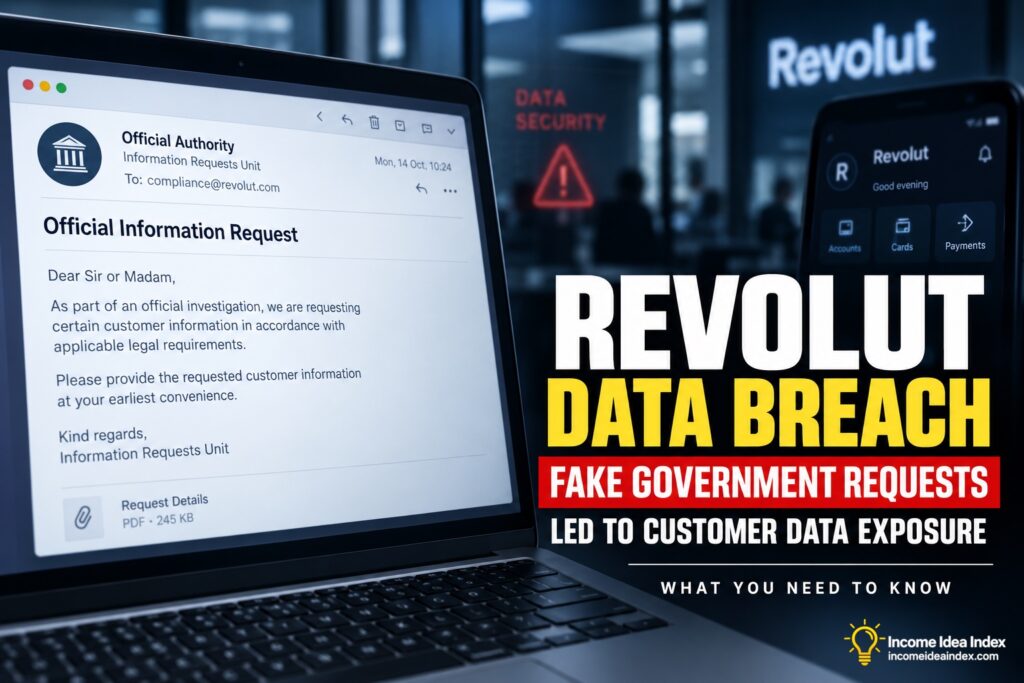
An unauthorized party used a legitimate government-agency email domain to make fraudulent requests for customer information, and sensitive data was disclosed in response.
Revolut says its systems and customer funds were unaffected.
But affected information may include names, birth dates, addresses, phone numbers, passports, driver’s licenses, verification selfies, account statements, and transaction histories.
That makes the biggest immediate concern less about money already disappearing from accounts and more about what someone could attempt next using that information.
If Revolut notified you that your information was affected, verify the notice through the app, review your transactions, treat unexpected calls and messages with extreme caution, and consider additional identity protections based on the specific information that was exposed.
And remember the most important rule after any breach:
Someone knowing private information about you does not prove they are someone you should trust.