

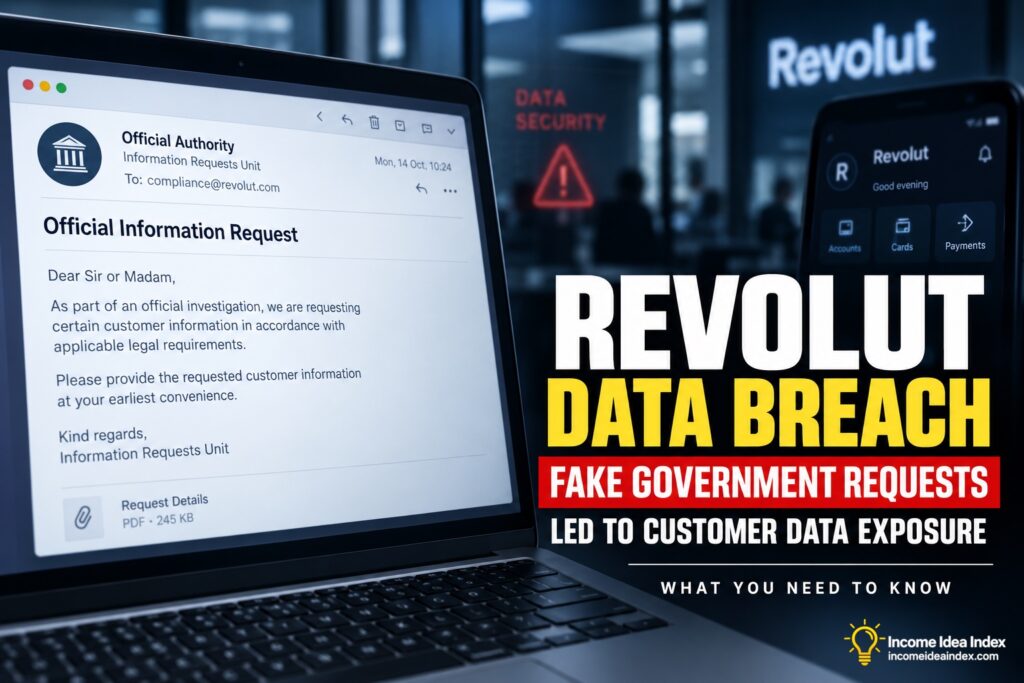
Revolut has confirmed a customer data breach with an unusual twist.
Attackers did not need to break directly into Revolut’s systems.
Instead, an unauthorized party reportedly used an email address connected to a legitimate government-agency domain to submit fraudulent requests for customer information.
Revolut responded to those requests and disclosed sensitive information belonging to some customers.
The Revolut data breach may have exposed contact information, dates of birth, identity documents, and—in some cases—financial account information and transaction histories.
Revolut says its systems were not compromised and customer funds remain unaffected.
That is reassuring.
But it does not make the exposed personal information harmless.
Data such as identity documents, addresses, account details, and transaction history can potentially give scammers enough information to create much more convincing impersonation attempts.
What Happened in the Revolut Data Breach?
The incident was essentially an impersonation attack.
According to Reuters, Revolut received fraudulent information requests that appeared to come from a legitimate government-agency email domain.
That made the requests look authentic.
Revolut disclosed customer information in response.
The company later determined that the requests came from an unauthorized third party.
Revolut said it then blocked the email address and notified the relevant government agency, law enforcement, data-protection authorities, and financial regulators.
This distinction is important.
There is currently no indication that attackers broke into Revolut’s internal systems and downloaded its entire customer database.
Instead, the weakness appears to have involved the process used to determine whether requests for customer information were legitimate.
That makes this a very different kind of security incident from a traditional database hack.
What Information Was Exposed?
The exact information varied by customer.
TechCrunch reported that affected information included identity and contact details such as:
- dates of birth;
- postal addresses;
- email addresses;
- phone numbers;
- passports;
- driver’s licenses.
Revolut’s notification to affected customers also indicated that some disclosures may have included:
- verification selfies;
- account statements;
- transaction histories.
Not every affected customer necessarily had all of those categories exposed.
Revolut has not publicly disclosed a complete breakdown showing how many customers had each type of information released.
That matters because the potential risk depends heavily on exactly what was disclosed.
A leaked email address creates a different risk from a leaked passport.
A transaction history creates different concerns from a phone number.
If Revolut notified you that your information was affected, the most useful first step is therefore to determine which information the company says was involved in your case.
How Many Revolut Customers Were Affected?
We do not know.
Revolut has described the number as limited or very limited, but it has not publicly disclosed an exact figure.
The company has also not publicly identified whether affected customers were concentrated in one country or spread across multiple markets.
That uncertainty is worth keeping in mind.
This is not currently being described as a breach affecting Revolut’s entire customer base.
But without a confirmed number, it is also difficult to independently measure the full scale.
If you are a Revolut customer and have not received a breach notification, that does not automatically mean you need to assume your information was exposed.
Revolut says affected customers were contacted directly.
Be cautious, however, because a widely reported breach can create a second problem:
scammers pretending to be Revolut contacting people about the breach.
Revolut Says Customer Funds Were Not Compromised
There is an important difference between personal information being disclosed and money being stolen from accounts.
Revolut says:
- its systems were not compromised;
- customer funds were unaffected.
That means this incident should not be interpreted as evidence that attackers gained direct control of Revolut accounts or drained customer balances.
There is also no confirmed report from Revolut that passwords or account login credentials were obtained through these fraudulent requests.
But customers should still take the breach seriously.
Personal information can be valuable even when it cannot directly move money.
Someone who knows your name, date of birth, address, phone number, banking provider, and perhaps details from a recent transaction can sound much more credible when pretending to be a bank employee.
That creates the possibility of follow-up fraud.
Why This Type of Breach Can Lead to Convincing Scams
Generic phishing emails are often easy to recognize.
They may use the wrong name.
They may not know which bank you use.
They may contain vague statements about a mysterious payment or account problem.
Stolen customer data can change that.
Imagine receiving a call from someone who knows:
- your full name;
- your address;
- your birth date;
- that you use Revolut;
- and perhaps details connected to your account activity.
The caller then claims:
“We’re calling from Revolut’s fraud department about the recent data incident.”
That message can feel much more legitimate because some of the information is correct.
The scammer could then try to obtain the one thing they still need—a password, authentication code, card detail, transfer, or approval inside the app.
The exposed data does not automatically give someone access to your account.
It can potentially help them convince you to give them access.
That is why heightened skepticism after a breach is so important.
How Is This Different From the IDScan Breach?
Income Idea Index recently covered the IDScan data breach involving approximately 153 million driver’s-license scans.
Both incidents involve sensitive identity information.
But they appear to have happened in very different ways.
The IDScan incident involved a large collection of identity data being stolen from company infrastructure.
The Revolut incident involved customer information being disclosed in response to fraudulent requests that appeared to come through a legitimate government channel.
That difference highlights an important point about cybersecurity:
Companies can have technically secure computer systems and still expose data if someone successfully manipulates the human or administrative processes surrounding those systems.
Security is not just about keeping hackers out of servers.
It is also about verifying who is asking for information before releasing it.
Why a Legitimate Government Email Domain Matters
Government agencies, law enforcement organizations, banks, technology companies, and other institutions routinely communicate with one another through official channels.
An email from a legitimate agency domain would normally carry much more credibility than a message from a random Gmail account.
That is precisely why this incident stands out.
The reported requests were not simply crude emails pretending to be government requests.
They came through an email domain associated with a legitimate government agency.
Revolut has not publicly identified the agency involved.
It also has not publicly explained exactly how the unauthorized party obtained or used access to that legitimate domain.
That leaves an important unanswered question:
How did someone without authorization gain the ability to make requests that looked authentic enough for customer information to be released?
Investigators and regulators may eventually provide more detail.
Could Your Identity Be Stolen?
A breach does not mean identity theft will definitely occur.
But identity documents deserve particular attention.
A driver’s license or passport contains information designed to prove who you are.
Copies of those documents can potentially be combined with other leaked information and used in attempts to:
- impersonate you;
- bypass identity checks;
- create fraudulent accounts;
- conduct financial scams;
- convince customer-service representatives that the attacker is you.
That does not mean every stolen identity document will successfully be used.
Modern financial companies often require multiple verification steps.
But when identity documents have been exposed, it is reasonable to be more cautious than you would be after an email-address leak alone.