
What Does This Mean for Digital Sellers?
The immediate benefit may be convenience for the customer, rather than direct additional revenue for the original seller.
That distinction matters.
Etsy’s current help documentation explains that the physical product is a separate order from Ventur Editions. It does not state that the creator of the original digital file receives a commission, royalty, or percentage of that second purchase.
Sellers therefore should not assume that a $5 digital download suddenly becomes a $5 sale plus additional print-on-demand income.
Unless Etsy introduces another compensation model or provides additional information, the safer way to look at the feature is this:
Your digital product may become easier for customers to use in physical form.
That still has potential value.
A buyer who likes a piece of printable artwork but does not want to deal with printing it may be more comfortable buying if there is an easy physical-print option afterward.
And making digital products more useful can potentially make the overall category more attractive.
This Could Make Print Quality More Important
There is another implication for sellers.
If customers can easily turn digital artwork into larger physical items, the quality of the original file matters even more.
A design that looks acceptable on a phone screen may not look good as a poster, canvas, tapestry, or other large printed product.
Digital-product sellers should already be paying attention to:
- Image resolution
- Aspect ratios
- Print dimensions
- File formats
- Cropping
- Typography
- Margins
- Image artifacts
- Overall print quality
The new Etsy test gives sellers another reason to take those details seriously.
If you are building digital products, our guide to digital products you can create once and sell repeatedly covers printables, templates, guides, spreadsheets, workbooks, and other product types that can be sold repeatedly without traditional inventory.
Should Sellers Change Their Products for This?
Probably not yet.
This is still a test.
There is no reason to rebuild an entire Etsy shop around a feature that may change, expand, or disappear as Etsy evaluates how buyers and sellers respond.
Instead, sellers with eligible visual products can pay attention to what happens.
Look at questions such as:
- Does Etsy expand the test to more sellers?
- Does Etsy add additional printing partners?
- Do more product types become available?
- Does Etsy eventually provide creators with a financial benefit from the physical transaction?
- Does the option make certain types of digital products more attractive to buyers?
- Does Etsy eventually allow sellers more control over which individual listings participate?
Those developments would make the feature much more significant.
For now, it is better viewed as an experiment worth watching rather than a completely new Etsy business model.
Sellers Who Already Use Print-on-Demand Are Different
Etsy specifically says that a digital listing may not qualify when the seller already offers a physical version of the design or uses their own print-on-demand integration.
That makes sense.
Some Etsy sellers already operate both sides of the business.
They may sell a downloadable version of an artwork for one price while also selling posters, mugs, shirts, or other physical versions through their own production partner.
Those sellers control the physical listing and receive the revenue associated with it.
Etsy’s new test serves a different situation: a creator who sells the digital file but does not already operate the physical-product side.
For a seller who wants direct control over pricing, branding, profit margins, product selection, and customer experience, running their own physical or print-on-demand listings remains a different business model.
For someone who only wants to create and sell digital products, Etsy’s test adds physical convenience without requiring them to become a fulfillment business.
Digital Products Still Have Their Original Advantage
The larger opportunity behind digital products has not changed.
A digital product can be created once and sold repeatedly without producing another physical unit for every customer.
That is why downloadable templates, planners, artwork, worksheets, guides, and other files remain attractive to people looking for scalable online income ideas.
There is still work involved.
You need a product people actually want.
You need good listings.
You need competitive research.
You need useful designs.
You need to understand the customer.
And you need a way for people to discover what you created.
But unlike a traditional physical product, another digital sale generally does not require another manufacturing cycle.
That distinction is one reason we include selling digital products among our realistic ways to make money online.
Etsy’s experiment does not replace that advantage.
Instead, it may give buyers another way to use the digital products they already purchase.
Should You Opt Out?
There is no universal answer.
If your eligible digital products are designed specifically for personal printing and you are comfortable with buyers using Etsy’s third-party print option, leaving the feature enabled may provide additional convenience.
On the other hand, a seller may prefer to opt out if they want tighter control over how their designs become physical products.
A seller might also opt out if they plan to launch their own physical versions later and want to control the product selection, pricing, presentation, fulfillment partner, or customer experience.
The important thing is to understand that Etsy says eligible sellers may be included automatically.
So if you sell digital products on Etsy, this is worth checking rather than assuming nothing has changed.
The Bottom Line
Etsy is experimenting with something that could blur the traditional line between digital downloads and physical merchandise.
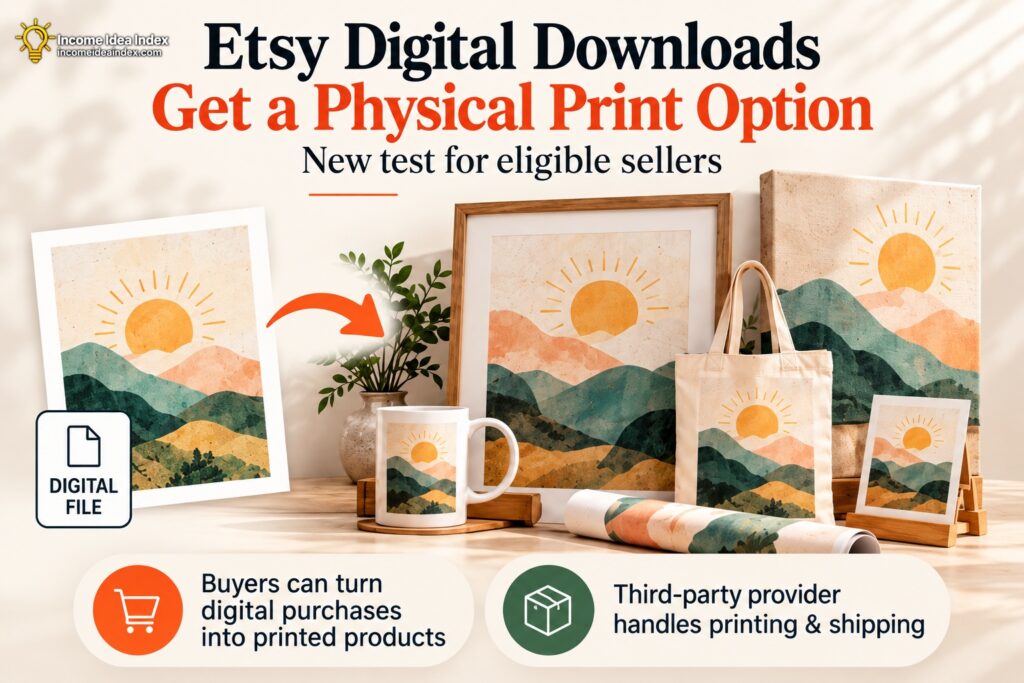
A customer may be able to buy a digital design and then quickly convert that purchase into a physical poster, canvas, mug, tote bag, sweatshirt, or another printed product without requiring the original creator to handle fulfillment.
For digital sellers, that could make their products easier for buyers to use.
But sellers should understand exactly what the test is—and what it is not.
The physical item is a separate transaction handled by Ventur Editions. Etsy’s current documentation does not say the original digital seller receives additional revenue from that transaction.
So this is not yet an automatic print-on-demand income stream for digital sellers.
It is a new layer of convenience built around digital purchases.
And if Etsy expands the program, changes its economics, or gives creators a direct share of physical-product sales, this experiment could become much more important.
For now, digital sellers should know whether their shop is participating, make sure eligible files are genuinely print-ready, and watch where Etsy takes the test next.