

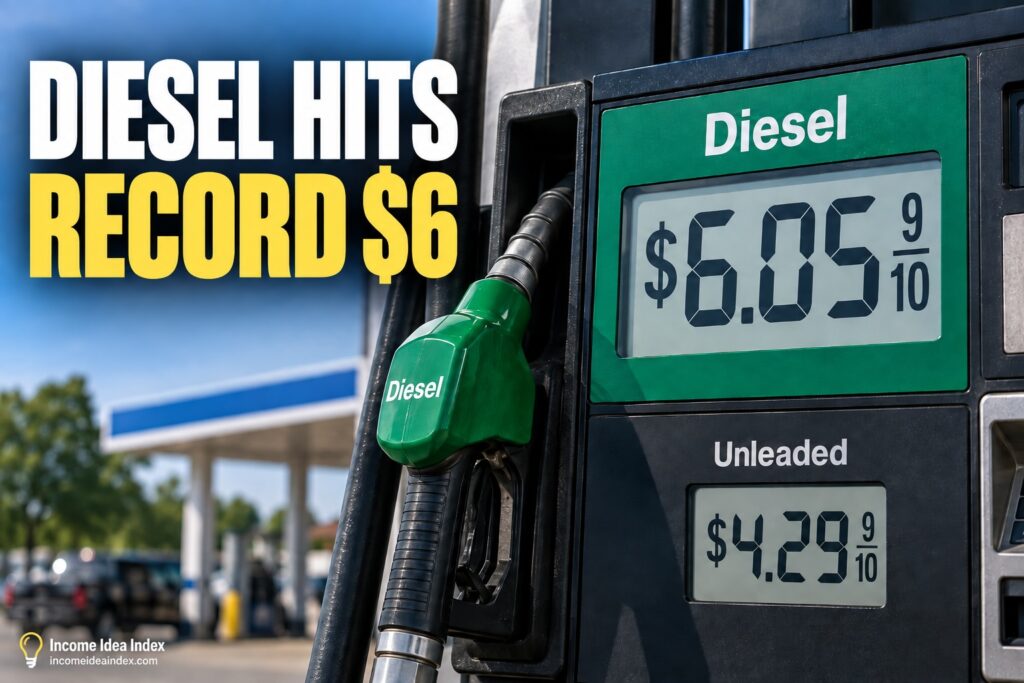
Why $6 Diesel Matters Even If Your Car Uses Gasoline
If you own a gasoline vehicle, you might look at the diesel number and think:
“That doesn’t affect me.”
Not directly at the pump.
But diesel is embedded in many of the things you buy.
Think about the journey of a normal grocery item.
A piece of produce may be harvested using diesel-powered farm equipment.
It may travel from the farm to a processing or distribution facility by truck.
It may move again to a regional warehouse.
Then another truck brings it to your local grocery store.
One product can accumulate transportation costs several times before you buy it.
The same basic principle applies to many other physical goods.
That is why a major diesel increase can become an economy-wide cost rather than simply a transportation expense for people who own diesel vehicles.
Groceries May Be One of the First Places Consumers Notice Pressure
Food is especially exposed to transportation costs.
Farms use diesel-powered tractors, harvesters, irrigation equipment, generators, and trucks.
Food then moves through processors, warehouses, refrigerated transportation networks, and grocery distribution systems.
Fresh products can be particularly sensitive because they have to move regularly and often cannot simply sit in storage while businesses wait for fuel prices to fall.
That does not mean a 60% increase in diesel automatically creates a 60% increase in grocery prices.
Transportation is only one part of the total cost of food.
Retailers, distributors, farmers, and trucking companies may also absorb some increases temporarily rather than passing them directly to customers.
But if high fuel costs last long enough, businesses eventually have to decide how much of that additional expense they can continue absorbing.
Consumers could then see the effect gradually rather than through one sudden price increase.
Shipping and Deliveries Can Become More Expensive
Online shopping has made transportation costs more visible.
Every package requires movement through a logistics network.
That network may include trucks traveling between warehouses, delivery hubs, airports, sorting facilities, and your neighborhood.
When fuel becomes significantly more expensive, shipping companies may use fuel surcharges or adjust other rates to compensate.
Businesses that ship their own products face the same problem.
A small online seller that once spent $500 per month moving inventory and fulfilling orders might suddenly find transportation eating much further into its margins.
It then has three basic choices:
- Absorb the higher expense.
- Raise prices.
- Charge customers more for delivery or shipping.
Often, the final answer is some combination of all three.
Small Businesses Can Feel the Increase Quickly
Large companies may negotiate long-term transportation contracts and have more room to absorb temporary cost spikes.
A small business may have much less flexibility.
Consider:
- Landscapers
- Contractors
- Mobile service businesses
- Delivery companies
- Farmers
- Food vendors
- Moving companies
- Independent truckers
- Construction businesses
- Local retailers receiving frequent shipments
For these businesses, fuel is not necessarily a small background expense.
It can be part of the cost of performing the work itself.
A contractor traveling between jobs cannot simply stop driving.
A delivery company cannot eliminate deliveries.
A farmer cannot harvest crops without operating equipment.
That creates a difficult problem when prices rise rapidly.
Businesses may initially accept smaller profit margins, but eventually some will need to adjust pricing.
Gig Drivers Have an Extra Reason to Watch Their Costs
Drivers working for delivery and gig platforms should pay close attention to rising vehicle costs even when they use gasoline rather than diesel.
Diesel can indirectly contribute to higher prices throughout the economy, while gasoline itself is also considerably more expensive than it was a year ago.
That makes knowing your actual driving costs increasingly important.
If you’re driving for Uber, Lyft, DoorDash, Instacart, Amazon Flex, or another platform, don’t judge a job only by the payment shown in the app.
Consider:
- Fuel
- Vehicle wear
- Maintenance
- Insurance
- Unpaid driving time
- Mileage between jobs
And keep accurate records.
Income Idea Index has a free gig-worker mileage tracker and guide that can help you record qualifying business mileage throughout the year.
Higher fuel prices make understanding your real net earnings even more important.
Could Record Diesel Prices Push Inflation Higher?
They can add inflationary pressure.
The latest Consumer Price Index report from the Bureau of Labor Statistics showed consumer prices rising 3.4% over the 12 months ending in August 2026.
Energy prices were up 16.3% over that period.
Gasoline alone was up 27.4% from a year earlier.
Those figures were measured before diesel reached its new $6 record.
Again, that doesn’t mean higher diesel will immediately appear in every category of the CPI.
Price changes work through the economy at different speeds.
Some businesses have fixed contracts.
Some have fuel hedges.
Some absorb temporary increases.
Some products require far more transportation than others.
But if energy and transportation costs remain elevated for months rather than days, the pressure becomes harder to contain.
Higher Diesel Can Affect More Than Product Prices
There is another layer to the story.
Persistent energy inflation can complicate decisions about interest rates.
Central banks pay close attention to whether temporary price increases begin spreading through the broader economy.
A brief fuel spike may fade.
A long-lasting energy shock that affects transportation, goods, services, wages, and inflation expectations is a different problem.
That is one reason sustained high oil and diesel prices can matter even to someone who rarely drives.
They can become part of the larger economic environment affecting borrowing costs, business decisions, consumer confidence, and household budgets.