

What Can Consumers Do About Higher Diesel Prices?
You cannot control global oil markets.
You cannot reopen a shipping route.
You cannot increase refinery capacity.
So the useful question is not:
“How do I stop diesel prices from rising?”
It is:
“What can I control if higher transportation costs begin affecting my budget?”
1. Watch the Categories Most Likely to Move
Pay attention to:
- Groceries
- Delivery fees
- Shipping charges
- Gasoline
- Airline fares
- Services involving significant driving
- Products that travel long distances
You do not need to track every price in your life.
The goal is simply to notice whether several transportation-sensitive expenses are beginning to move at the same time.
2. Review Your Spending Before Cutting Random Things
When prices rise, the natural reaction is often to start eliminating small purchases.
Sometimes that helps.
But first determine where your money is actually going.
You can use a 30-minute personal expense audit to identify recurring charges, expensive categories, fees, and other spending that may deserve more attention.
Finding one meaningful expense to reduce can be more useful than obsessing over every small purchase.
3. Give Your Grocery Budget Some Flexibility
Food prices do not move uniformly.
One item may increase while another falls.
That means a rigid shopping list can sometimes become unnecessarily expensive.
Compare unit prices.
Switch brands when the difference is meaningful.
Buy substitutes when a particular item spikes.
Use store promotions for things you already planned to purchase.
And avoid assuming that buying in bulk is automatically cheaper.
The objective is not to stockpile food because diesel reached $6.
It is to become slightly more flexible if grocery prices begin responding to higher transportation costs.
4. Combine Trips When It Actually Makes Sense
Regular gasoline is expensive too.
AAA’s national average is now above $4 per gallon.
You do not need to redesign your entire life around fuel economy, but combining errands can reduce unnecessary driving.
For example, instead of making separate trips for groceries, prescriptions, and household supplies, handle them together when the locations and timing make sense.
Small changes will not completely offset higher fuel prices.
But reducing waste becomes more useful when every mile costs more.
5. Build More Room Into Your Budget
If essential expenses are gradually increasing, the solution is not always to cut everything enjoyable.
The bigger goal is creating breathing room.
That might mean lowering one recurring bill, pausing a service you rarely use, increasing income, reducing debt costs, or adjusting discretionary spending temporarily.
Our guide on why it feels harder to save money in 2026 goes deeper into ways to create that room without trying to build a perfect budget.
6. Don’t Panic-Buy Because of a Headline
Record diesel prices are significant.
That doesn’t mean you should immediately fill your house with groceries or rush to buy products because you assume everything will cost more next week.
Supply-chain costs do not pass through evenly or instantly.
Some prices may rise.
Others may remain stable.
Some could even fall because of weaker demand or unrelated changes in supply.
Financial decisions are usually better when they respond to actual changes in your budget rather than fear about what might happen.
What Should Small-Business Owners Do?
If you run a business that depends heavily on transportation, the calculation is different.
Fuel increases can directly affect your profit margin.
Start by determining how much your actual costs have changed.
Do not automatically raise every price because diesel made the news.
Instead, calculate:
- Your previous monthly fuel or delivery cost
- Your current monthly cost
- The increase per job, order, route, or customer
- Whether the increase is temporary or persistent
- How much you can realistically absorb
Then decide whether your prices still make sense.
For businesses with irregular revenue, it may also help to separate operating cash from money that is actually available to spend. Our guide on managing irregular income explains how to create a more stable system when income and expenses change from month to month.
The important thing is to avoid discovering months later that higher operating costs have quietly erased your profit.
Will Diesel Prices Keep Rising?
No one can say with certainty.
Fuel markets can reverse quickly.
A diplomatic breakthrough, restored oil shipments, improved refinery output, weaker demand, increased production, or other changes could push prices lower.
But there are also reasons the pressure could remain.
Oil is still trading above $100 per barrel.
Major supply routes remain disrupted.
The International Energy Agency has warned about declining global supply and shrinking inventories.
And industry leaders have cautioned that some of the buffers previously used to soften the energy shock are being depleted.
That creates a market where new disruptions can have an outsized effect.
For consumers, the most useful approach is not trying to predict the exact price of diesel next month.
Watch whether the current spike lasts.
A short-lived jump is one thing.
Several months of $6 diesel is another.
The Bigger Story Is the Cost of Moving Things
Most Americans will never fill a personal vehicle with diesel.
That is why diesel prices can be easy to ignore.
But modern life depends on moving enormous amounts of physical goods.
Food has to move.
Packages have to move.
Building materials have to move.
Farm products have to move.
Store inventory has to move.
And much of that movement still relies on diesel.
That is what makes the new record important.
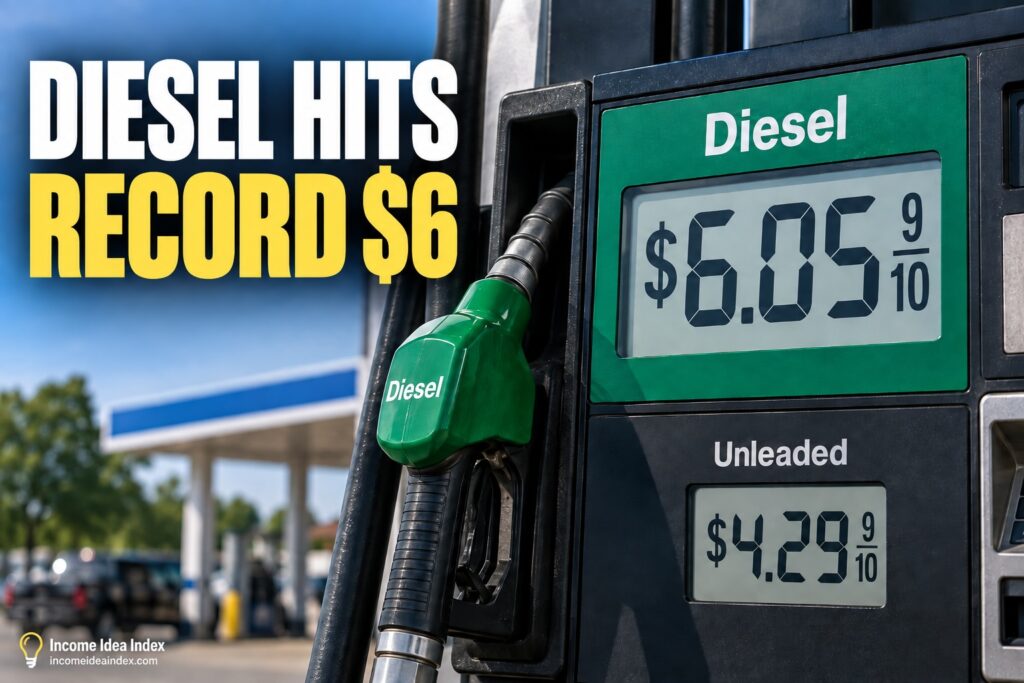
The problem is not simply that a particular fuel now costs more than $6 per gallon.
It is that one of the fuels powering the country’s transportation and supply networks has become dramatically more expensive at a time when many households are already dealing with higher living costs.
Some businesses will absorb the increase.
Some costs will eventually fall again.
But some will likely make their way to consumers.
The longer diesel stays expensive, the more opportunities those higher transportation costs have to spread.
So even if you never touch a diesel pump, it is worth paying attention.
The $6 price isn’t only a truck-driver story.
It may eventually become part of your grocery bill, your shipping charge, your business expenses—or simply the growing cost of everyday life.