
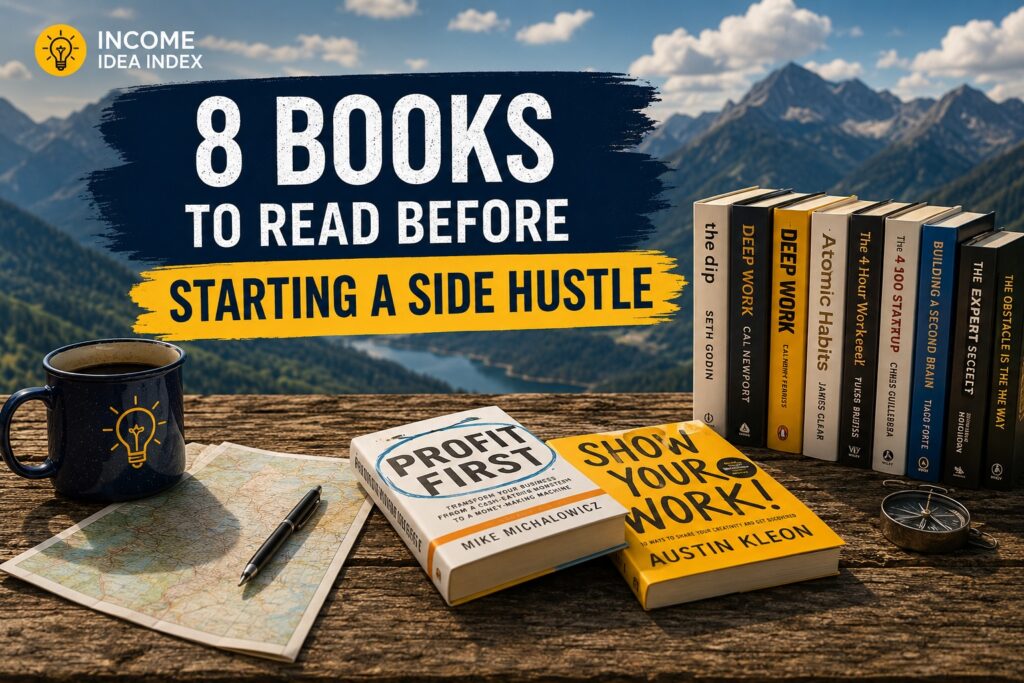
If you’re looking for books to read before starting a side hustle, these eight can help you avoid common mistakes and make smarter decisions from the beginning.
Starting a side hustle can feel deceptively simple.
Pick an idea. Create something. Find customers. Make extra money.
Then you actually try to do it.
Suddenly, you have questions.
Is this idea worth pursuing?
Would anyone actually pay for it?
How much should you charge?
How do you find customers without spending all day on social media?
How much money should you put into the business?
And how are you supposed to build any of this when you already have a job, responsibilities, and a life?
A good business book won’t build your side hustle for you.
But the right book can help you avoid months of unnecessary trial and error.
The eight books below aren’t simply a collection of popular entrepreneurship titles. Each one is useful for a different part of starting a side hustle—from choosing and testing an idea to marketing it, managing the money, and creating enough consistency to keep going.
You don’t need to read all eight before earning your first dollar.
But if you’re serious about building something useful instead of endlessly planning, these are worth having on your reading list.
Disclosure: This article contains Amazon affiliate links. As an Amazon Associate I earn from qualifying purchases.
1. Side Hustle: From Idea to Income in 27 Days — Chris Guillebeau
If you’re starting with nothing more than “I want a side hustle,” this is probably the most obvious place to begin.
Chris Guillebeau’s Side Hustle: From Idea to Income in 27 Days is specifically structured around taking a side-hustle idea from concept to launch without requiring you to quit your existing job.
The book uses a 27-day process designed to move you toward an income-generating project rather than leaving you stuck researching possibilities indefinitely.
That’s important because one of the easiest ways to fail at a side hustle is never actually starting one.
You can spend weeks comparing business models.
Then weeks researching tools.
Then another month choosing a name.
Then another week debating whether you need a logo.
None of those things proves that someone wants what you’re selling.
A side hustle becomes real when you create an offer and put it in front of people.
The biggest value of this book is therefore not a secret business formula. It’s momentum.
It pushes you toward decisions.
What are you going to sell?
Who might buy it?
What will you charge?
How can you test it?
How do you get it in front of someone quickly?
For a beginner, that structure can be much more useful than a 500-page business textbook.
Best for: Someone who knows they want to start earning outside their regular job but hasn’t yet turned that goal into a concrete business.
2. The Mom Test — Rob Fitzpatrick
A lot of bad business ideas receive very encouraging feedback.
“I love that!”
“That’s such a good idea.”
“You should totally do it.”
Then the product launches.
Nobody buys it.
That’s the problem The Mom Test by Rob Fitzpatrick is designed to address. Fitzpatrick describes the book as a guide to talking with customers and figuring out whether a business idea is actually good when people have a tendency to give you polite or misleading answers.
This may be one of the most useful lessons a first-time side hustler can learn:
Compliments are not demand.
Interest is not demand.
Someone saying, “I’d probably buy that,” is not the same thing as that person reaching for a credit card.
When you’re emotionally attached to an idea, it’s easy to ask questions that practically invite people to tell you what you want to hear.
“Wouldn’t this be useful?”
“Do you think this is a good idea?”
“Would you use something like this?”
Those questions can produce encouraging answers while teaching you almost nothing.
A better conversation focuses on what people already do.
What problem are they experiencing?
How are they solving it now?
Have they spent money trying to solve it?
How frequently does the problem occur?
What happens when they don’t solve it?
That kind of information is much more valuable because it is grounded in actual behavior.
You don’t need a large market-research budget to validate a small side hustle.
You do need to become better at separating genuine evidence from friendly encouragement.
Best for: Anyone who has an idea and wants to test whether there is a real problem—and potentially a real customer—behind it.
3. The $100 Startup — Chris Guillebeau
One reason people postpone starting a business is the assumption that starting requires significant capital.
Sometimes it does.
Many side hustles don’t.
Chris Guillebeau’s The $100 Startup looks at small businesses created from relatively modest investments and focuses heavily on turning existing knowledge, interests, or skills into something customers will pay for. The book grew from research into 1,500 business owners, with 50 cases receiving particular focus.
The useful lesson isn’t that every business should literally cost $100 to start.
It’s that beginners often overestimate what must exist before they can begin.
You may not need an office.
You may not need employees.
You may not need expensive software.
You may not need a custom-built website.
You may not even need a particularly original idea.
What you need is something useful enough that another person is willing to exchange money for it.
That could be a service.
A digital product.
A specialized physical product.
Consulting.
Freelance work.
Education.
A niche information resource.
Or something built around a skill you’ve been treating as ordinary because you’ve had it for years.
The book is especially useful for shifting your attention away from “How do I build a company?” and toward the much smaller initial question:
“What useful thing can I sell?”
That is a much easier place to begin.
Best for: People who believe they need more money, credentials, infrastructure, or preparation before they are allowed to start.
4. Company of One — Paul Jarvis
A strange thing happens when people start businesses.
Before they’ve earned their first $100, they sometimes begin planning how they’ll eventually manage 25 employees.
But what if you don’t want 25 employees?
What if you don’t want investors?
What if you don’t want your small income project to evolve into an organization that consumes your entire life?
Paul Jarvis’s Company of One challenges the assumption that every successful business should continuously become larger. Its central argument focuses on becoming better rather than automatically becoming bigger, with an emphasis on building a sustainable business around the life you actually want.
That’s particularly relevant to side hustlers.
The goal of a side hustle may simply be an extra $500 a month.
Or enough freelance income to pay off debt.
Or a small online business that eventually replaces one portion of your salary.
Or a creative project that generates income without becoming your entire identity.
Those are legitimate goals.
More revenue can be useful.
More customers can be useful.
Growth can be useful.
But growth also creates complexity.
More customers may require more support.
More products may require more systems.
More employees may require management.
More revenue can create new expenses and expectations.
Before you start your side hustle, it helps to decide what “enough” might eventually look like.
You can always change your goal later.
But if you never define success for yourself, it’s easy to inherit somebody else’s version of it.
Best for: Anyone who wants a profitable, flexible side business without automatically turning it into a large company.