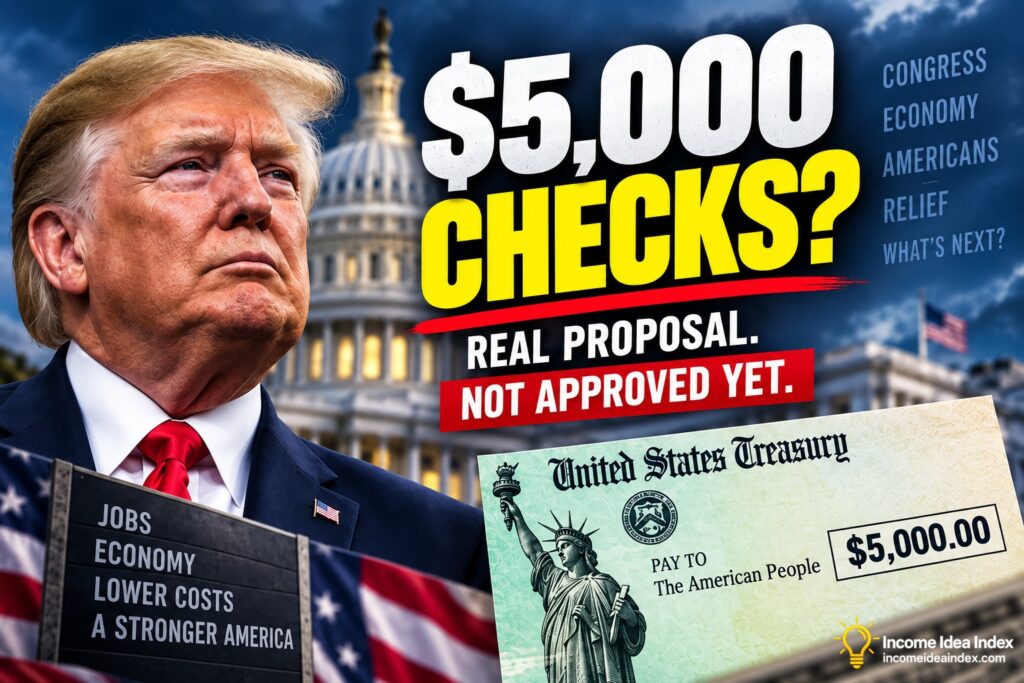
A $5,000 payment would get almost anyone’s attention.
President Donald Trump has proposed Trump dividend checks worth $5,000 for American adults if Republicans retain control of both the House and Senate in the November 2026 midterm elections.
That immediately raises some obvious questions.
Are the checks approved?
Who would qualify?
Where would the money come from?
When could payments arrive?
And should anyone start planning around an extra $5,000?
The most important answer right now is simple:
No $5,000 payment has been approved.
Trump has made the proposal publicly, but Congress would still have to turn the idea into law before the federal government could begin sending payments.
What Exactly Did Trump Propose?
Trump introduced the idea during the Republican midterm convention in Dallas and has continued promoting it.
The proposal calls for a $5,000 payment to American adults if Republicans maintain control of Congress after the November election.
Trump has described the payment as a “dividend.”
On September 13, he again defended the proposal and argued that the federal government could afford it because of the amount of revenue coming into the government.
Reuters reported that Trump said the payments would be financially manageable.
But proposing a payment and authorizing one are two very different things.
There is currently no enacted federal program authorizing these $5,000 payments.
There is no payment schedule.
There is no application.
And there is no official date when Americans should expect money to arrive.
Are the $5,000 Checks Approved?
No.
This is the part worth emphasizing because headlines mentioning “$5,000 checks” can easily make the proposal sound further along than it really is.
The payments have not been approved by Congress.
House Speaker Mike Johnson said Congress would need to authorize the plan before payments could be made.
The Associated Press reported that Johnson said legislative approval would be necessary even though Trump had suggested the payments could move forward without it.
That distinction matters.
The president can advocate for a new federal payment program, but spending more than $1 trillion requires a legal funding mechanism.
Until legislation is introduced, passed by Congress, and signed into law, Americans should not treat the proposal as guaranteed money.
How Much Would the $5,000 Dividend Cost?
Potentially more than $1 trillion.
If approximately 240 million adults received $5,000 each, the total would be around:
240 million × $5,000 = $1.2 trillion
That does not include any administrative costs associated with creating and distributing the program.
Both Reuters and AP have reported that the proposal could cost more than $1 trillion.
That enormous price tag is one reason the idea is already receiving scrutiny from lawmakers and economists.
Even lawmakers who support the concept would still have to answer a fundamental question:
Where does $1 trillion or more come from?
What Has to Happen Before Any $5,000 Payment Could Be Sent?
There are several major steps between a campaign proposal and money appearing in someone’s bank account.
First, Republicans would have to satisfy the political condition Trump attached to the proposal: retaining control of Congress in the November midterm election.
But even if that happens, the payments would not automatically begin.
Congress would still have to determine exactly how the program works.
That would likely require lawmakers to settle questions including:
- Who qualifies?
- Is there an income limit?
- Are payments restricted to U.S. citizens?
- Would dependents receive anything?
- How would the government determine eligibility?
- Would the payment be taxable?
- Where would the funding come from?
- Would payments be issued by the IRS, Treasury Department, or another agency?
- Would people need to file a tax return or take another action?
- When would payments actually begin?
Congress would then have to pass the legislation.
The president would have to sign it.
Federal agencies would need to create the administrative process necessary to distribute the money.
That is why a political promise of a $5,000 payment should not be confused with an approved $5,000 payment.
What Is Still Unknown About the $5,000 Checks?
A lot.
The headline number is clear.
The details are not.
Trump has broadly described the proposal as a $5,000 payment to American adults, but a complete eligibility framework has not been released.
That means we do not yet know whether every adult would actually receive the same amount.
For example, there is currently no finalized public rule explaining whether high-income households would qualify.
There is no finalized treatment for married couples.
There is no detailed rule for dependents.
There is no confirmed process for adults who do not normally file federal tax returns.
And there is no confirmed payment date.
Those details would matter enormously if Congress eventually considers legislation.
Until then, websites or social-media posts claiming that specific people are already “approved” for $5,000 should be treated cautiously.
There is currently no legitimate federal $5,000 dividend application because the program itself has not been enacted.
Where Would the Money Come From?
This may become the biggest debate surrounding the proposal.
Trump has argued that strong federal revenues make the payments affordable.
But Congress would ultimately have to identify or authorize the funding.
With a potential cost above $1 trillion, lawmakers could not simply treat the program as a small change in federal spending.
Possible funding claims will need to be examined against actual federal revenue and spending numbers once legislation exists.
Until that happens, it is too early to say exactly how the payments would be financed.
This is also why the final legislation—if legislation is eventually introduced—will matter more than campaign speeches.
A proposal can describe the goal.
The bill has to explain how the numbers work.
Could $5,000 Payments Increase Inflation?
Potentially.
But the actual effect would depend on how the program was funded, when the money was distributed, the condition of the economy at the time, and how households used the payments.