

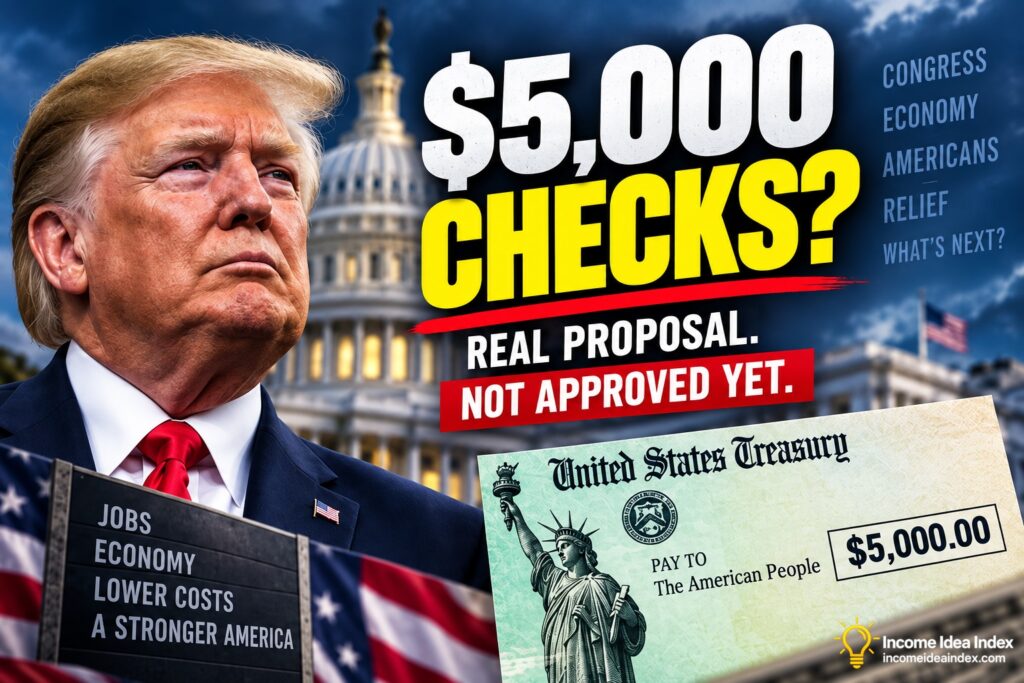
What Is Still Unknown About the $5,000 Checks?
A lot.
The headline number is clear.
The details are not.
Trump has broadly described the proposal as a $5,000 payment to American adults, but a complete eligibility framework has not been released.
That means we do not yet know whether every adult would actually receive the same amount.
For example, there is currently no finalized public rule explaining whether high-income households would qualify.
There is no finalized treatment for married couples.
There is no detailed rule for dependents.
There is no confirmed process for adults who do not normally file federal tax returns.
And there is no confirmed payment date.
Those details would matter enormously if Congress eventually considers legislation.
Until then, websites or social-media posts claiming that specific people are already “approved” for $5,000 should be treated cautiously.
There is currently no legitimate federal $5,000 dividend application because the program itself has not been enacted.
Where Would the Money Come From?
This may become the biggest debate surrounding the proposal.
Trump has argued that strong federal revenues make the payments affordable.
But Congress would ultimately have to identify or authorize the funding.
With a potential cost above $1 trillion, lawmakers could not simply treat the program as a small change in federal spending.
Possible funding claims will need to be examined against actual federal revenue and spending numbers once legislation exists.
Until that happens, it is too early to say exactly how the payments would be financed.
This is also why the final legislation—if legislation is eventually introduced—will matter more than campaign speeches.
A proposal can describe the goal.
The bill has to explain how the numbers work.
Could $5,000 Payments Increase Inflation?
Potentially.
But the actual effect would depend on how the program was funded, when the money was distributed, the condition of the economy at the time, and how households used the payments.
Putting more than $1 trillion into consumers’ hands could increase spending.
If consumer demand rises faster than businesses can increase the supply of goods and services, that can create additional upward pressure on prices.
That concern is especially relevant when inflation is already an economic issue.
On the other hand, the effect would not necessarily be identical across every part of the economy. Some households might spend the money immediately, while others could save it, invest it, or use it to pay down debt.
That is one reason economists and lawmakers are likely to pay close attention to the funding mechanism if the proposal advances.
A $5,000 payment can help an individual household while still creating much larger questions when multiplied across hundreds of millions of people.
Is This Another Stimulus Check?
Not exactly.
It may look similar because it involves the federal government sending money directly to individuals.
But the proposed Trump dividend is not currently an approved economic-stimulus program.
The COVID-era stimulus checks were authorized through legislation passed by Congress and signed into law.
This $5,000 proposal has not reached that stage.
Calling it a “stimulus check” now could therefore create the wrong impression.
A more accurate description is a proposed federal cash payment or dividend that would still require congressional action.
Should You Start Planning Around Receiving $5,000?
No.
Not yet.
It is fine to follow the proposal.
It is not a good idea to build your finances around money that Congress has not approved.
That means you probably should not:
- make a purchase because you expect a $5,000 payment;
- take on debt expecting the payment to cover it;
- postpone necessary savings;
- count it toward a down payment;
- assume it will cover upcoming bills;
- or change your financial plan based on the announcement.
Think of the $5,000 as hypothetical money until the legislative process says otherwise.
This is the same principle that applies to bonuses, tax refunds, uncertain commissions, and other potential windfalls:
Do not spend money before you actually have it.
If saving already feels difficult, Income Idea Index has a practical guide on why it feels harder to save money in 2026 and what you can actually do about it.
Building even a modest financial buffer now gives you more control regardless of what eventually happens with the dividend proposal.
What Could You Do With $5,000 If Payments Eventually Are Approved?
If the proposal eventually becomes law, $5,000 could be meaningful money for many households.
It could also disappear surprisingly quickly without a plan.
You would not necessarily need to put every dollar toward one goal.
You could divide the money based on your financial priorities.
For example, someone might use part of a $5,000 windfall to:
- build or strengthen an emergency fund;
- pay down high-interest credit card debt;
- catch up on overdue bills;
- cover an important home or car repair;
- save toward a larger financial goal;
- invest for the future;
- or handle an expense that would otherwise require borrowing.
The best use would depend on your own financial situation.
If you do not already have much of a cash buffer, keeping some of the money available for emergencies could provide benefits long after the initial payment arrives.
The Income Idea Index guide to 7 simple money habits that can improve your finances over time explains why even a relatively small emergency fund can reduce your dependence on expensive borrowing.
And before deciding where a windfall should go, a quick personal expense audit can help identify bills, fees, subscriptions, or other expenses that may already be draining your money.
The important part is not assuming the payment will solve every financial problem.
A one-time $5,000 payment is still one-time money.
Watch Out for $5,000 Check Scams
Big government-payment headlines often create opportunities for scammers.
Because no $5,000 dividend program has been approved, there is currently no legitimate reason for someone to contact you asking you to “register” for your payment.
Be especially cautious if someone asks for:
- your Social Security number;
- bank login information;
- a payment or processing fee;
- gift cards;
- cryptocurrency;
- a credit card number;
- or money to “release” your $5,000 check.
Do not assume a message is legitimate just because it mentions the government, IRS, Treasury Department, Trump dividend, or stimulus payments.
If a real federal payment program is eventually created, official instructions would come from government agencies after the law is enacted.
What Should You Watch Next?
There are several developments that would make this proposal much more concrete.
The first is the November 2026 midterm election, because Trump explicitly tied the dividend to Republicans retaining congressional control.
After that, watch for actual legislation.
A bill would answer questions that speeches cannot.
The important developments would include:
- A bill being introduced in Congress
- Specific eligibility requirements
- A documented funding source
- House and Senate votes
- The president signing legislation
- Official payment guidance from a federal agency
- A confirmed payment schedule
Until those things begin happening, the $5,000 dividend remains a proposal.
The Bottom Line
Yes, President Trump really has proposed sending $5,000 to American adults if Republicans retain control of Congress.
But that does not mean $5,000 checks are currently on the way.
Congress has not approved the payments.
There is no finalized eligibility system.
There is no official payment date.
There is no application.
And major questions remain about how a program costing more than $1 trillion would be funded.
The story is worth watching because a $5,000 payment would be financially significant for millions of households.
Just keep the distinction clear:
The proposal is real. The checks are not approved.
If Congress begins moving actual legislation, that is when the details—and your financial planning—become much more important.