Separate ordinary work from administrative activity when practical. Use an administrator account for configuration or privileged operations, not every routine task. Review external contractors’ access and revoke it when the engagement ends. If an agency manages a business website, give it appropriate access without transferring ownership of the domain or leaving the business dependent on one person’s private email account.
An offboarding process should identify which accounts, devices, keys and shared information are affected when someone leaves. Revoke individual access, invalidate relevant sessions and rotate any credentials that were actually shared or exposed. Maintain continuity by ensuring the business retains legitimate control of records and critical accounts.
Phishing prevention and payment fraud
Phishing prevention often begins with recognizing badly written emails and suspicious links, but businesses should prepare for messages that look convincing. A fraudulent request may appear to come from a supplier, employee, bank or familiar software provider. A genuine email account can also be compromised, which means a familiar sender name alone is not proof that the request is authorized.
Consider a supplier sending a request to change the bank account used for invoices. A cautious business should verify the change using a known contact method already on file, not the telephone number supplied in the new message. The employee should not treat urgency, a convincing signature or an apparent reply in an existing conversation as a substitute for verification.
Establish clear rules for sensitive changes, including payment destinations, payroll details, account recovery information and large refunds. Where staffing permits, require independent approval from a second authorized person for particularly consequential transactions. A solo business owner can create separation through a deliberate verification step and transaction limits, even without a second employee.
The FBI’s Internet Crime Complaint Center overview of business email compromise describes fraud involving payment requests and emphasizes the importance of swift contact with the financial institution if a fraudulent transfer occurs. Business owners should keep independently verified banking contact information available rather than searching for help through a suspicious email or unfamiliar search advertisement during an emergency.
Train employees using situations relevant to their jobs. Someone working at a retail counter may encounter a person claiming to be a payment terminal technician. A customer-support worker may be asked to change an account’s email address. A bookkeeper may see a changed invoice. The training should explain the verification process and provide a clear person to contact if a request appears unusual.
Avoid building a culture in which employees hide mistakes. A worker who clicked a link or approved an unexpected request needs to report it quickly. Delayed reporting can provide additional time for a compromise to spread. A practical policy rewards prompt escalation and addresses the underlying weakness rather than assuming that blame alone will prevent recurrence.
Network security: building the right perimeter
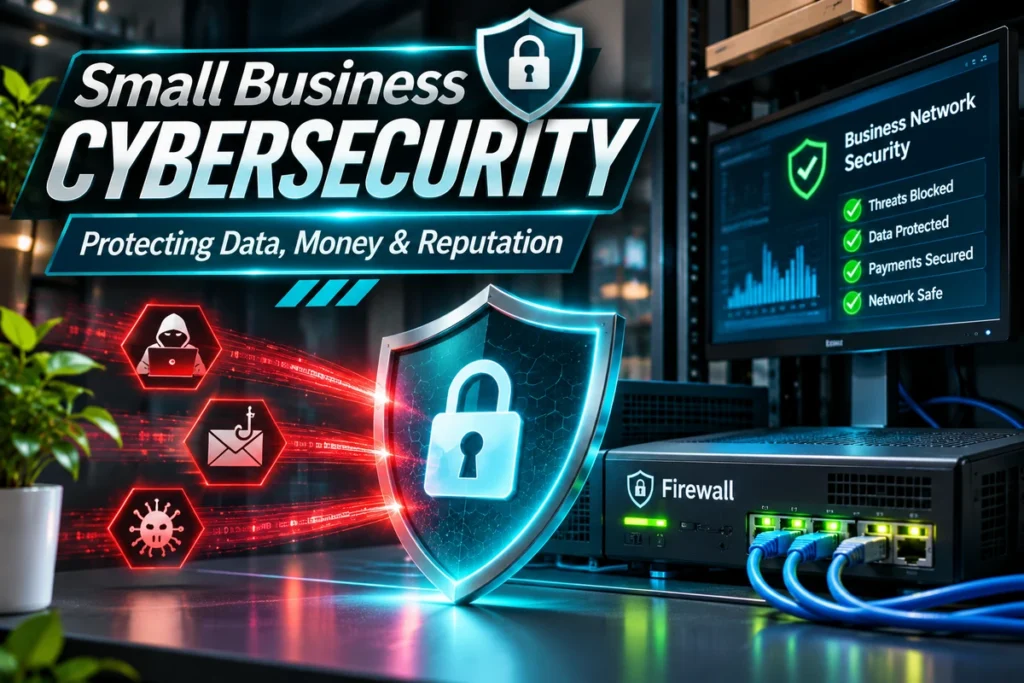
A firewall represents one layer of small business cybersecurity. In a real business, network protection works alongside account security, software maintenance, safe configuration and monitoring. A firewall can restrict certain network connections, but it cannot guarantee that an authorized user will never be deceived or that a cloud account will never be compromised.
For a basic network security baseline, a small-business router should use current supported firmware, changed default administrative credentials and appropriate wireless security. Avoid exposing its management interface to the public internet unless a justified, securely designed arrangement requires it. Use vendor-supported remote access solutions with appropriate authentication and configuration rather than opening unnecessary network ports. If the device no longer receives security updates, evaluate replacement based on risk and business needs.
Network security can benefit from separating devices that do not need to communicate with one another. A retail store might provide customers with guest Wi-Fi while keeping business equipment on a restricted network. Payment devices, cameras and other connected equipment may need their own carefully controlled segments, depending on the environment. Configuration should actually enforce separation; a different Wi-Fi name alone is not necessarily sufficient.
Inventory computers, phones, network equipment, printers, cameras and other connected devices. Enable supported security updates and remove unsupported software where practical. A device that is no longer being used should not remain connected indefinitely simply because nobody has been assigned to remove it. A short scheduled maintenance window can help avoid both neglected updates and unplanned interruptions during business hours.
For computers that handle business information, use supported operating systems, appropriate endpoint protection, screen locking and disk encryption where suitable. Keep encryption recovery keys securely accessible to authorized people. A stolen computer that contains readable customer records can create a different problem from a stolen, appropriately protected computer, although encryption alone does not address every possible risk.
Small organizations that lack technical experience can benefit from qualified assistance. Ask a prospective provider to explain how remote access is protected, how administrator permissions are managed, how incidents are reported and what happens to business data when the relationship ends. Do not grant an outside provider unlimited access indefinitely without a business reason and a clear agreement.
Protecting customer information and payment systems
A business often collects information because an application makes collection easy, not because each piece of information is needed. Old spreadsheets of customer details, copies of identity documents, exported mailing lists and recorded calls may persist long after their original purpose has ended. Every unnecessary copy creates an additional location to protect.
The FTC’s guide to protecting personal information provides U.S. businesses with guidance on managing sensitive information. Begin by identifying the data you actually need, the legitimate reasons for keeping it and the people who require access. Establish a retention and disposal process that respects legal obligations and relevant contracts. Do not indiscriminately delete records subject to mandatory retention or a litigation hold.
Payment card information requires particular care. Use reputable payment services and avoid recording card details in ordinary email, documents or notes. The PCI Security Standards Council’s merchant guidance provides payment-security resources. Outsourcing payment processing can reduce the systems that directly handle card data, but it does not automatically remove every merchant responsibility. Confirm applicable requirements with the merchant bank or payment provider.