Google Connected Apps is the focus of this practical guide. Below, we separate what the company has officially announced from what businesses and developers still need to verify before acting.
Why Google Connected Apps matters
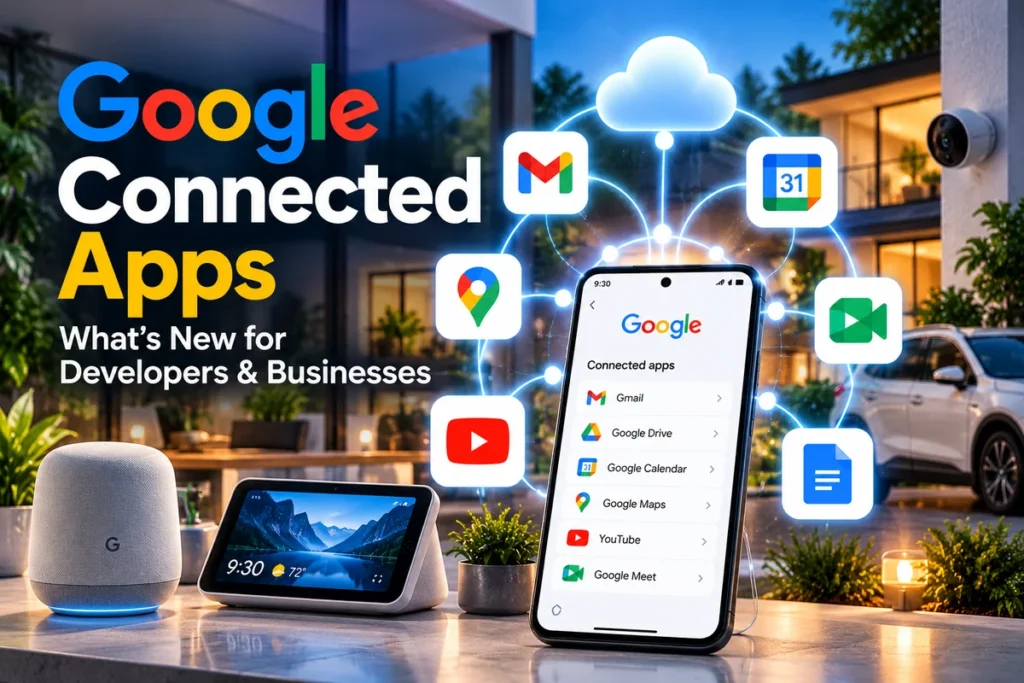
Google Connected Apps is a new way for developers to make their services available inside Google Search and the Gemini app. Announced on October 28, 2026, the Connected Apps Platform is a preview rather than a universally available publishing channel. Its central promise is straightforward: developers can build an integration once, register it in a common console, and potentially reach people who are already trying to accomplish a task in Google products.
That distinction matters for businesses. An ordinary search result sends someone to a website, where they must work out what to do next. A connected service can potentially help the person act within an AI-assisted experience. For a travel provider, that might mean checking a booking option; for a productivity service, it might mean finding or creating information. Those are illustrations of the interaction model, not a promise that every category is currently supported.
The most useful question for a small company is not whether it can add another Google badge to its homepage. It is whether customers regularly ask for a task that the company could reliably complete through a secure, well-designed integration.
What Google actually announced
Google says developers can connect a cloud-hosted Model Context Protocol (MCP) server or use Android MCP with AppFunctions APIs. They then use the Google Connected Console to register, test, and submit their app. Before review, developers choose whether to seek distribution in Search, the Gemini app, or both. The platform also offers visibility into traffic, latency, and errors after launch.
The announcement describes phased access. Google is inviting developers to sign up for the preview, and it plans to add developers, markets, and products over time. That means businesses should not confuse a preview sign-up with approval, a launch date, or guaranteed placement. Review and availability may vary by integration and destination.
Google also described more than 50 Connected Apps across Search and Gemini, with examples involving Adobe, Experian, Localiza, Peloton, and upcoming Calm experiences. Those partner examples show the range of possibilities, but they do not establish that any arbitrary website can connect to the same features today.
How the integration path works
The technical workflow starts with a useful service that can respond to structured requests. Developers need to define which actions are available, what information those actions require, and what happens when a request is incomplete. A read-only lookup should be handled differently from an action that changes an account or places an order.
Next comes identity and permissions. Google highlights verified logos and authenticated accounts, but the service operator still needs its own controls for access, consent, error handling, and sensitive data. An AI interface should not be allowed to guess an account identity or silently perform a consequential action. The integration should fail safely when a permission is missing.
After registration and testing in the Connected Console, the app goes through submission and review. Developers should monitor failed requests, slow responses, and abandonment. A successful technical connection is only the beginning: the experience has to help a real person finish a task accurately and predictably.
Where the business opportunity could be
For an established online service, Connected Apps could eventually become another discovery and transaction channel. People might encounter a service while researching a problem rather than by typing its brand name. That makes accurate descriptions, reliable task completion, and clear branding more important than a flashy demo.
However, the opportunity is not identical to traditional search-engine optimization or advertising. Google has not promised a ranking formula, a conversion rate, or free distribution to every developer. Companies should treat this as a product integration initiative with possible marketing benefits, not a shortcut that replaces their website or existing customer acquisition.
Businesses that do not operate a software service may still benefit indirectly as connected tools become more common. They can observe whether customers begin expecting booking, ordering, scheduling, or account-management actions inside conversational interfaces. The right response may be to improve their existing digital processes first.
A practical preparation checklist
Start by identifying one customer task that has a clear beginning and end. Examples include retrieving a reservation, checking inventory, or preparing a quote. Document the required information, the permission boundary, the successful outcome, and the most likely failure cases. Avoid starting with an ambitious collection of unrelated actions.
Then review the underlying API or service. It should return structured, current information, protect private data, and explain errors without exposing internal details. If it already struggles with ordinary traffic or inconsistent records, connecting it to another interface will magnify those weaknesses.
Finally, establish a measurement plan. Track completed tasks, support requests, failed authentication, latency, and customer satisfaction. Compare these outcomes with your website and app before allocating a large budget. A new distribution surface is valuable only when it produces reliable results.
A sample customer journey to test
Imagine a person asking an assistant to organize a weekend activity. A connected provider might return available sessions, show the cancellation policy, and request confirmation before a reservation is made. A useful integration must keep those steps distinct: searching does not authorize a purchase, a distinction that also matters when AI agents take actions on a user’s behalf, and displaying availability is not the same as securing a booking. This is a hypothetical workflow, not a claim about a currently supported Google partner.
A developer can use that scenario to write acceptance tests. Does the service handle an unavailable time correctly? Can it distinguish a guest from a signed-in customer? Does it explain taxes, restrictions, or additional fees before confirmation? If the underlying service cannot answer those questions consistently, broader AI distribution will not fix the customer experience.
For businesses considering AI-powered workflow integrations, a useful early metric is the share of attempted tasks completed without support intervention. Measure that alongside satisfaction and conversion, because a technically successful API call can still leave a customer confused. The best integration is one that reduces friction without hiding important choices from the user.
What to do next
Developers should read the official Connected Apps documentation and confirm preview eligibility before investing in a full build. Business owners can begin by mapping the customer tasks they would want an AI assistant to complete, even if they are not ready to integrate.
The broader lesson is that discovery and action are moving closer together. That could be meaningful for companies with useful digital services, but Google Connected Apps remains a phased platform preview, as described in Google’s platform announcement. Plan around verified capabilities and measurable customer value rather than assumptions about instant access.