Step 17: Don’t Create Content Only for Search Engines
This is where SEO can go wrong.
You find a list of keywords.
You generate hundreds of shallow articles.
You add the keywords.
You publish them as quickly as possible.
Technically, you are doing things associated with SEO.
Strategically, you may be building a very weak website.
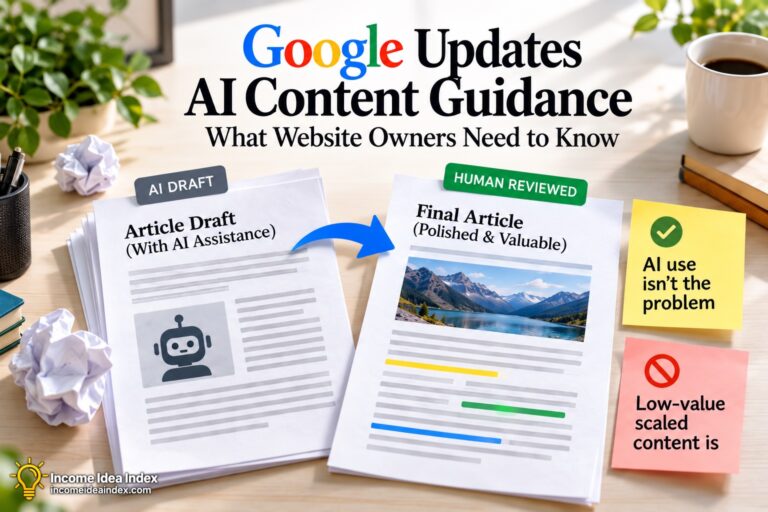
Google’s guidance explicitly recommends creating content primarily for people rather than producing large amounts of material mainly to attract search traffic.
That does not mean keyword research is bad.
It means keyword research should help you discover useful questions—not replace the responsibility to answer them well.
The distinction matters.
Search-first thinking:
“This keyword gets traffic. What can I publish around it?”
People-first SEO thinking:
“People keep searching for this problem. Can I create something genuinely useful that solves it?”
The second approach still uses SEO.
It simply starts with usefulness.
What About SEO for AI Search?
One of the biggest SEO questions in 2026 is whether websites need a completely different strategy for AI search.
At least for Google’s own AI search experiences, the answer is currently no.
Google says the same fundamental SEO practices remain relevant for AI Overviews and AI Mode.
There is no special AI schema you must add simply to qualify for those features.
The fundamentals still matter:
- Make pages crawlable
- Create useful content
- Use clear internal links
- Provide important information as text
- Maintain a good user experience
- Use relevant images and video when helpful
- Ensure structured data matches the visible page
- Keep information accurate
This makes sense.
AI systems still need useful information to work with.
Clear explanations, good structure, original insight, accurate information, and identifiable sources are useful whether the information appears as a traditional blue link or contributes to an AI-assisted search experience.
How Long Does SEO Take?
SEO is usually not immediate.
A new article may be discovered quickly but take longer to gain meaningful visibility.
A new website may take considerably longer because it has less history, fewer links, and less established authority.
There is no universal timeline.
Different pages compete in different search environments.
Instead of asking:
How many days until this ranks?
a better question is:
Is the page becoming more visible over time?
Watch indicators such as:
- Indexed pages
- Search impressions
- Number of queries triggering your content
- Search clicks
- Returning visitors
- Links from other websites
- Growth across related articles
SEO is better viewed as a long-term discovery system than an instant traffic switch.
Common SEO Mistakes Beginners Should Avoid
You can save yourself considerable frustration by avoiding a few common mistakes.
Targeting Keywords That Are Far Too Broad
A small new site probably will not outrank the largest websites on the internet for a one-word keyword.
Start narrower.
Writing for an Algorithm Instead of a Person
Keywords should support the article.
They should not make it sound robotic.
Ignoring Search Intent
Ranking for the wrong intent will not help much because the visitor wanted something different.
Publishing and Never Updating Anything
Older articles may eventually contain outdated statistics, broken links, obsolete products, or incomplete information.
Review important content periodically.
Forgetting Internal Links
An excellent article becomes harder to discover when nothing on your own website links to it.
Buying Questionable Backlinks
Shortcut link schemes can create more problems than they solve.
Expecting Immediate Results
SEO generally rewards persistent improvement more than impatience.
Depending Entirely on Google
Search traffic can be valuable, but your website should not have only one route to an audience.
Social media, email, direct visitors, referrals, video, communities, and other discovery channels can all contribute.
A Simple SEO Checklist for Beginners
Before publishing an article, check the basics.
- Is there a clear primary topic?
- Does the title describe what the article actually delivers?
- Is the main keyword used naturally near the beginning?
- Does the article satisfy the likely search intent?
- Are the headings descriptive?
- Is the URL simple?
- Did you write a useful meta description?
- Did you add relevant internal links?
- Did you link to authoritative external resources when appropriate?
- Are images properly sized and described?
- Is the article readable on mobile?
- Does the page load properly?
- Is it indexable?
- Does the article offer something genuinely useful?
- Can readers easily find another relevant page afterward?
If you can consistently answer yes to those questions, you are already doing more meaningful SEO than many beginners.
You Don’t Need to Master SEO Before Starting
SEO can become extremely technical.
You can study:
- Advanced keyword research
- Crawl budgets
- Log-file analysis
- Schema markup
- JavaScript rendering
- Link analysis
- Content pruning
- Entity optimization
- International SEO
- Ecommerce SEO
- Programmatic SEO
- Local SEO
You do not need any of that before publishing your first useful article.
Start with the foundation.
Choose a real question.
Understand why someone is searching for it.
Create the best answer you reasonably can.
Give the page a clear title.
Organize it with useful headings.
Link it to related content.
Make sure search engines can access it.
Then use real performance data to improve your work.
SEO becomes much easier when you stop thinking of it as a collection of tricks.
It is a process of making useful information easier to discover.
The Bottom Line
SEO for beginners in 2026 still comes down to a surprisingly practical idea:
Help the right person find the right information.
Search engines have changed.
AI Overviews and AI Mode have changed the way some Google results appear.
Bing and Copilot are blending traditional search with AI-assisted discovery.
More changes will come.
But the fundamentals remain useful.
Create content that answers real questions.
Use the language people actually search for.
Match the searcher’s intent.
Structure pages clearly.
Use internal links.
Reference credible sources.
Keep your website technically accessible.
Measure what happens.
Improve what works.
And do not build your entire strategy around pleasing an algorithm.
Your real objective is not a green SEO score, a particular keyword density, or even a #1 ranking by itself.
Your objective is to create somethinguseful enough that the person who finds it is glad they did.
Do that consistently, and SEO can become one of the most valuable ways to help new readers discover your website.