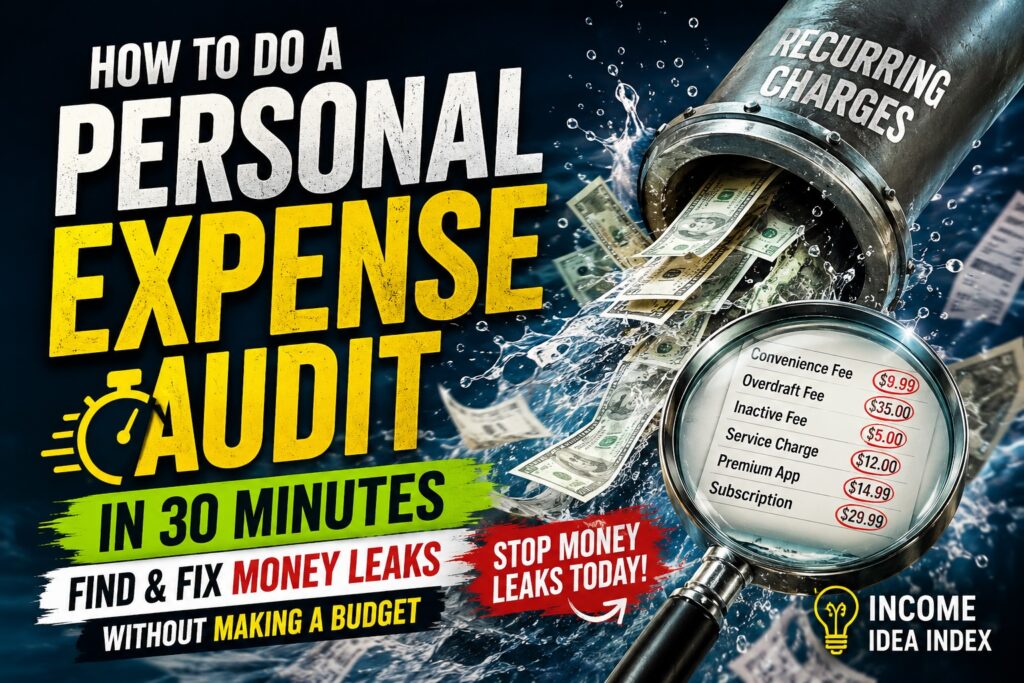
Minutes 10–15: Look for Bills That Quietly Increased
Next, check the expenses you expect to pay every month.
Automatic billing makes it surprisingly easy to miss gradual price increases.
Look at things such as:
- internet;
- mobile service;
- insurance;
- subscriptions;
- storage plans;
- software;
- utilities;
- and memberships.
Compare the current amount with what you remember paying previously.
A small increase by itself may not matter.
But several increases stacked together can meaningfully raise your monthly cost of living.
Suppose five services each increased by $5 a month.
That is another $25 every month—or $300 per year.
Price increases are not automatically unreasonable.
The question is whether you still believe the service is worth the new price.
If not, investigate whether you can:
- downgrade;
- switch plans;
- remove unnecessary features;
- negotiate;
- change providers;
- or cancel.
Minutes 15–20: Search for Fees
Fees are one of the least satisfying ways to spend money.
Search your transactions for words such as:
- fee;
- service charge;
- interest;
- late fee;
- ATM fee;
- overdraft;
- maintenance;
- delivery;
- convenience;
- processing.
Some fees may be unavoidable.
Others may be surprisingly easy to eliminate.
For example, you may discover that you are paying a monthly account fee because your balance no longer meets a requirement.
Or perhaps you regularly pay delivery fees even though pickup or another option would cost less.
Credit card interest deserves particular attention because carrying a balance can make previous purchases substantially more expensive over time.
The purpose of this step is not to solve every fee immediately.
Simply identify the ones that repeatedly take money without giving you meaningful value.
Those become high-priority targets.
Minutes 20–25: Look for Spending Patterns
This is where an expense audit becomes more useful than simply hunting for subscriptions.
Look for patterns, not isolated purchases.
Maybe you ordered takeout eight times.
Maybe you repeatedly paid for expedited shipping.
Maybe you stopped at the same convenience store every few days.
Maybe small online purchases appeared throughout the month.
None of those purchases necessarily represents a problem.
What matters is whether the pattern surprises you.
You might discover:
“I didn’t realize I was ordering food that often.”
Or:
“I’m paying for express shipping constantly because I keep ordering things at the last minute.”
Or:
“I’m making small online purchases so frequently that they add up to more than the larger purchases I actually remember.”
Avoid turning this into self-criticism.
You are collecting information.
The useful question is:
Does this spending pattern provide enough value to justify what it costs me?
Sometimes the answer is yes.
Sometimes seeing the total changes your mind.
Minutes 25–30: Choose Your Changes
Now stop reviewing transactions.
The last five minutes are for decisions.
Take everything you flagged and divide it into four simple groups.
Cancel
Things you no longer use or want.
Reduce
Things you want to keep but could get more cheaply.
Investigate
Charges, increases, plans, or fees you need more information about.
Keep
Expenses that passed the audit.
This last category matters.
The goal is not to eliminate everything.
If something brings real value to your life and comfortably fits your finances, keeping it is a legitimate decision.
A personal expense audit should leave you with a short action list.
For example:
- Cancel unused streaming service.
- Downgrade cloud storage.
- Call internet provider about the new rate.
- Turn off an unused paid app.
- Check an unexpected $12.95 charge.
- Stop paying unnecessary ATM fees.
- Keep gym membership.
- Keep weekly restaurant night.
That is already useful financial progress.
Don’t Waste Time Cutting the Wrong Expenses
There is a common problem with money-saving advice.
It often concentrates on highly visible small pleasures.
Coffee.
Restaurants.
Entertainment.
A small hobby purchase.
Those expenses are easy to criticize because you can see them.
But your biggest unnecessary expenses may be elsewhere.
Imagine someone spends $20 a month buying coffee they genuinely enjoy.
That is easy to notice.
Meanwhile, they may also be paying:
- $30 for unused subscriptions;
- $25 in unnecessary bank and card fees;
- $40 too much for an old phone plan;
- and $50 more than necessary for another recurring service.
That is $145 per month hiding inside relatively boring expenses.
Reducing those costs could save $1,740 per year without eliminating the coffee at all.
Start with spending that delivers little or no value.
Then decide whether changing lifestyle expenses is actually necessary.
That distinction matters even more when everyday costs are already putting pressure on household finances. Why It Feels Harder to Save Money in 2026—And What You Can Actually Do About It looks at those broader pressures and practical ways to create more financial breathing room.
Watch for Subscription Creep
Subscription businesses are everywhere because recurring billing is convenient.
The downside is subscription creep.
One service becomes three.
Three becomes seven.
You subscribe to music, video, software, storage, news, games, apps, delivery programs, fitness platforms, and specialized services.
Individually, many seem inexpensive.
Together, they can become a meaningful household expense.
Try adding up your recurring subscriptions during your audit.
You may be surprised by the annual number.
For example, $80 per month in subscriptions equals $960 per year.
That does not mean you should cancel all of them.
It means nearly $1,000 of annual spending deserves a conscious decision.
Don’t Forget Annual Expenses
Not every recurring expense appears monthly.
Annual renewals are particularly easy to forget.
You may pay once per year for:
- memberships;
- software;
- domain names;
- cloud services;
- insurance;
- apps;
- professional organizations;
- credit card fees;
- or other services.
Because the payment occurs infrequently, you may completely forget about it until the charge appears.
When you encounter an annual payment, ask the same question:
Would I renew this today?
If not, turn off automatic renewal while you are thinking about it.
Do not rely on remembering eleven months from now.
Separate Personal and Business Expenses
If you earn money through freelancing, gig work, self-employment, or a small business, be careful not to mix every expense together mentally.