
Avoid Choosing Based on Trends
Business models move in and out of fashion.
At different times, people become convinced that everyone should create:
- an ecommerce brand,
- an online course,
- a subscription,
- a newsletter,
- an app,
- a SaaS company,
- a dropshipping store,
- a coaching business,
- or an AI product.
A model becoming popular does not mean it fits your opportunity.
The useful question is not:
“What business model is hot right now?”
It is:
“What is the simplest business model that solves this problem for this customer at economics that can work?”
That question survives trends.
Do Not Confuse Easy to Start With Easy to Succeed
Some business models have very low barriers to entry.
That is useful.
It can also create heavy competition.
Anyone may be able to create a template.
Anyone may be able to offer a basic freelance service.
Anyone may be able to list a product online.
Low startup difficulty does not remove the need for:
- positioning,
- trust,
- quality,
- customer acquisition,
- useful differentiation,
- and execution.
When researching competitors, look beyond whether similar businesses exist.
Study how they package the model, what customers seem to value, what they charge, and where gaps may exist.
How to Research Your Competitors walks through that process in more detail.
Let Willingness to Pay Influence the Model
Sometimes your first model is wrong even when the underlying problem is right.
Suppose customers clearly need help organizing their finances.
You try to sell a $19 template.
Nobody buys.
During customer conversations, you discover that people do not want another file to manage.
They want someone to help them set up the system.
That may point toward a service.
The reverse can happen too.
You offer a custom service but repeatedly hear:
“Can I just buy the template you use?”
That may reveal a product opportunity.
This is why business-model selection belongs inside validation.
The model should respond to what customers show you.
If Article #5 is already live before you publish this one, connect this decision to How to Know Whether People Will Pay for Your Idea. Actual buying behavior is more useful than choosing a model entirely on paper.
Test the Smallest Version of the Model
Once you have a leading model, resist the urge to build its complete version.
Test the minimum version that can answer the next important question.
For a service:
Sell one clearly defined package.
For a digital product:
Build the smallest useful version or sample.
For a physical product:
Test a prototype, sample, small batch, or legitimate preorder approach where appropriate.
For a subscription:
Test whether customers value the recurring outcome before building a large membership infrastructure.
For a marketplace:
Manually connect a small number of buyers and sellers before investing heavily in platform technology.
For an audience business:
Publish enough useful material to test whether you can consistently attract the intended audience before building a large content operation.
The objective is not to look like a large established company.
The objective is to learn.
Give the First Model a Specific Job
Your first business model does not need to solve every long-term objective.
It may have one job.
For example:
Service first: Generate cash and learn directly from customers.
Digital product first: Test whether a standardized solution can sell repeatedly.
Physical product first: Prove demand before increasing inventory.
Subscription first: Test whether the problem and value truly recur.
Audience first: Build access to a particular customer group.
Thinking this way prevents you from judging the first version against the final company you imagine five years from now.
A model can be useful because of what it teaches you.
Make the Decision With a Simple Scorecard
Take your top two or three possible models and score each from 1 to 5 on:
- speed to first sale,
- startup cost,
- ease of testing,
- customer fit,
- delivery complexity,
- profit potential,
- repeatability,
- customer acquisition difficulty,
- fit with your current skills,
- fit with your available time,
- and long-term growth potential.
Do not treat the final number as scientific.
Its purpose is to expose tradeoffs.
You may discover that a digital product has better repeatability but a service has much better speed, customer access, and validation potential.
That could suggest:
Start with the service. Learn. Then build the product.
Another idea may clearly require a physical product because the customer’s problem cannot be solved digitally.
The scorecard helps you see the decision instead of arguing with yourself abstractly.
Your Next Step
Write down the problem you are trying to solve.
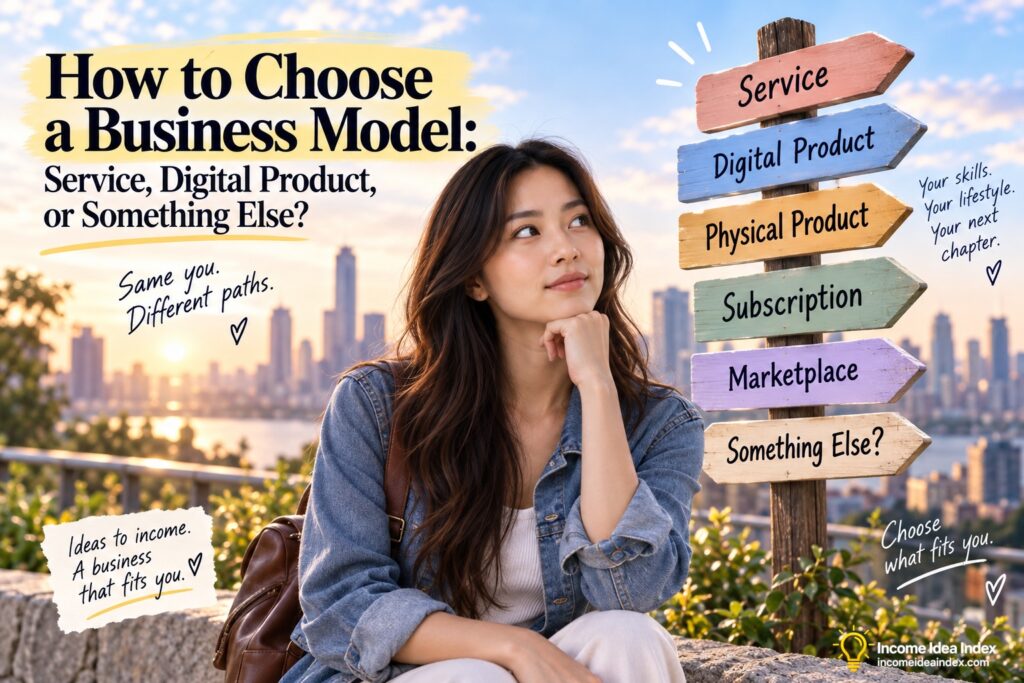
Then list the two or three business models that could realistically solve it.
For each model, answer:
Customer: Who buys?
Offer: What exactly do they receive?
Payment: How and how often do they pay?
Delivery: What must happen after the sale?
Cost: What does it cost to start and fulfill?
Distribution: How will customers discover the offer?
Test: What is the smallest version you could put in front of real customers?
Evidence: What customer behavior would justify continuing?
Then choose the model that lets you gather useful evidence without taking more risk than necessary.
You are not trying to predict the perfect business structure forever.
You are choosing the best vehicle for the next stage of the idea.
Once you know the customer, understand the problem, have evidence of demand, and have chosen a realistic business model, the next question is straightforward:
How can you test it without building the entire business first?
That is where Stage 1 ends and your idea starts facing the real world.
Continue through the Business Roadmap as you move from choosing the model to testing the smallest real version of it.