- higher prices,
- specialization,
- recurring retainers,
- standardized packages,
- templates,
- automation,
- subcontractors,
- employees,
- or productized services.
But the early question is simpler:
Can you reliably deliver the promised result at a price that makes the work worthwhile?
If yes, a service can be one of the fastest ways to turn an idea into a real market test.
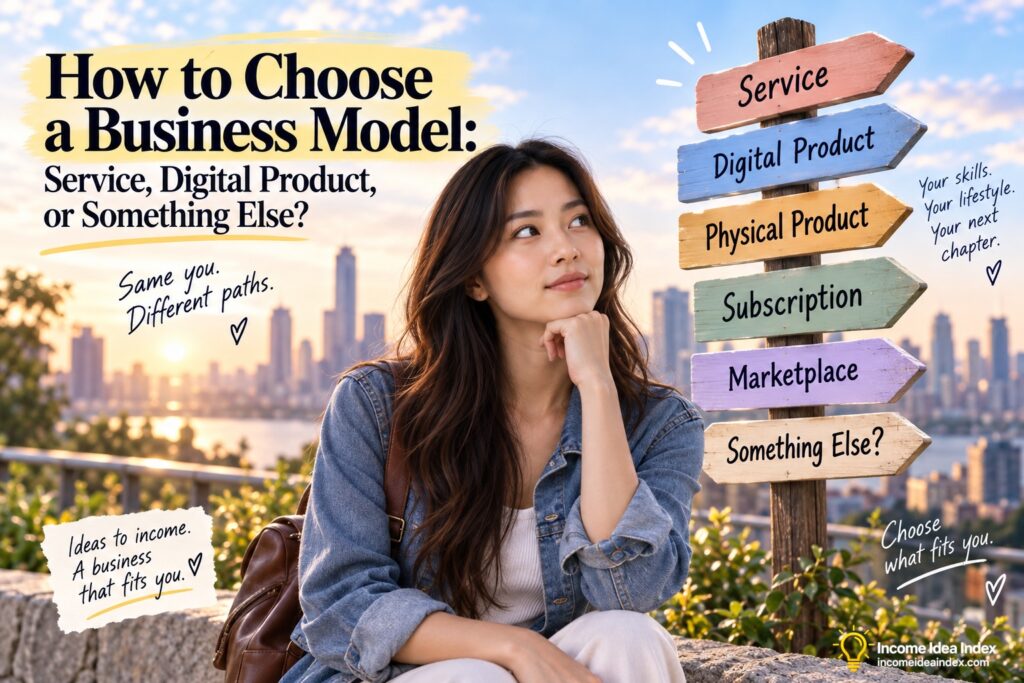
Option 2: Sell a Digital Product
A digital product is something created electronically and delivered repeatedly without manufacturing another physical unit each time.
Examples include:
- templates,
- spreadsheets,
- calculators,
- ebooks,
- guides,
- digital planners,
- printables,
- courses,
- stock assets,
- design files,
- software,
- plugins,
- workflow systems,
- and specialized toolkits.
Digital products are attractive because the same core file or system can often be sold more than once.
That creates leverage.
You might spend ten hours building a useful spreadsheet and then sell copies without rebuilding the spreadsheet for every customer.
But that does not mean digital products are passive or automatically scalable.
Someone still has to discover the product.
Customers have to trust that it solves their problem.
The product needs to be maintained.
You may need customer support.
Platforms may charge fees.
Advertising can cost money.
Refunds and updates still exist.
And a beautifully created product with no distribution may produce no meaningful income.
Digital products work best when the problem repeats
A stronger digital-product opportunity often appears when you notice the same problem being solved repeatedly.
For example:
A consultant repeatedly creates the same project-planning spreadsheet for clients.
A designer repeatedly gets asked for the same type of template.
A teacher notices students struggling with the same study process.
A small-business owner repeatedly explains the same procedure.
Those patterns may reveal something that can be standardized.
Instead of starting with:
“What digital product should I make?”
ask:
“What useful result am I already seeing people repeatedly need?”
That keeps the product grounded in demand.
Option 3: Sell a Physical Product
A physical-product business sells something tangible.
Examples include:
- clothing,
- food,
- accessories,
- tools,
- household products,
- beauty products,
- handmade goods,
- printed products,
- electronics,
- specialty equipment,
- and manufactured products.
Physical products can create strong brands and repeat customers.
But they also introduce operational questions that digital products and many services avoid.
You may need to manage:
- inventory,
- manufacturing,
- suppliers,
- packaging,
- storage,
- shipping,
- damaged items,
- returns,
- quality control,
- minimum order quantities,
- and cash tied up in unsold stock.
That does not make physical products a bad model.
It means the test should be designed carefully.
Before ordering a large quantity of anything, use the validation principles in How to Validate a Business Idea Before You Spend Money on It.
A small batch, sample, preorder, local test, prototype, or limited release may tell you far more than placing a large inventory order based on optimism.
Option 4: Build Recurring Revenue With a Subscription
A subscription model charges customers repeatedly—often monthly or annually—in exchange for ongoing access, products, services, or value.
Examples include:
- software subscriptions,
- memberships,
- maintenance plans,
- recurring service packages,
- paid newsletters,
- subscription boxes,
- support plans,
- data services,
- and ongoing content libraries.
Recurring revenue is attractive because one sale can potentially produce more than one payment.
But that only works when the customer continues receiving enough value to stay.
Getting a customer is not the end of the sale.
You have to keep earning the renewal.
Ask:
“What changes next month that gives this customer a reason to keep paying?”
A subscription can make sense when the problem is recurring.
For example:
Monthly bookkeeping naturally creates recurring work.
Website maintenance continues.
Software keeps performing a task.
A specialized research service may provide updated information.
A membership may provide ongoing access or support.
But turning a one-time problem into a subscription just because recurring revenue sounds attractive usually creates weak retention.
The payment model should follow the customer need.
Option 5: Use a Marketplace or Platform Model
A marketplace connects two groups that need each other.
Examples include platforms that connect:
- buyers and sellers,
- customers and service providers,
- renters and owners,
- employers and workers,
- students and instructors,
- or advertisers and audiences.
Instead of producing every service or product yourself, the business creates the environment where transactions happen.
Revenue may come from:
- transaction fees,
- commissions,
- listing fees,
- subscriptions,
- advertising,
- or premium access.
The appeal is obvious.
If the marketplace grows, the business does not necessarily have to personally deliver every transaction.
The difficulty is also obvious.
You usually need both sides.
Sellers do not want to join a marketplace with no buyers.
Buyers do not want to visit a marketplace with nothing to buy.
That is sometimes called the marketplace’s chicken-and-egg problem.
For a first-time entrepreneur, a marketplace can therefore be significantly more complex to validate than a simple service or product.
A narrow starting market can make the problem more manageable.
Instead of trying to build:
“A marketplace for all local services”
you might start with:
“A way for homeowners in one city to find available weekend pool-maintenance providers.”
Narrowness gives you a realistic environment in which to learn.
Option 6: Build Around Content or an Audience
Some businesses begin by attracting an audience and then monetizing the attention or trust.
Revenue might eventually come from:
- advertising,
- sponsorships,
- affiliate marketing,
- memberships,
- courses,
- digital products,
- consulting,
- paid communities,
- events,
- or physical products.
This can work through:
- websites,
- newsletters,
- YouTube,
- podcasts,
- social media,
- communities,
- or other publishing channels.