Read the terms carefully.
If you are building savings gradually, an account with no meaningful minimum may be more practical than an account with a slightly higher APY but a balance requirement you cannot consistently meet.
5. How Quickly You Can Access Your Money
Your savings account should match the purpose of the money.
If it contains your emergency fund, access matters.
Ask how you can withdraw funds:
- Bank-to-bank transfer
- ATM withdrawal
- Debit or ATM card
- Check
- Wire transfer
- Transfer to a linked checking account
Also check how long transfers typically take.
A savings account that requires several business days to move money may still be perfectly suitable for many goals.
But if it holds your only emergency cash, you should know that before an emergency happens.
6. Withdrawal and Transfer Rules
You may remember hearing that savings accounts are limited to six withdrawals per month.
That federal requirement changed.
In 2020, the Federal Reserve removed the Regulation D six-transfer limit for savings deposits. However, financial institutions can still create their own account policies, restrictions, or fees.
The Federal Reserve explains the change in its Savings Deposits Frequently Asked Questions.
So do not assume either that you are limited to six transactions or that withdrawals are unlimited.
Check the specific account agreement.
7. Whether the Rate Has Conditions
A high advertised APY may apply only when certain requirements are met.
For example, an institution could require:
- Direct deposit
- A minimum monthly deposit
- A linked checking account
- A specific balance range
- Electronic statements
- Certain account activity
There is nothing automatically wrong with conditional rates.
The question is whether the conditions fit the way you already manage your money.
Avoid redesigning your entire financial routine just to earn a slightly higher savings rate.
8. Customer Service and Account Tools
Interest matters, but so does usability.
Consider whether the institution provides:
- A reliable mobile app
- Two-factor authentication or other account-security tools
- Easy external-account linking
- Automatic transfers
- Savings buckets or subaccounts
- Useful alerts
- Accessible customer service
- Clear transaction records
If you plan to automate savings, good digital tools can be particularly valuable.
Automation is one of the simple money habits that can improve your finances over time, because it turns saving into a repeatable system rather than a decision you have to make every payday.
9. Whether You Are Dealing Directly With a Bank
This has become increasingly important as financial apps and fintech companies offer products that look and feel like bank accounts.
A company may say your money is held at an FDIC-insured partner bank.
That is not necessarily the same arrangement as opening an account directly with that bank.
The FDIC warns consumers that money sent to a nonbank company is not automatically eligible for deposit insurance merely because the company works with an insured bank. Certain conditions must be satisfied for pass-through deposit insurance to apply.
If you are considering a savings product offered through a third-party app:
- Identify the actual bank holding your deposits.
- Read the account agreement.
- Understand when your money reaches the insured bank.
- Verify the bank through FDIC BankFind.
- Understand what happens if the fintech company—not the bank—fails.
This does not mean every fintech arrangement is unsafe.
It means the structure deserves more attention than an advertisement saying “FDIC insured.”
What Is a High-Yield Savings Account Good For?
High-yield savings accounts work particularly well for money that needs to remain relatively safe and accessible.
Emergency Savings
An emergency fund is one of the clearest uses.
You want emergency money available when something goes wrong, which generally makes exposing it to major short-term market fluctuations inappropriate.
At the same time, an emergency fund could sit untouched for months.
A competitive savings account allows that money to continue earning interest while it waits.
If building a large emergency fund feels overwhelming, start with smaller milestones. Our guide to saving money when your budget already feels tight explains how to build a financial buffer in stages rather than waiting until you can save several months of expenses at once.
Sinking Funds
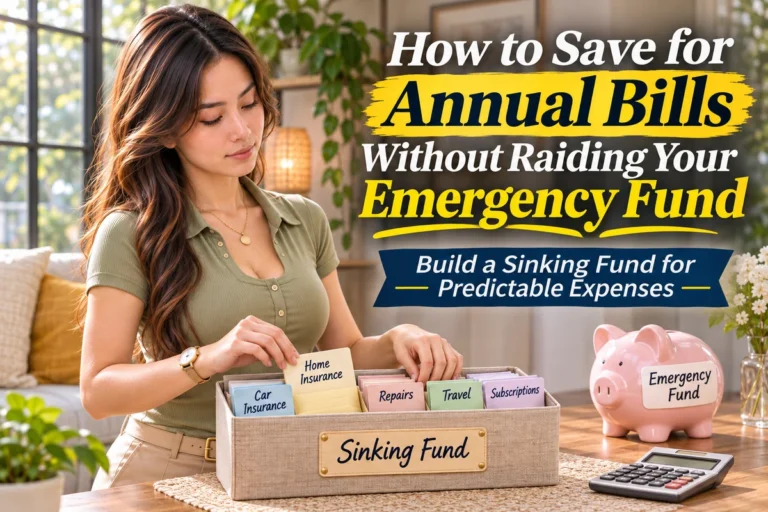
A sinking fund is money gradually saved for an expected future expense.
Examples include:
- Car repairs
- Insurance premiums
- Holiday spending
- Home maintenance
- Annual subscriptions
- Travel
- Property taxes
- A future vehicle purchase
Because you know the money will eventually be spent, keeping it liquid can make more sense than investing it in assets that may be down when you need the cash.
Short-Term Financial Goals
A HYSA may also work for money intended for a goal within the next few years.
That could include:
- A wedding
- A vacation
- Moving expenses
- A home down payment
- Starting a business
- Education expenses
- A major purchase
The appropriate place for your money depends on your timeline and tolerance for risk, but savings accounts can be useful when preserving principal and maintaining access matter more than pursuing higher investment returns.
An Income Buffer
People with variable income may use a separate savings account to hold excess cash from stronger months.
That money can then help cover expenses during slower periods.
This creates a buffer between fluctuating income and regular bills.
If your earnings vary, see our full guide on how to manage irregular income without feeling broke between paychecks.
High-Yield Savings Account vs. Money Market Account vs. CD
Several banking products can pay interest, but they do not all work the same way.
| Feature | High-Yield Savings Account | Money Market Deposit Account | Certificate of Deposit |
|---|---|---|---|
| Money generally accessible | Yes | Yes | Usually restricted until maturity |
| Rate usually variable | Yes | Usually | Often fixed for the CD term |
| May include check/card access | Sometimes | More commonly | No |
| Early withdrawal penalty | Usually no | Usually no | Common |
| FDIC/NCUA insurance possible | Yes | Yes | Yes |
| Best suited for | Accessible savings | Accessible savings with transaction features | Money you can leave untouched for a set term |
A money market deposit account is a bank deposit product and may have features such as checks or a debit card.
Do not confuse that with a money market mutual fund, which is an investment product rather than a bank deposit and is not FDIC insured.
A certificate of deposit, or CD, generally asks you to leave money deposited for a specified term. In exchange, you may receive a fixed rate, but withdrawing the money early can trigger a penalty.
A HYSA generally provides more flexibility because you are not agreeing to leave the money untouched until a maturity date.
When a High-Yield Savings Account May Not Be the Best Choice
HYSAs are useful, but they are not the answer for every dollar.
Money You Need for Everyday Spending
Your rent, groceries, utility bills, and ordinary purchases usually belong in an account designed for frequent transactions.
A checking account is generally better suited to that role.
Money You Will Not Need for Many Years
Keeping long-term wealth-building money entirely in cash can create a different problem.