

What Google Wants Website Owners to Focus On
Google’s guidance specifically tells publishers to focus on accuracy, quality, and relevance, particularly when content is automatically generated.
That extends beyond the main article.
Google says website owners should also pay attention to automatically generated:
- Page titles
- Meta descriptions
- Structured data
- Image alt text
In other words, using AI to generate SEO elements does not mean those elements should go online unchecked.
If an AI-generated meta description inaccurately describes the article, that is still inaccurate information.
If AI creates image alt text describing something that is not actually in the image, it is still wrong.
If generated structured data claims something about the page that the visible content does not support, that can also create problems.
Automation can make these jobs faster.
It should not make them careless.
Originality Is Becoming More Important
Google’s broader Search guidance increasingly emphasizes content that provides something beyond information that can be easily reproduced.
That can include:
- First-hand experience
- Original analysis
- Testing
- Unique examples
- Personal observations
- Original research
- Useful comparisons
- A distinctive point of view
- Better explanations of complicated subjects
This is especially relevant as AI makes generic information much easier to produce.
An article explaining “10 ways to save money” can now be generated in seconds.
Thousands of websites can publish versions of the same basic information.
The harder question is:
Why should someone read yours?
Maybe you tested the strategies.
Maybe you explain exactly which ones worked.
Maybe you show actual numbers.
Maybe you identify situations where common advice does not work.
Maybe you organize complicated information better than anyone else.
Maybe you connect several developments and explain what they mean.
AI can help you communicate those ideas.
But the underlying value still needs to exist.
Google makes a similar argument in its guidance for appearing in AI-powered search features. It recommends creating useful, distinctive, “non-commodity” content rather than simply repeating information that already exists everywhere else.
Website owners can read Google’s official guide to optimizing for generative AI features in Search for more information.
Should You Disclose That You Used AI?
Google’s guidance is more nuanced than simply saying every page needs an “AI-generated” label.
Google says providing information about how content was created can give readers useful context, particularly when automation played a substantial role.
Its people-first content guidance encourages publishers to consider explaining how content was produced when a reader might reasonably wonder.
That could matter more for certain types of content than others.
For example, readers may care whether:
- A product was actually tested
- A photograph is AI-generated
- A comparison involved first-hand experience
- Research was conducted by a person
- Automated tools generated substantial parts of the material
The appropriate disclosure will depend on the content.
But disclosure does not fix poor content.
Labeling an inaccurate, unoriginal article as AI-generated does not suddenly make the article useful.
Quality still comes first.
What About Bloggers Who Use ChatGPT or Gemini?
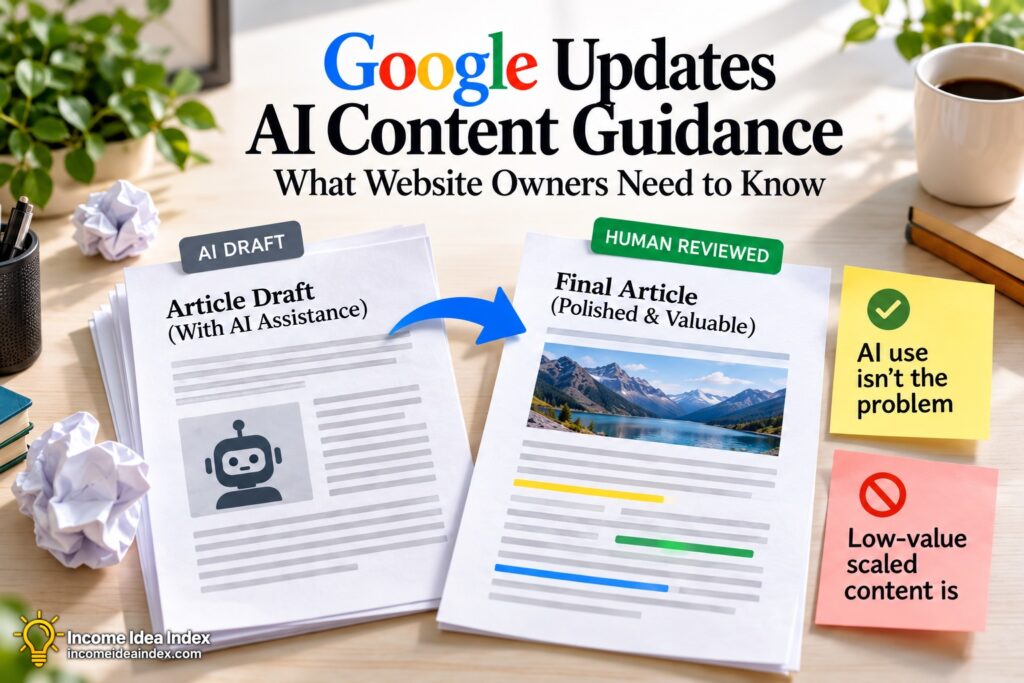
There is no reason for a responsible blogger to panic and stop using AI tools because of this update.
The more useful question is how those tools fit into your workflow.
A reasonable AI-assisted workflow could look like this:
- Choose a topic that genuinely fits your audience.
- Research the subject using reliable sources.
- Use AI to help organize ideas or build an initial structure.
- Draft or refine the article.
- Check important facts against primary or authoritative sources.
- Add useful context, examples, experience, or analysis.
- Remove generic filler.
- Review the finished article as a reader.
- Optimize the page for search without sacrificing readability.
- Update the article when the information changes.
That is a controlled process.
The publisher still makes the decisions.
Compare that with:
- Find 1,000 keywords.
- Automatically generate 1,000 articles.
- Publish all of them.
- Hope some rank.
Those are fundamentally different approaches.
Google’s policies are much more concerned with the second model.
Does Using AI Hurt Your Google Rankings?
There is no simple rule that says:
AI content = lower rankings.
Google evaluates content using numerous systems and signals. Its public guidance continues to emphasize helpfulness, reliability, originality, relevance, and whether content was created primarily for people.
The fact that AI was involved does not automatically answer any of those questions.
A poorly researched article written entirely by a human can still be low quality.
A carefully reviewed article created with AI assistance can still provide useful information.
The tool alone does not determine the value of the finished work.
Google’s people-first content guidance asks publishers to evaluate whether their content provides original information, substantial value, accurate information, useful analysis, and a satisfying experience for readers.
Those are better questions to ask than:
“Did AI touch this article?”
AI Makes Publishing Easier—and That Raises the Standard
There is an interesting side effect to all of this.
AI makes it easier than ever to produce words.
That means simply producing words becomes less valuable.
A few years ago, publishing a well-structured 2,000-word article required considerable time.
Today, an AI system can generate that amount of text almost instantly.
But speed does not guarantee usefulness.
As more generic content becomes easy to create, the things that are harder to automate may become increasingly important:
- Judgment
- Experience
- Verification
- Original reporting
- Testing
- Trust
- Perspective
- Real expertise
That does not make AI less useful.
It changes where the value comes from.
The AI may help you get from an empty page to a strong starting point much faster.
Your job is to make sure the finished product deserves to exist.
What Website Owners Should Do Now
There is no need to delete every page that involved AI or completely change a responsible content workflow.
Instead, this is a good opportunity to review how your site uses automation.
Ask:
- Are we publishing information primarily because it helps our audience?
- Are important facts being checked?
- Are we adding anything beyond what already exists elsewhere?
- Are we creating dozens of unnecessary pages around tiny keyword variations?
- Would this article still be worth publishing if Google did not exist?
- Does the content demonstrate real effort?
- Does the article actually answer the question promised by its title?
- Are AI-generated titles, descriptions, images, and metadata accurate?
- Would we be comfortable putting our name on the finished page?
Those questions align surprisingly well with good content strategy in general.
And if you are building an online business, our Tools & Resources page includes AI and content tools that can help with the work without turning automation into the entire strategy.
The Bottom Line
Google’s latest AI content guidance does not tell website owners to stop using artificial intelligence.
It tells them not to confuse automation with value.
AI can help research, organize, draft, edit, summarize, brainstorm, and accelerate parts of the publishing process.
But a faster publishing process does not remove the need for accuracy, originality, judgment, and human oversight.
The biggest risk is not simply that AI helped write something.
The bigger risk is building a website around large amounts of low-effort, unoriginal content created primarily to capture search traffic.
For responsible website owners, the practical takeaway is much simpler:
Use AI where it genuinely helps.
Check the work.
Add something useful.
Publish for people first.
And make sure every page earns its place on your website.