

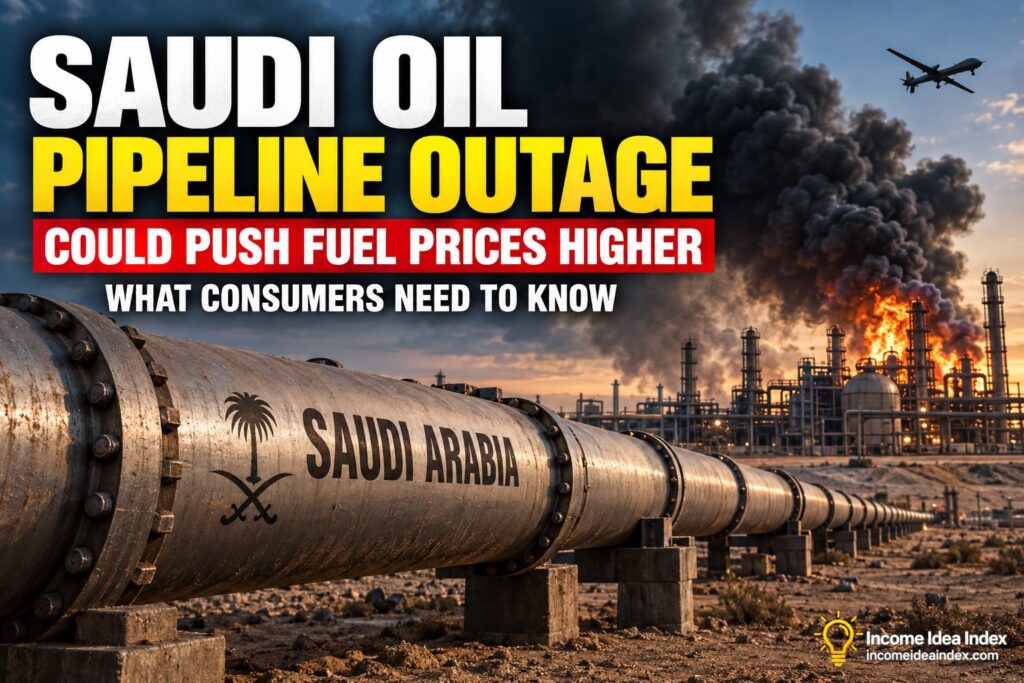
A major oil pipeline in Saudi Arabia is offline, another commercial vessel has been struck near the Strait of Hormuz, and the combination is raising new concerns about global energy supplies.
The Saudi oil pipeline outage matters well beyond the Middle East.
If the disruption lasts, it could put renewed upward pressure on crude oil prices, gasoline, diesel, shipping costs, and eventually some of the everyday goods consumers buy.
That does not mean gas prices will automatically surge tomorrow.
But it does mean another important part of the global oil system is under pressure at a time when energy markets are already strained.
What Happened to Saudi Arabia’s Oil Pipeline?
Saudi Arabia shut down its major East-West oil pipeline after it was attacked by drones.
The pipeline carries crude oil across Saudi Arabia from production areas in the east toward the Red Sea port of Yanbu in the west.
That geography is important.
Normally, much of the oil produced in the Persian Gulf region can leave through the Strait of Hormuz.
But when shipping through Hormuz becomes dangerous or restricted, alternative routes become much more valuable.
The East-West pipeline is one of those alternatives.
Reuters reported that Saudi Arabia temporarily closed the pipeline following the aerial attack.
The shutdown would already matter under normal circumstances.
It matters even more now because the pipeline has been helping Saudi Arabia move oil around the disrupted Strait of Hormuz.
Why Is the East-West Pipeline So Important?
Think of the global oil system as a network of highways.
The Strait of Hormuz is one of the busiest highways in the world.
If that highway becomes difficult to use, producers need alternate routes.
Saudi Arabia’s East-West pipeline is effectively one of the detours.
The pipeline moves crude oil westward across the country to the Red Sea, allowing some Saudi oil exports to avoid Hormuz entirely.
According to the U.S. Energy Information Administration, the Strait of Hormuz has historically handled enormous volumes of global petroleum traffic.
EIA data show that oil flows through Hormuz averaged about 20.9 million barrels per day during the first half of 2025, equivalent to roughly 20% of global petroleum liquids consumption at the time.
Alternative pipelines in Saudi Arabia and the United Arab Emirates can bypass some of that traffic.
But they cannot replace all of it.
That is why losing capacity from one of the most important bypass routes creates a new problem.
The route that was helping reduce dependence on Hormuz is now facing its own disruption.
How Much Oil Could Be at Risk?
Potentially a significant amount.
Reuters reported on September 13 that the pipeline had recently been moving roughly 4 million barrels of oil per daytoward Yanbu.
If the pipeline remains offline and Saudi Arabia cannot continue drawing down available inventories near the Red Sea, the disruption could eventually jeopardize access to an amount of oil equal to roughly 4% of global supply.
That does not mean 4% of the world’s oil disappeared the moment the pipeline shut down.
Oil inventories can temporarily cushion disruptions.
Repairs may restore some or all of the route.
Other producers or transportation routes may also offset part of the lost supply.
But the longer the pipeline remains unavailable, the more important those limitations become.
Reuters reported that available stocks at Yanbu could cover exports for only a limited period if pipeline flows are not restored.
That creates a clock.
A brief outage and a prolonged outage are two very different economic stories.
Why Does the Strait of Hormuz Make This More Serious?
Because the Saudi pipeline problem is not happening in isolation.
The Strait of Hormuz is already one of the central pressure points in the current conflict.
On Sunday, September 13, an Iranian commercial vessel was struck near the strait.
The Associated Press reported that the strike killed one person, according to Iranian state media.
Responsibility for the attack was not immediately clear.
For energy markets, the larger issue is not simply who attacked one vessel.
It is whether commercial shipping through a critical oil corridor becomes more dangerous, expensive, or restricted.
Shipping companies have to think about crew safety.
Insurers have to price the additional risk.
Tankers may avoid certain areas.
Routes can become longer.
Available ships can become harder to secure.
And every additional disruption can make the energy supply chain less efficient.
That is how a military or geopolitical event thousands of miles away can eventually become a financial issue for households that have nothing to do with the conflict.
Oil Was Already Above $100 Before This Latest Escalation
Energy markets were already under pressure before the weekend developments.
On Friday, September 11, Brent crude settled at $104.61 per barrel, according to Reuters.
That report also noted severe pressure in U.S. diesel markets.
The latest Saudi pipeline outage and new Hormuz incident occurred after that.
Because major oil markets are closed over the weekend, the full market reaction was not yet visible when these developments occurred.
Reuters reported that traders expected renewed upward pressure when markets reopened.
Whether that actually produces a large jump will depend heavily on what happens next.
If Saudi Arabia quickly restores pipeline operations and shipping conditions stabilize, some of the immediate fear could fade.
If disruptions expand, the opposite could happen.