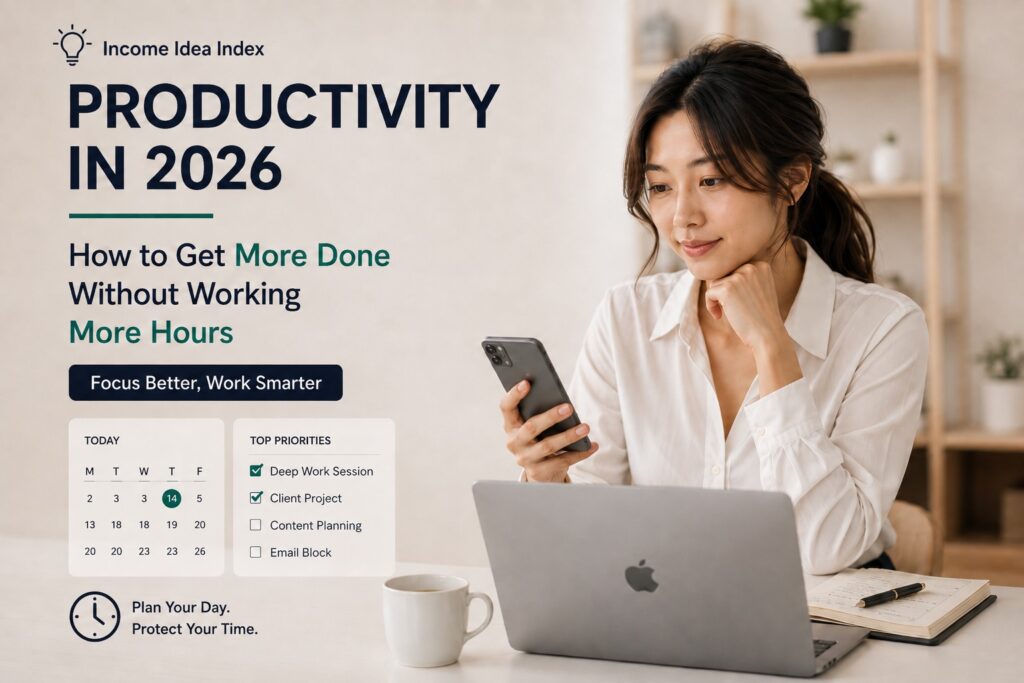
Give Tasks a Place on the Calendar
A to-do list tells you what you want to do.
A calendar forces you to confront when you’re going to do it.
Suppose your list says:
“Work on presentation.”
That task can remain untouched for days.
Now imagine your calendar says:
Tuesday, 9:00–10:30 a.m.: Finish presentation slides.
The task has a location in your day.
This technique is sometimes called time blocking.
You don’t have to schedule every minute.
Instead, use blocks for the activities most likely to be pushed aside unless you deliberately protect time for them.
Break Large Projects Into Visible Next Actions
“Write report” can feel intimidating.
“Open report and draft introduction” feels much easier to start.
Large projects often create procrastination because the next action is unclear.
If you keep avoiding something, make the task smaller.
Instead of:
Build website
Try:
Choose homepage headline.
Instead of:
Organize finances
Try:
Download last month’s bank statement.
Instead of:
Start exercising
Try:
Walk for 15 minutes after dinner.
The easier it is to identify the next physical action, the easier it becomes to begin.
Use the Two-Minute Rule Carefully
A popular productivity idea says that if something takes less than two minutes, do it immediately.
That can work well for small tasks.
But there’s a catch.
Ten two-minute tasks can easily turn into 30 minutes of distraction.
If you’re already in a focused work session, don’t abandon an important project every time a tiny task appears.
Capture it somewhere.
Then handle those small tasks together later.
The two-minute rule is useful when you’re already processing small tasks.
It is less useful when it repeatedly interrupts your most important work.
Group Similar Tasks Together
Switching between completely different types of work can be mentally expensive.
You answer an email.
Then edit a spreadsheet.
Then make a phone call.
Then design something.
Then return to the spreadsheet.
Then check another message.
Instead, try grouping similar work.
Answer several emails together.
Make several calls together.
Process invoices together.
Create social posts together.
Handle administrative tasks in one block.
This is often called batching.
You spend less time mentally changing gears and more time completing similar work while you’re already in the right mode.
Make Starting Easier
Procrastination isn’t always about laziness.
Sometimes the beginning of a task simply feels unpleasant.
The project seems too large.
You don’t know where to start.
You’re worried the result won’t be good enough.
Or the task just sounds boring.
Lower the barrier.
Tell yourself you only need to work for ten minutes.
Open the file.
Write one paragraph.
Organize one folder.
Read one page.
Do the first step.
Starting creates momentum.
And momentum often matters more than motivation.
Don’t Confuse Perfection With Productivity
Perfectionism can make productive people surprisingly unproductive.
You finish something.
Then improve it.
Then improve it again.
Then change something that was already fine.
Then reconsider the entire project.
Eventually, the final 10% takes longer than the first 90%.
Not every task deserves your absolute best work.
Some tasks deserve excellence.
Some deserve good enough.
Some simply need to be completed.
Learning the difference can save enormous amounts of time.
Ask:
“What level of quality does this task actually require?”
Then deliver that.
Create a Shutdown Routine
Productivity isn’t just about beginning work effectively.
It also helps to know when work is finished.
Without a clear ending, unfinished tasks can remain mentally active throughout the evening.
A simple shutdown routine might involve reviewing what you completed, moving unfinished tasks to tomorrow, identifying tomorrow’s first priority, closing unnecessary tabs, and leaving your workspace ready for the next day.
The entire process may take only a few minutes.
But it tells your brain:
Today’s work has been accounted for.
You don’t have to keep mentally carrying everything around.
Rest Is Part of Productivity
Working longer doesn’t always produce more.
There is a point where an extra hour creates very little value because your concentration has already fallen apart.
You reread the same paragraph.
Make careless mistakes.
Stare at the screen.
Switch tabs repeatedly.
Spend 30 minutes completing something that normally takes ten.
Sometimes the productive decision is to stop.
Sleep.
Eat.
Walk.
Exercise.
Talk to someone.
Do something unrelated to work.
Rest isn’t the opposite of productivity.
It helps restore the attention productivity requires.
How to Improve Productivity in 2026
If your current system feels chaotic, don’t replace your calendar, download six new apps, buy a planner, create a complicated morning routine, and attempt 12 new habits at once.
That creates another project.
Start smaller.
For the next week, try this simple system:
- Choose one most-important task each morning.
- Give that task a protected block of focused time.
- Reduce unnecessary notifications while you work.
- Keep your daily task list short and realistic.
- Batch small administrative tasks instead of constantly switching.
- Use AI only where it genuinely saves time or improves the result.
- End the day by deciding tomorrow’s first priority.
That is enough to learn a great deal about how you actually work.
Once those habits become natural, add other techniques only when you have a specific problem they can solve.
You Don’t Need the Perfect Productivity System
One reason productivity can become overwhelming is that there are endless systems promising to solve it.
Paper planners.
Digital planners.
Habit trackers.
Time trackers.
Pomodoro timers.
Task-management apps.
Calendar systems.
AI assistants.
Notion templates.
Morning routines.
Evening routines.
Some of them are excellent.
None of them works for everyone.
A productivity system should make your life simpler.
If maintaining the system becomes another major responsibility, the system may be working against you.
The best method is often the one simple enough that you’ll continue using it.
The Real Goal of Productivity
The purpose of becoming more productive isn’t to turn every free minute into another opportunity to work.
It’s the opposite.
Productivity should help you complete what matters so that work doesn’t consume everything else.
Finishing important tasks can create more room for:
Family.
Friends.
Exercise.
Hobbies.
Rest.
Travel.
Learning.
Doing absolutely nothing for a while.
The reward for becoming efficient shouldn’t automatically be more work.
It should be more control over your time.
The Bottom Line
Productivity in 2026 is less about doing more things and more about protecting your attention for the right things.
Technology can save time.
AI can remove repetitive work.
Automation can reduce routine decisions.
But none of those tools can decide what actually deserves your attention.
That part is still yours.
Choose fewer priorities.
Protect time for meaningful work.
Reduce unnecessary interruptions.
Use technology deliberately.
Finish things before endlessly improving them.
And remember that a productive day doesn’t have to be a day when you were busy every minute.
Sometimes the most productive day is simply the one where you finished what mattered—and still had some of your life left afterward.
Image Disclosure: The featured image in this article was created using artificial intelligence. The person depicted is an AI-generated model and does not represent a real individual.