

Know When to Continue, Change, or Stop
Testing only works if the result can affect your decision.
There are three legitimate outcomes.
Continue
Continue when the evidence supports the idea.
You might see:
- qualified customers paying,
- repeated interest from the same customer type,
- healthy enough delivery economics,
- clear demand,
- useful referrals,
- repeat purchasing,
- or stronger response as the offer improves.
Continuing does not mean immediately scaling.
It means the idea has earned another investment.
Change
Change when part of the idea works but another part clearly does not.
You might adjust:
- the target customer,
- the scope,
- the format,
- the pricing,
- the message,
- the channel,
- the delivery method,
- or the business model.
Do not pivot simply because testing feels uncomfortable.
Change something because the evidence suggests why.
Stop
Stopping is a valid result.
Consider stopping when repeated good-faith tests show:
- little customer concern about the problem,
- almost no meaningful buying behavior,
- economics that cannot reasonably work,
- customer acquisition that appears prohibitively difficult,
- operational requirements you do not want to manage,
- or a better opportunity for your limited resources.
The goal of validation was never to prove that your favorite idea must succeed.
The goal was to make a better decision.
An inexpensive failed test can be an excellent outcome if it prevents an expensive failed launch.
Do Not Let Sunk Cost Make the Decision
The more you build before testing, the harder it becomes to walk away.
You spent six months on the software.
You ordered the inventory.
You paid for branding.
You registered several domains.
You told everyone you were launching.
Now every negative signal feels like something that must be overcome rather than information that should be evaluated.
Small tests reduce this psychological trap.
You have less to defend.
That makes it easier to ask:
“If I had not already spent this time or money, would today’s evidence make me choose this idea again?”
That question can be uncomfortable.
It can also save months or years.
Know What Stage 1 Is Supposed to Produce
Stage 1 does not need to produce a finished company.
It should produce evidence and a decision.
By the end of this stage, you should be able to answer:
Problem:
What meaningful problem or desire are you addressing?
Customer:
Who specifically experiences it?
Competition:
What do customers use now?
Demand:
What evidence shows the problem matters?
Willingness to pay:
What evidence suggests customers will exchange money for the result?
Business model:
How will you deliver the value and get paid?
Test:
What happened when you put a small real version in front of the market?
You do not need perfect certainty.
You need enough evidence to decide whether the idea deserves the next level of commitment.
Your Stage 1 Decision
At this point, give the idea one of three labels:
Move Forward
The evidence is strong enough to justify building the next layer.
Document what worked.
Keep the first customer insights.
Preserve the assumptions that still need testing.
Then move into the next stage deliberately.
Refine and Retest
The opportunity still looks promising, but one or two important pieces are unresolved.
Define exactly what needs another test.
Do not restart the entire process.
Test the uncertainty.
Stop or Park the Idea
The evidence does not currently justify more investment.
Record what you learned.
An idea you stop today may become viable later because:
- the market changes,
- technology changes,
- your skills improve,
- your audience grows,
- costs fall,
- or a different customer appears.
Stopping investment is not the same as erasing the idea.
The Goal Was Never to Build Fast—It Was to Learn Fast
Starting a business always involves uncertainty.
You cannot research it away completely.
At some point, you have to make an offer, serve a customer, put something into the market, and learn from the result.
But there is a major difference between taking calculated uncertainty and taking unnecessary risk.
Building the entire business before testing demand is unnecessary risk.
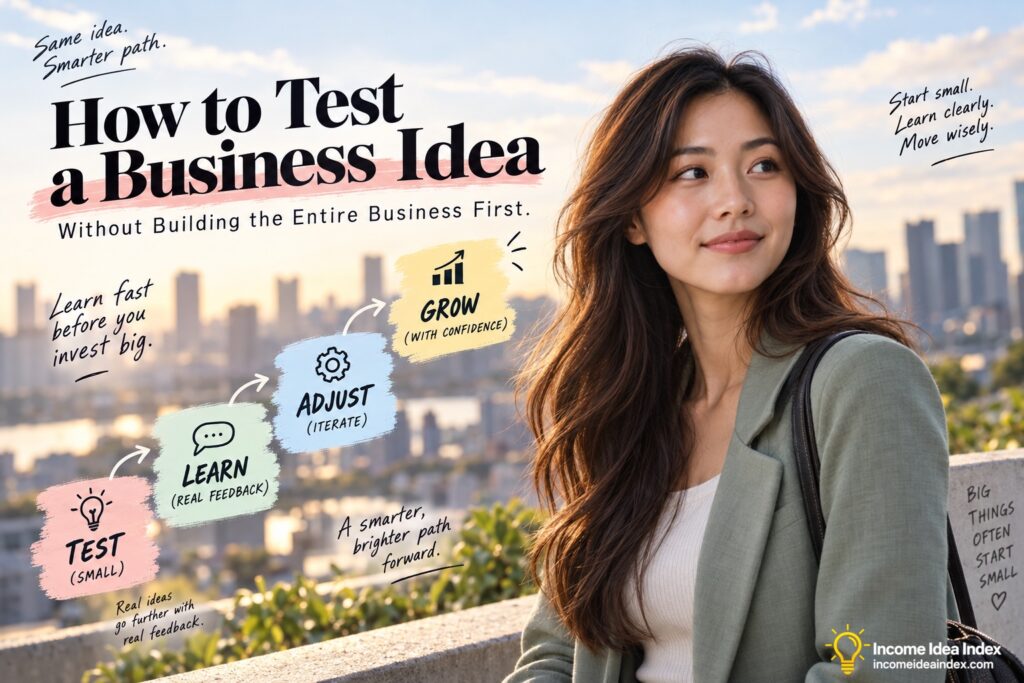
A smaller approach gives you a better sequence:
Learn.
Test.
Observe.
Adjust.
Invest a little more.
Test again.
That does not guarantee success.
It does make each decision more informed.
And that is the real purpose of Stage 1.
You are no longer asking:
“Do I think this is a good idea?”
You are asking:
“What evidence have I collected, and what does that evidence justify doing next?”
That is a much stronger place from which to build.
When your idea has earned the right to move forward, continue through the Start a Business Roadmap and begin turning the validated idea into a business you can actually launch and operate.