But you can build a sample content calendar, write strong posts, develop a basic campaign, and explain how you would measure results.
Show the work.
If projects from your current employer are confidential, do not publish them.
Create demonstration projects using fictional, personal, or publicly available information instead.
The objective is simple:
Make it easier for someone to imagine hiring you.
5. Build Your Network While You Don’t Need Anything
Networking often feels uncomfortable because people wait until something goes wrong.
Then the first message in three years is:
“Hey! I just lost my job. Do you know anyone hiring?”
There is nothing wrong with asking for help when you need it.
But professional relationships are much easier to maintain when every interaction is not an emergency request.
You probably already have more of a network than you realize.
Think about:
- former coworkers
- former managers
- customers
- vendors
- classmates
- people you met through previous jobs
- professional groups
- industry contacts
- friends working in related fields
- people you have collaborated with on projects
You do not need hundreds of close professional relationships.
You simply do not want every useful connection to go cold.
Occasionally congratulate someone on a new role.
Send them something genuinely relevant to their work.
Check in with a former coworker.
Recommend someone when you can.
Answer a question if you know the answer.
Participate in an industry discussion.
Help before you need help.
Job boards show you positions that have already been posted.
Relationships can sometimes expose opportunities before a public job posting exists at all.
They can also give you something job listings cannot:
Information.
Someone inside an industry can tell you which skills employers actually care about, which companies are expanding, what salaries are realistic, and what hiring managers are struggling to find.
That knowledge can make the rest of your career backup plan much more accurate.
6. Develop a Small Backup Income Stream
A career backup plan becomes much stronger when losing one paycheck does not immediately mean losing every source of income.
That does not mean you need to build a second full-time job.
And it definitely does not mean you need five side hustles consuming every evening and weekend.
Start smaller.
A backup income stream might be:
- occasional freelance work
- consulting
- tutoring
- contract assignments
- weekend work
- a specialized local service
- gig work
- digital products
- physical products
- selling a skill you already use professionally
The important question is not:
Can this replace my salary today?
Ask:
Could I turn this on or expand it if I suddenly needed additional income?
Imagine that a small freelance service earns only $200 in a normal month.
That will not replace a full-time salary.
But you already know how to find a customer.
You know what to charge.
You know how to complete the work.
You know how to get paid.
If your circumstances changed, growing that $200 to $800 or $1,500 may be much easier than inventing an income source from zero while unemployed.
A small income stream also teaches you what the market actually values.
You may discover that people will pay for a skill you thought was ordinary.
You may also discover that an idea you expected to work has very little demand.
Both lessons are useful when you learn them before you depend on the money.
AI has also made some small service businesses easier to operate because one person can research, organize, draft, analyze, and complete routine work faster than before. If that direction interests you, Income Idea Index’s 10 Realistic Ways Beginners Can Use ChatGPT to Make Money in 2026 explores practical examples without treating AI itself as a magic business.
The principle remains the same whether AI is involved or not:
Solve something useful for someone.
You do not need to create a business empire.
You need an option.
7. Know Your Financial Runway
Career preparation is not only about how quickly you can find another job.
It is also about how much time you can give yourself to make a good decision.
Imagine two workers lose similar jobs on the same day.
One has enough available cash to cover essential expenses for two weeks.
The other could cover several months.
They may have identical resumes and identical professional skills.
But they are making decisions under very different levels of pressure.
The first person may need to accept almost anything immediately.
The second may have enough room to:
- compare job offers
- negotiate compensation
- search more broadly
- complete a certification
- wait for a better opportunity
- increase freelance or contract work
- make a deliberate career change
That is what financial runway provides.
Time.
You do not need to reach a magical savings number before your career backup plan becomes useful.
Start by figuring out your current runway.
Look at the money you could realistically access and estimate how long it could cover essential expenses if your normal paycheck stopped.
Then look for practical ways to increase that period gradually.
That could mean building savings.
It could mean paying down an expensive monthly obligation.
It could mean reducing recurring expenses.
It could mean maintaining another income stream.
And it may simply mean knowing exactly where your money is going.
If you want to identify expenses you could reduce without building an elaborate budget, How to Do a Personal Expense Audit in 30 Minutes—Without Making a Budget walks through a quick way to find subscriptions, fees, recurring charges, and other spending leaks.
The purpose of building financial runway is not to hoard money because something bad might happen.
It is to create decision-making time.
A Career Backup Plan Is Preparation, Not Pessimism
It can feel unnecessary to think about career disruption when your current job seems stable.
Recent labor data provides a useful reminder that stability can change.
In August 2026, the Bureau of Labor Statistics reported that 3.3 million workers had been displaced between 2023 and 2025 from jobs they had held for at least three years. That was 746,000 more long-tenured displaced workers than in the previous survey period.
The reasons varied. Some positions or shifts were abolished. Some businesses closed or moved. Others simply did not have enough work.
But there is another important part of the data:
By January 2026, 66.1% of those long-tenured displaced workers were employed again.
Job disruption happens.
People also recover from it.
The purpose of a career backup plan is to make that recovery easier if you ever need it.
You do not have to quit a stable job.
You do not need to spend every evening preparing for a hypothetical layoff.
You do not need to constantly worry about what might happen.
Instead, gradually make yourself harder to trap.
Keep your resume current.
Strengthen one useful skill.
Build proof of what you can do.
Maintain professional relationships.
Develop another way to earn at least some money.
Create financial breathing room.
And know where you would go next if your current situation changed.
A good career backup plan may sit unused for years.
That is completely fine.
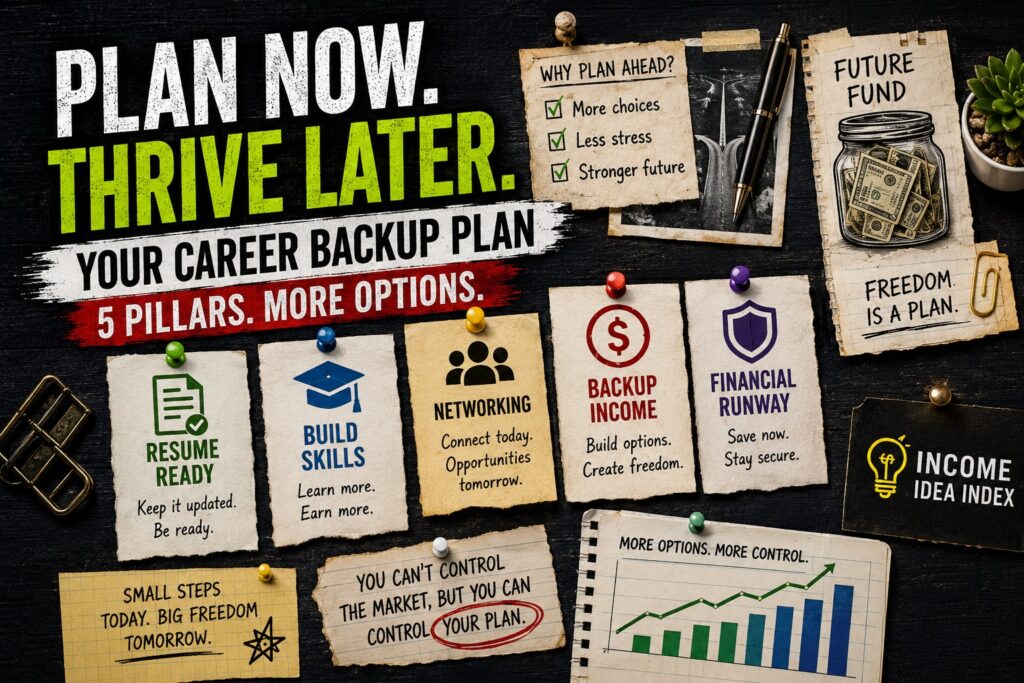
The best time to build options is when you still have plenty of them.