

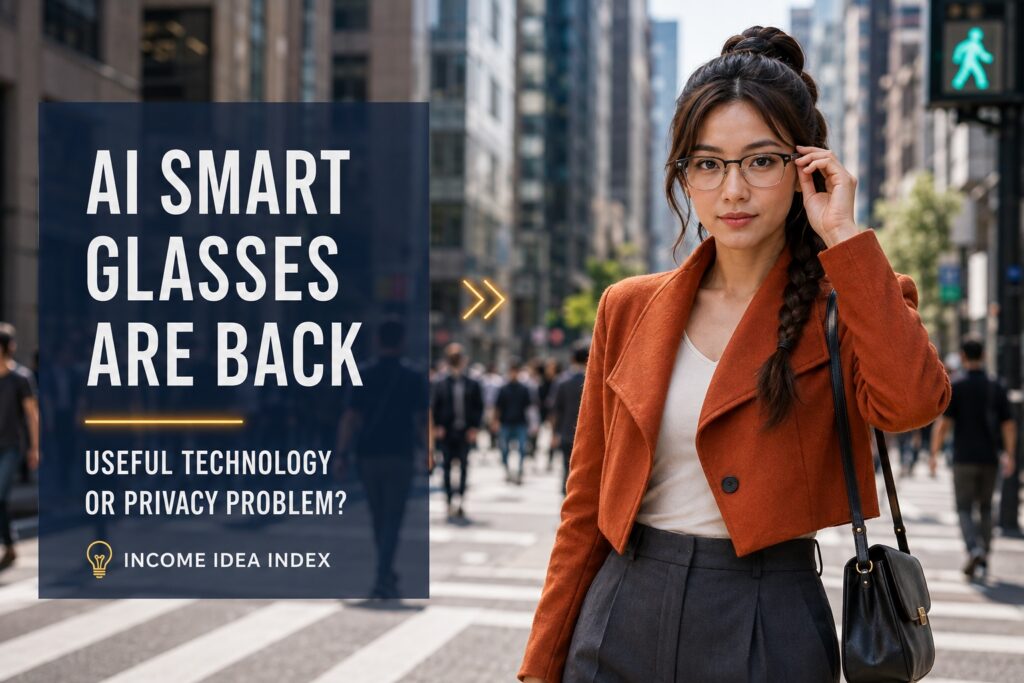
AI smart glasses are back, and this time they are not relying on futuristic promises alone. New models can take photos, play audio, translate conversations, answer questions about whatever the wearer is looking at, provide directions, and—in some cases—place digital information directly in front of the eyes.
That sounds convenient. It also means cameras, microphones, artificial intelligence, and potentially a display can travel through the world on someone’s face.
The technology has improved enough to attract serious attention. EssilorLuxottica, the eyewear company working with Meta, reported that more than seven million Ray-Ban Meta and Oakley Meta units were sold during 2025. Google has announced Gemini-powered glasses made with Samsung, Gentle Monster, and Warby Parker, while Snap has introduced a new generation of augmented-reality eyewear.
AI smart glasses no longer look like a forgotten experiment. They look like a possible new consumer-tech category.
But a product can be useful and unsettling at the same time. Before these glasses become as ordinary as smartphones or earbuds, we need to ask two separate questions: What can they genuinely improve, and what happens to privacy when wearable cameras and AI become normal?
Why AI Smart Glasses Are Making a Comeback
Smart glasses are not a new idea. Earlier attempts struggled because the technology was conspicuous, expensive, limited, or socially awkward. Many people could not identify a strong reason to wear a computer on their face.
The current generation is different in several important ways.
First, many models look much more like ordinary eyewear. A person can choose familiar frame shapes, prescription lenses, sunglasses, or sport-focused designs instead of wearing something that resembles a laboratory prototype.
Second, generative AI gives the glasses a more natural interface. Instead of navigating tiny menus, the wearer can ask a question aloud: “What am I looking at?” “Translate this sign.” “Remember where I parked.” “Take a photo.” The AI can use the camera, microphones, location, and connected phone to understand the request.
This builds on the same promise behind many practical ways to use AI to save time: removing small steps from routine tasks so technology feels less intrusive.
Third, the glasses do not always try to replace the phone. Many current models act as a hands-free extension of it. That narrower goal is easier to understand and more practical than promising an entirely new digital world.
Finally, the technology is arriving through recognizable eyewear brands. Style matters more here than it does with most gadgets. If a device sits on someone’s face for hours, comfort and appearance are not optional features.
Not All Smart Glasses Work the Same Way
The term “AI smart glasses” now covers several types of products.
Audio-and-camera glasses usually include speakers, microphones, a camera, voice controls, and an AI assistant, but no display inside the lens. They can play music, handle calls, capture first-person photos or video, and respond aloud to questions. Ray-Ban Meta glasses are the best-known example.
Display glasses add a small visual display that can show messages, directions, translations, photo previews, or other information. The display may be subtle and limited rather than a full augmented-reality experience.
Augmented-reality glasses place interactive digital objects or screens into the wearer’s view of the physical world. They require more processing power and raise harder questions about battery life, price, weight, and comfort.
Google has described a similar split in its 2026 plans. Its Gemini-powered intelligent-eyewear announcement separates audio glasses from display glasses, with audio models planned first. Snap’s new SPECS augmented-reality glassesmove further toward wearable computing, including spatial displays, hand tracking, AI assistance, and virtual workspaces.
These categories may eventually overlap, but the distinction matters today. Someone who wants hands-free photos and audio has different needs from someone who wants digital screens floating in a room.
What AI Smart Glasses Can Actually Do
The strongest uses are not necessarily the most dramatic ones. Smart glasses are most convincing when they remove a small but repeated inconvenience.
Capture a First-Person View Without Holding a Phone
A parent can record a child’s first bicycle ride while keeping both hands free. A cook can document a recipe from their own point of view. A traveler can capture a moment without watching it through a phone screen. A creator can film short, natural clips that show exactly what they see.
This is one of the clearest advantages of camera glasses. The perspective feels more immediate, and the wearer does not have to stop what they are doing to reach for a device.
The same convenience creates a privacy problem, however, because people nearby may not immediately realize that a camera is present. We will return to that concern on the next page.
Provide Information About What the Wearer Sees
Multimodal AI can combine visual input with a spoken question. A wearer might ask for information about a landmark, help reading a label, an explanation of an unfamiliar object, or a summary of text in front of them.
This can feel more natural than taking out a phone, opening an app, pointing the camera, and typing a question. The real advantage is not that the AI answer is impossible to get elsewhere. It is that the process becomes faster and hands-free.
Translate Speech, Signs, and Menus
Translation is an obvious fit for wearable technology. Audio glasses can speak a translation into the wearer’s ear, while display models may show translated text in the field of view.
For travelers, multilingual families, and people working across languages, that could make everyday conversations easier. It will not eliminate mistakes, accents, background noise, or cultural misunderstandings, but it can reduce friction.
Give Directions Without Constantly Checking a Screen
Walking through an unfamiliar neighborhood while repeatedly looking down at a phone is inconvenient and distracting. Smart glasses can provide spoken turn-by-turn directions, and display models can place directional cues where they are easier to see.
This could be particularly useful when walking, traveling, or carrying bags. Safety still matters: directions should assist the wearer, not block awareness of traffic, obstacles, or other people.
Support People With Disabilities
Some of the most meaningful uses have little to do with novelty. Visual AI can describe surroundings, read documents or menus aloud, identify objects, and connect a blind or low-vision user with assistance. Hands-free controls can also help people who have difficulty operating a phone.
Meta has expanded detailed visual responses and volunteer assistance for blind and low-vision users, as described in its accessibility update for AI glasses. The technology is not a replacement for every specialized accessibility tool, and it must be dependable to earn trust. Still, this is an area where wearable AI can offer real independence rather than simple convenience.
Assist With Hands-On Work and Training
Technicians, mechanics, health workers, warehouse employees, and trainees may benefit from instructions or remote guidance without putting down their tools. A worker could hear the next step, document a repair, contact an expert, or review information while keeping both hands available.
In 2026, Meta announced grants for projects using AI glasses in construction training, roadside repair, agriculture, accessibility, and workforce safety. These AI-glasses pilot projects are early examples rather than proof that every workplace needs smart glasses. They do show why the form factor may be valuable when a phone is inconvenient or unsafe to hold.
Where the Technology Still Falls Short
The idea is advancing faster than some of the practical details.
Battery life can change depending on recording, calls, AI requests, audio, displays, and network use. A pair of glasses that needs frequent charging may not feel like dependable all-day eyewear.
Comfort is equally important. Weight that seems minor during a ten-minute demonstration may feel different after several hours. Fit, heat, prescription support, lens quality, and the balance of the frame all matter.
AI features may also depend on a phone, an account, an internet connection, a particular country, or a supported language. Some advertised capabilities arrive later through software updates or roll out gradually.
Then there is accuracy. An AI assistant can misunderstand a question, misread what the camera sees, or provide an answer that sounds confident but is wrong. The National Institute of Standards and Technology identifies confidently presented false information as a known generative-AI risk. Smart glasses should not be treated as the sole authority for medical decisions, dangerous repairs, navigation in hazardous conditions, or anything else where an incorrect answer could cause harm.
The most sensible expectation is not “a perfect computer that sees everything.” It is “a wearable assistant that may save time in specific situations.”